
Non-FictionSelf-HelpWorking Parent
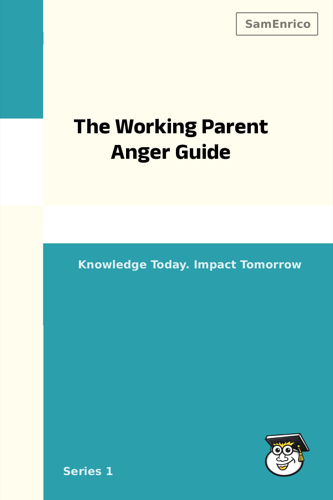
The Working Parent Anger Guide eBook
Balance job pressure and parenting without taking
by Toney Kassie
Balance job pressure and parenting without taking work stress home.
Formats
Free sample
Chapter 1: The 24/7 Lie--–- You are standing in your kitchen. It is 6:47 PM on a Tuesday. Your laptop is still warm from the last Zoom call you ended four minutes ago. Your child is tugging on your sleeve asking for help with a Lego tower that keeps collapsing. Your phone is buzzing with three Slack messages and an email from your boss marked “urgent.” Your partner just texted asking what’s for dinner.
You haven’t eaten since 1:30 PM. Your jaw is clenched. Your shoulders are up near your ears. And somewhere underneath all of that—under the fatigue, under the noise, under the love you genuinely feel for your family—there is a low, humming anger. It’s not directed at anyone in particular.
It’s just there. A wire that’s been frayed all day and is now sparking against everything it touches.You are not a bad person. You are not a bad parent. You are not even an unusually angry person. You are a working parent who has been sold a lie.
The lie is this: that you can be a top performer at work and a perfectly present, patient, emotionally regulated parent at home—simultaneously, every day, without cost. The lie says that if you just tried harder, managed your time better, or found the “right” system, you could do it all. And the lie is the single biggest reason you are angry.This chapter dismantles that lie. It will show you why the 24/7 availability mindset is not a virtue but a trap. It will explain the cognitive science behind why switching between work and family roles drains your patience.
And it will give you the first concrete tool of this book: the Expectation Audit, a method for separating the expectations that actually matter from the ones that are slowly destroying your peace.The Myth of the Superparent Let’s name the myth directly. The myth of the Superparent says that a good working parent does the following, every single day: wakes up early to exercise or meditate, makes a nutritious breakfast, gets the children dressed and out the door without yelling, excels at work (but never stays late), picks up the children with a smile, makes a home-cooked dinner, helps with homework, reads bedtime stories, has sex with their partner, gets eight hours of sleep, and wakes up to do it all again. The Superparent never yells. Never checks email at the dinner table. Never wishes they were at the office instead of home, or home instead of the office.
The Superparent is, in other words, a fictional character—and holding yourself to their standard is a form of slow violence against your own nervous system.Where does this myth come from? It comes from everywhere. It comes from social media, where parents post only their highlight reels. It comes from workplace cultures that reward availability over output. It comes from the generations before us, who often had one parent at home full-time and don’t understand why we’re so tired.
It comes from inside us—from the part of our psyche that wants to prove we can have it all, be it all, and do it all without breaking.But the myth has a cost. And that cost is paid in anger.Here’s how it works. When you believe you should be able to do everything perfectly, you set expectations that are impossible to meet. You expect to leave work at 5 PM—but your boss schedules a 4:30 meeting. You expect your child to listen the first time—but they are four years old and their brain is literally not developed enough for impulse control.
You expect to feel calm and present at dinner—but you haven’t had a moment to yourself in fourteen hours. Every time reality fails to meet your impossible expectations, your nervous system registers a violation. And violations, when they accumulate, become anger.This is not a moral failing. It is basic behavioral psychology. Expectation minus reality equals frustration.
Frustration, repeated and unaddressed, equals anger. Anger, repeatedly expressed at the wrong targets, becomes shame. And shame makes you try even harder to be perfect—which sets even more impossible expectations. The cycle is self-perpetuating. The only way out is not to try harder.
The way out is to change the expectations themselves.The Cognitive Switching Tax There is a second mechanism that feeds the 24/7 lie, and it has nothing to do with your character and everything to do with how your brain is wired. It is called the switching cost.Your brain is not a computer that can run multiple programs simultaneously without losing efficiency. When you switch from one task to another—from writing an email to helping with homework, from a strategy call to making a sandwich—your brain does not instantly jump. It has to disengage from the first task, reorient to the second, and rebuild the mental context for the second task. That process takes time.
Not much time—fractions of a second, usually. But when you switch dozens or hundreds of times per day, those fractions add up. Researchers estimate that frequent task-switching can cost you as much as 40 percent of your productive time. More importantly for our purposes, each switch also costs you a small amount of emotional regulation capacity.Think of your emotional regulation capacity as a bucket. Every switch—every time you check a work email while your child is talking to you, every time you think about a deadline while you’re cutting vegetables, every time you mentally rehearse a conversation with your boss while you’re helping with bath time—drains a little water from that bucket.
By the end of the day, the bucket is empty. And when the bucket is empty, you have nothing left to regulate your anger with.This is why the parent who is “always available” to both work and family is actually available to neither. When you are half-present at work, you make mistakes that create more work. When you are half-present at home, you miss the small cues that could prevent a meltdown. And when you switch back and forth all day, you drain your regulation bucket so thoroughly that by 6:47 PM, anything—a spilled cup, a whine, a request for help with a Lego tower—can push you over the edge.The solution is not to become a better multitasker.
Multitasking, in the cognitive science literature, barely exists. What we call multitasking is actually rapid task-switching, and it is always less efficient than monotasking. The solution is to stop switching so much. To build walls. To be either at work or at home, not both at once.
But that requires something that feels impossible when you’re trying to do everything: it requires you to say no.The Grass Is Greener Fallacy There is a third mechanism that keeps the 24/7 lie alive. It is the “grass is greener” fallacy, and it works like this: when you are at work, you long for home. You imagine how peaceful it would be to sit on the couch with your child, to read a book, to have a quiet evening. You romanticize home…
This is the end of the free sample. Get the eBook to keep going. Buy now
About this book
Details
- Author
- Toney Kassie
- Publisher
- SamEnrico
- Language
- English
- Genre
- Non-Fiction, Self-Help, Working Parent
- Released
- 2026-06-08
- Pages (approx.)
- 122
- Available as
- eBook, Audiobook

Read better in the ZLOADR app
Your eBooks on your phone or tablet. Sign in with your SamEnrico account and start reading.
More by Toney Kassie
 Validation For BoredomToney Kassie$11.99
 ED and Relationship GuideToney Kassie$11.99
 The MO Change Over Time GuideToney Kassie$11.99
 Step Six Readiness CourseToney Kassie$11.99
 The Phoenix Protocol: How a Cold War Spy Saved the World from Nuclear AnnihilationToney Kassie$11.99
 A Beginners Guide to Hardball squash (Volume 1)Toney Kassie$11.99
 Minority Subcontracting PlansToney Kassie$12.99
 PR for B2B StartupsToney Kassie$12.99
 The Breeder's Guide to Narragansett TurkeysToney Kassie$11.99
 Makingwalking SticksToney Kassie$11.99
You may also like
 Hong Kong Handover 1997Dunn Johnnie$11.99
 Zumba For Postnatal Recovery CourseNeal Christian$11.99
 Zumba for BeginnersLadner Nikia$11.99
 YouTube Comment Mining GuideHumes Pandora$12.99
 Worry Box MeditationCarlin Rudy$11.99
 Workplace Stress MeditationNguyen Lynn$11.99
 Workplace Stress and Sleep RepairHawley Ivory$11.99
 Workplace Perfectionism CureDelaney Jeffry$11.99
 Workplace Injustice Anger GuideWallen Isabelle$11.99
 Work Addiction and Burnout LinkGreenwood Ester$11.99
 Women in Yoga and WellnessBeattie Galina$11.99
 Women in Stand Up ComedyChun Evangeline$11.99