
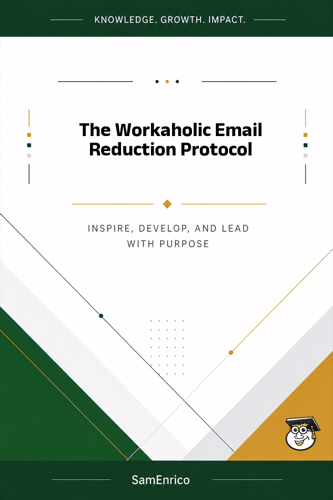
Non-FictionSelf-HelpEmail Management
The Workaholic Email Reduction Protocol eBook
Provides specific email management protocols to re
by Davis Eric
Provides specific email management protocols to reduce compulsive email checking and response.
Formats
Free sample
Chapter 1: The Dopamine Trap--You don’t have an email problem. You have a dopamine problem.Let that land for a moment. If you are reading this book, you have likely told yourself a hundred times that you just need more discipline, better systems, or a stricter schedule. You have tried turning off notifications—only to turn them back on because you felt anxious. You have tried checking email only three times a day—only to find yourself sneaking a peek within the first hour.
You have promised yourself that this week will be different, only to realize on Wednesday that you have already spent more than ten hours in your inbox without completing a single meaningful piece of work.None of that is a character flaw. None of it means you are lazy, incompetent, or uniquely broken. What you are experiencing is a neurological conditioning that has been deliberately engineered by technology and reinforced by your own workaholic tendencies. Your inbox is not a neutral tool. It is a carefully designed slot machine, and you have been pulling the lever thousands of times without even realizing it.This chapter will do three things.
First, it will explain exactly why your brain has become addicted to checking email, drawing on neuroscience that you can use to your advantage. Second, it will confront you with data about how much of your life you are losing to this compulsion—not just time, but focus, energy, and peace of mind. Third, it will redefine what success looks like for the workaholic, shifting your goal from an empty inbox to a quiet mind. By the end of this chapter, you will understand that your compulsion is not a moral failure. It is a conditioned response.
And conditioning can be reversed.The Slot Machine on Your Desk Imagine for a moment that you are standing in a casino. In front of you is a slot machine. You pull the lever, and the wheels spin. Sometimes you lose—nothing happens. Sometimes you win a small amount—just enough to keep you interested.
And very rarely, you hit the jackpot, and lights flash, bells ring, and you feel a rush of exhilaration. That unpredictable pattern of rewards—not knowing whether the next pull will bring nothing, something, or everything—is what makes slot machines so addictive. The technical term is variable-ratio reinforcement, and it is the most powerful behavioral conditioning mechanism known to psychology.Now look at your inbox. Every time you check your email, you are pulling a lever. Most of the time, there is nothing important—just a newsletter, a CC that does not involve you, or a routine update.
Sometimes, there is a small win—a colleague’s approval, a question you can answer quickly, a task you can clear. And occasionally, there is a jackpot—a career-making opportunity, a crisis that requires your heroics, or a message from someone you have been hoping to hear from. The pattern is unpredictable. The rewards are variable. And your brain responds exactly as it would to a slot machine.This is not an analogy.
This is neuroscience. When you receive an email, your brain releases a small amount of dopamine—not primarily when you read the email, but when you anticipate it. The dopamine spike happens the moment you see the notification, hear the chime, or feel the phantom vibration. Your brain is not rewarding you for the content of the email. It is rewarding you for the possibility of a reward.
This is why you can check email fifty times in a day, find nothing important forty-nine times, and still feel compelled to check again. The one time you found something good has conditioned your brain to keep seeking.The Compulsive Loop The habit of checking email follows a predictable neurological loop, which we will call the Compulsive Loop. Understanding this loop is the first step to breaking it. The loop has four stages: Cue, Craving, Response, and Reward.The Cue is the trigger that tells your brain to start the habit loop. For email, cues can be external—a notification banner, a sound, a vibrating phone, a colleague who says “I just sent you something.” Cues can also be internal—boredom, anxiety, the completion of another task, or simply the thought that you might have missed something.
Workaholics are particularly sensitive to internal cues because their identity is tied to being responsive and needed.The Craving is the desire for the reward. It feels like tension, restlessness, or a nagging thought that you should check “just in case.” The craving is not for the email itself but for the anticipated relief that checking will bring. The workaholic’s craving is often laced with anxiety: “What if someone needs me right now?” “What if there is a problem that only I can solve?” “What if I look irresponsible by not replying immediately?” That anxiety is not a sign of diligence. It is a symptom of conditioning.The Response is the action you take to satisfy the craving. You open your email client.
You read the subject lines. You scan, click, reply, archive, or delete. The response is automatic—often so fast that you do not even remember deciding to check. This is the hallmark of a compulsion: the action happens before conscious thought can intervene.The Reward is the brief relief or satisfaction that follows the response. Maybe you cleared a message.
Maybe you saw that nothing was urgent and felt relieved. Maybe you replied quickly and felt virtuous. That reward—no matter how small—releases dopamine and strengthens the loop. The next time a cue appears, the craving will be slightly stronger, and the response will be slightly more automatic.This loop runs hundreds of times per day for the average workaholic. Each repetition makes the habit stronger.
Willpower alone cannot stop it because willpower is a conscious, effortful process, while the Compulsive Loop runs below the level of conscious awareness. You cannot out-discipline a neurological pathway that fires before you even know it is firing.The Data That Will Make You Uncomfortable Let us move from theory to numbers. These statistics are drawn from peer-reviewed research and workplace studies over the past decade. They are not designed to shame you. They are designed to wake you up.The average professional spends 28 percent of their workweek on email.
That is more than eleven hours per week. Over a year, that is more than five hundred hours—the equivalent of twelve and a half standard workweeks spent entirely in an inbox. If you work for forty years, you will spend two full years of your life reading and replying to email.But the direct time spent on email is only part of the story. The real cost is the switching cost—the time it takes your brain to disengage from one task and re-engage with another. Research consistently shows that after checking email, it takes an average of twenty-three minutes to return to a state of deep focus on your original task.
If you check email ten times per day, you are losing nearly four hours to switching costs alone. Add that to the eleven hours…
This is the end of the free sample. Get the eBook to keep going. Buy now
About this book
Details
- Author
- Davis Eric
- Publisher
- SamEnrico
- Language
- English
- Genre
- Non-Fiction, Self-Help, Email Management
- Released
- 2026-06-09
- Pages (approx.)
- 139
- Available as
- eBook, Audiobook

Read better in the ZLOADR app
Your eBooks on your phone or tablet. Sign in with your SamEnrico account and start reading.
More by Davis Eric
 Letting Go of Past HurtsDavis Eric$11.99
 Fertility Tracking SimplifiedDavis Eric$11.99
 Teen Mobile Gaming DemographicsDavis Eric$11.99
 The Ptolemaic Paradox: A Renaissance of the CosmosDavis Eric$11.99
 US Signing Bonus Instead RaiseDavis Eric$12.99
 How to Start a Hobby in CarromDavis Eric$11.99
 Cloud Support EngineerDavis Eric$11.99
 How to Produce BarwareDavis Eric$11.99
You may also like
 Hong Kong Handover 1997Dunn Johnnie$11.99
 Zumba For Postnatal Recovery CourseNeal Christian$11.99
 Zumba for BeginnersLadner Nikia$11.99
 YouTube Comment Mining GuideHumes Pandora$12.99
 Worry Box MeditationCarlin Rudy$11.99
 Workplace Stress MeditationNguyen Lynn$11.99
 Workplace Stress and Sleep RepairHawley Ivory$11.99
 Workplace Perfectionism CureDelaney Jeffry$11.99
 Workplace Injustice Anger GuideWallen Isabelle$11.99
 Work Addiction and Burnout LinkGreenwood Ester$11.99
 Women in Yoga and WellnessBeattie Galina$11.99
 Women in Stand Up ComedyChun Evangeline$11.99