
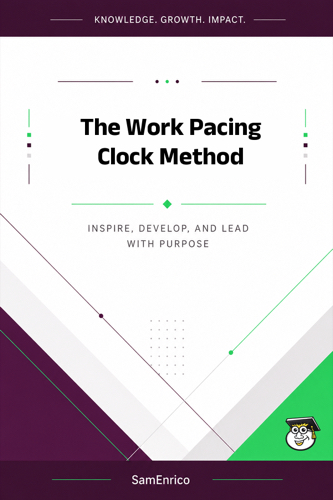
Non-FictionSelf-HelpTime Structuring
The Work Pacing Clock Method eBook
Uses a visual clock method to alternate 50 minutes
by Bates Becky
Uses a visual clock method to alternate 50 minutes of work with 10 minutes of genuine rest.
Formats
Free sample
Chapter 1: The 47-Check Day--–- The confession arrived on a Tuesday afternoon, scribbled in the margins of a spiral notebook I’d been using to track my “productivity.” For three months, I had been logging my work hours, my break times, my Pomodoro cycles, and my subjective focus ratings. I had charts. I had graphs. I had a color-coded spreadsheet that would have made a Six Sigma consultant weep with joy. And I was burning out so slowly that I didn’t notice the flames until my six-year-old daughter asked me a question I could not answer.She had crawled under my desk during a “break” — one of those five-minute gaps between Pomodoro timers that I spent scrolling Twitter while pretending to stretch my neck.
She tugged my sleeve and said, “Mommy, why is your face always on the rectangle?”I looked down at my phone. Then at my computer screen. Then at the second phone my company had issued me. Three rectangles, all within arm’s reach, all demanding attention. I had no answer for her.
Worse, I realized I had not looked her in the eye for the entire ten minutes she had been sitting there. I had been “on a break,” but my nervous system was still sprinting.That night, after she went to sleep, I did something I had never done before. I installed a tracking app on my laptop that recorded every time I looked at a timer, a clock, or a countdown during work hours. No judgment. Just data.
The next day, I worked as I normally would — switching between tasks, checking the clock, resetting timers, glancing at my phone’s countdown app. At 5:00 PM, I exported the log.Forty-seven times.I had checked a timer, clock, or countdown forty-seven times in a single workday. That was not an exaggeration or a spike. When I ran the same experiment for the rest of the week, the numbers were forty-three, fifty-one, thirty-nine, and forty-eight. My average was forty-five point six glances per day.
Each glance, according to the research I would later uncover, cost me approximately twenty-three seconds of focus recovery — the time it takes for your brain to fully re-engage with a task after a momentary distraction. Forty-seven glances times twenty-three seconds equaled eighteen minutes of pure waste. Plus the cognitive whiplash. Plus the cortisol. Plus the quiet, accumulating certainty that I was broken.I was not broken.
I was being manipulated.The Discovery That Changed Everything The manipulation had a name: the digital timer industrial complex. That is my term for the vast, invisible architecture of countdown clocks, progress bars, and numeric timers embedded in every productivity app, fitness tracker, and smartwatch on the planet. These tools promise control over time. They deliver the opposite. They deliver a low-grade, persistent anxiety disguised as accountability.I started researching this phenomenon by accident.
A colleague mentioned a obscure paper from the Journal of Experimental Psychology titled “The Effect of Countdown Timers on Cognitive Load and Task Performance.” The abstract contained a sentence that stopped me cold: “Participants in the digital countdown condition reported significantly higher state anxiety and demonstrated more frequent task-switching behaviors than those in the analog display condition, despite completing identical tasks in identical durations.”In plain English: people who watched a digital clock count down were more anxious and more distracted than people who watched an analog clock, even though both groups worked for the same amount of time and did the same work.I fell into the research rabbit hole for six months. I read studies on ultradian rhythms, the default mode network, time perception, flow states, and the neurochemistry of interruption. I interviewed cognitive psychologists, productivity researchers, and one very patient neuroscientist who drew me a diagram of the prefrontal cortex that I still do not fully understand but carry in my wallet like a talisman. And I discovered something that the productivity industry does not want you to know.The problem is not your willpower. The problem is not your motivation.
The problem is not that you are lazy, undisciplined, or fundamentally incapable of deep work.The problem is the timer.Why Digital Timers Are Designed to Fail You Let me be precise about what I mean. A digital timer displays time as a shrinking number: 25:00, 24:59, 24:58, and so on. This seems neutral. It is not. Every time you glance at that number, your brain performs a rapid, unconscious calculation: How much time is left?
Is that enough to continue? Should I speed up? Am I falling behind? These calculations take less than a second, but they are not free. They consume working memory.
They activate your sympathetic nervous system — the fight-or-flight branch. And they interrupt the neural oscillations associated with deep focus.This is not speculation. In a 2019 study published in the journal Attention, Perception, & Psychophysics, researchers used EEG to measure brain activity in participants performing timed tasks. Those who watched digital countdowns showed increased theta-wave activity — a marker of cognitive load and mental effort — compared to those who watched analog displays. The digital group worked just as hard but felt more tired and made more errors.Here is the kicker: the analog group in that study was not using a fancy device.
They were watching a standard wall clock with a second hand. The only difference was the format of the display. Numbers versus spatial position.Your brain processes spatial information — the position of a hand on a clock face, the size of a shrinking pie chart — approximately sixty thousand times faster than it processes numeric symbols. That is not a typo. Sixty thousand times faster.
This is because spatial processing is handled by the visual-spatial sketchpad, a component of working memory that operates largely outside conscious awareness. Numeric processing requires the phonological loop, which is slower, more deliberate, and more easily disrupted.Every time you check a digital timer, you are forcing your brain to do math. Every time you check an analog clock, you are simply seeing where the hand is. One is a calculation. The other is a perception.The Math Problem You Did Not Know You Were Solving Let me make this concrete.
Imagine you are twenty-three minutes into a twenty-five-minute Pomodoro. You glance at your phone. The timer reads 01:59. What does that mean? It means one minute and fifty-nine seconds remain.
But your brain does not see that instantly. It parses the digits: 01 colon 59. It converts the colon into a unit separator. It recognizes that 01 means one minute and 59 means fifty-nine seconds. It then calculates, based on your knowledge that there are sixty seconds in a minute, that you have 119 seconds left.
Then it asks: is 119 seconds enough to finish what you are doing? This entire cascade happens in less than a second, but it happens, and it consumes cognitive resources that should be directed at your task.Now imagine you are watching an analog clock. The hour hand is irrelevant. The minute hand is at the twenty-three-minute mark. The second hand is sweeping.
You do not calculate anything. You see the spatial relationship between the hand and the endpoint. You know, instantly and without thought, that you are more than halfway done.…
This is the end of the free sample. Get the eBook to keep going. Buy now
About this book
Details
- Author
- Bates Becky
- Publisher
- SamEnrico
- Language
- English
- Genre
- Non-Fiction, Self-Help, Time Structuring
- Released
- 2026-06-07
- Pages (approx.)
- 126
- Available as
- eBook, Audiobook

Read better in the ZLOADR app
Your eBooks on your phone or tablet. Sign in with your SamEnrico account and start reading.
More by Bates Becky
 Dividend Stock SentimentBates Becky$11.99
 High School Stress ReliefBates Becky$11.99
 Loneliness for Single AdultsBates Becky$11.99
 The Beast of Bristol: Britain's Phantom Serial KillerBates Becky$11.99
 Resin Transfer Molding (Rtm)Bates Becky$11.99
 How to Produce Baby DrinksBates Becky$11.99
 Sprint Retrospective Survival GuideBates Becky$12.99
 How to Start a Beer Store BusinessBates Becky$11.99
You may also like
 Hong Kong Handover 1997Dunn Johnnie$11.99
 Zumba For Postnatal Recovery CourseNeal Christian$11.99
 Zumba for BeginnersLadner Nikia$11.99
 YouTube Comment Mining GuideHumes Pandora$12.99
 Worry Box MeditationCarlin Rudy$11.99
 Workplace Stress MeditationNguyen Lynn$11.99
 Workplace Stress and Sleep RepairHawley Ivory$11.99
 Workplace Perfectionism CureDelaney Jeffry$11.99
 Workplace Injustice Anger GuideWallen Isabelle$11.99
 Work Addiction and Burnout LinkGreenwood Ester$11.99
 Women in Yoga and WellnessBeattie Galina$11.99
 Women in Stand Up ComedyChun Evangeline$11.99