
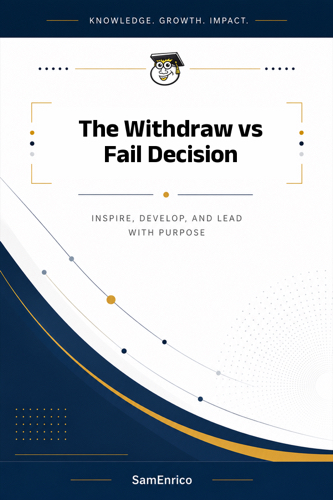
Non-FictionSelf-HelpCourse Withdrawal
The Withdraw vs Fail Decision eBook
Choose course withdrawal without shame or fear of
Choose course withdrawal without shame or fear of transcript.
Formats
Free sample
Chapter 1: The Voice of Fraud...--–- The first time Sarah considered dropping out of medical school, she had a B-plus average.She was sitting in her 2003 Honda Civic in the parking lot of the university health sciences building, the engine still running, the November rain streaking across her windshield like tears she hadn't cried yet. Her phone was open to the withdrawal portal. Her thumb hovered over the submit button. Her heart was pounding so hard she could feel it in her temples.She had just received her first quiz score back in Gross Anatomy: 72 out of 100. The class average was 91.In her mind, this was not a single low grade.
This was proof. Proof that she had fooled the admissions committee. Proof that she was the "mistake" — the applicant who had slipped through because of a good personal statement and a sympathetic interviewer. Proof that everyone was about to find out she didn't belong there.She withdrew from two classes that week. Both had been passing grades.
Both were core requirements she would have to retake the following summer at an additional cost of $8,000 in tuition.Three years later, when Sarah told me this story from her residency interview waiting room — she matched into her top-choice internal medicine program — she laughed at the memory. Not because it was funny, but because she could finally see what she couldn't see then: she had not been failing. She had been afraid.This chapter is about the difference between those two things.The Most Expensive Emotion in Academia Fear is not the enemy of academic success. Fear is a signal. It tells you that something matters, that the stakes are high, that your brain has identified a potential threat.
The problem is not fear itself. The problem is what fear does to your decision-making when you cannot distinguish between productive panic and paralytic terror.Let me define these two terms clearly, because they will appear throughout this book and the distinction will save you thousands of dollars and years of academic regret.Productive panic is fear that leads to action you would not have taken otherwise. A student experiencing productive panic might: email the professor to ask about study strategies, form a study group, visit the tutoring center, recalculate their grade projection, or increase their study hours strategically. Productive panic has an outcome. It changes behavior.
It is fear that serves you.Paralytic terror is fear that leads to avoidance, withdrawal, or self-destructive decisions. A student experiencing paralytic terror might: stop attending class (because seeing the material makes the anxiety worse), avoid checking grades (because ignorance feels safer), withdraw preemptively from a class they are passing, or convince themselves that they are fundamentally unfit for the field. Paralytic terror has an outcome too — but the outcome is almost always worse than the feared event.Sarah experienced paralytic terror. Her quiz score was below average, but it was a B-minus equivalent in a class where the standard deviation was high. She had not failed.
She had not even been warned by the professor. But her brain interpreted the gap between her score and the class average as evidence of a fundamental defect — something the psychologist Carol Dweck would later call a "fixed mindset" belief that intelligence is static and a low grade is proof of permanent inadequacy.The alternative — a "growth mindset" — treats the same low grade as data. Not evidence of who you are. Information about what you need to do next.This chapter will teach you how to recognize the difference between these two mindsets in yourself. More importantly, it will give you a tool — the Emotion vs.
Data Worksheet — that you will use before every single withdrawal decision you ever make. Because once you have separated your feelings from the facts, you can make a rational choice. Until then, you are just reacting.The Imposter Epidemic: You Are Not Alone Before we go any further, I need you to understand something that will sound like a platitude but is actually a statistical fact: almost every student who makes it to college has felt like a fraud at some point. The phenomenon is so common that psychologists have a name for it: Imposter Syndrome.First identified by psychologists Pauline Clance and Suzanne Imes in 1978, Imposter Syndrome is the internal experience of believing that you are not as competent as others perceive you to be. Despite external evidence of your competence — grades, test scores, admission to competitive programs — you remain convinced that you are a fraud and that you will eventually be exposed.The data on Imposter Syndrome in college students is staggering.
A 2019 meta-analysis of 62 studies involving over 14,000 students found that approximately 70% of college students report experiencing Imposter Syndrome at some point during their academic career. Among first-generation college students, that number rises to 85%. Among medical students specifically, multiple studies have found rates between 35% and 65% depending on the year of training.Here is what this means for you: if you have ever felt like you don't belong, like you got in by accident, like everyone else is smarter than you, like any moment someone will tap you on the shoulder and say "we made a mistake" — you are not broken. You are not uniquely inadequate. You are experiencing a documented psychological phenomenon that affects the vast majority of people in your position.The students who succeed despite Imposter Syndrome are not the ones who never feel it.
They are the ones who have learned to recognize it, name it, and make decisions based on data rather than the voice in their head.The Fixed Mindset Trap To understand why Imposter Syndrome leads to bad withdrawal decisions, we need to talk about Carol Dweck's research on mindsets. Dweck, a psychologist at Stanford University, spent decades studying how people respond to failure and challenge. Her core insight is simple but profound: people tend to hold one of two beliefs about intelligence.The fixed mindset is the belief that intelligence is static. You are born with a certain amount of smarts, and that amount does not change significantly over time. Every test, every quiz, every assignment is therefore a measure of your fixed capacity.
A low grade is not information about what to study next; it is a judgment on your permanent worth.The growth mindset is the belief that intelligence can be developed. You are not born smart or dumb; you become smarter through effort, strategy, and learning from mistakes. Every test, every quiz, every assignment is therefore data. A low grade tells you what you don't know yet and where to focus your effort.Here is how these mindsets play out in the withdrawal decision:A student with a fixed mindset gets a low grade on the first quiz. Their internal monologue goes something like this: "I got a 65.
The class average was 80. That means I'm not smart enough for this class. If I'm not smart enough for this class, maybe I'm not smart enough for this major. If I'm not smart enough for this major, maybe I don't belong in college at all. I should withdraw before anyone finds out how stupid I am."A student with a growth mindset…
This is the end of the free sample. Get the eBook to keep going. Buy now
About this book
Details
- Author
- Cardona Misti
- Publisher
- SamEnrico
- Language
- English
- Genre
- Non-Fiction, Self-Help, Course Withdrawal
- Released
- 2026-06-07
- Pages (approx.)
- 133
- Available as
- eBook, Audiobook

Read better in the ZLOADR app
Your eBooks on your phone or tablet. Sign in with your SamEnrico account and start reading.
More by Cardona Misti
 Therapeutic Disclosure for CouplesCardona Misti$11.99
 Binge Eating Prevention For AthletesCardona Misti$11.99
 The Resveratrol Brain GuideCardona Misti$11.99
 Spouse Grief Art TherapyCardona Misti$11.99
 Sudden Departure Crisis Comms ChecklistCardona Misti$11.99
 Zoom Presentation AnxietyCardona Misti$11.99
 EU Merger Fines HandbookCardona Misti$11.99
 Cannabis Use Disorder PregnancyCardona Misti$11.99
 Fafnir's Curse: The Dragon Who Wept GoldCardona Misti$11.99
 The Siege of La Rochelle: Faith, Fire, and the Birth of Modern Siege WarfareCardona Misti$11.99
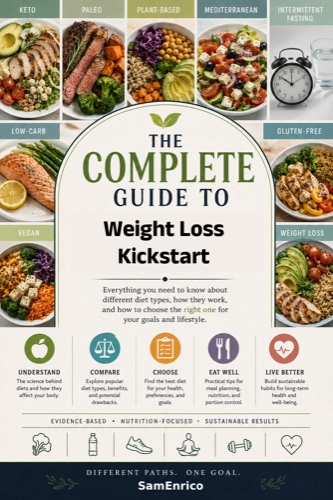 The Complete Guide to Weight Loss KickstartCardona Misti$11.99
 Small Business Invoice AI ProcessingCardona Misti$12.99
You may also like
 Hong Kong Handover 1997Dunn Johnnie$11.99
 Zumba For Postnatal Recovery CourseNeal Christian$11.99
 Zumba for BeginnersLadner Nikia$11.99
 YouTube Comment Mining GuideHumes Pandora$12.99
 Worry Box MeditationCarlin Rudy$11.99
 Workplace Stress MeditationNguyen Lynn$11.99
 Workplace Stress and Sleep RepairHawley Ivory$11.99
 Workplace Perfectionism CureDelaney Jeffry$11.99
 Workplace Injustice Anger GuideWallen Isabelle$11.99
 Work Addiction and Burnout LinkGreenwood Ester$11.99
 Women in Yoga and WellnessBeattie Galina$11.99
 Women in Stand Up ComedyChun Evangeline$11.99