
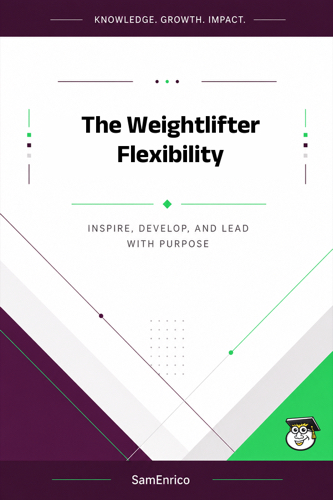
The Weightlifter Flexibility eBook
Improve squat depth and overhead position with str
by Boyce Richie
Improve squat depth and overhead position with strength-specific stretching.
Formats
Free sample
Chapter 1: Beyond The Mat--The first time I watched a talented lifter fail a squat not because of weak legs but because of a stiff ankle, I realized the fitness industry had been lying to us.His name was Marcus. He was twenty-four years old, could deadlift 220 kilograms, and had the quadriceps development of a sprinter. But every time he descended into a squat with more than 140 kilograms on his back, his heels lifted off the floor, his chest dropped toward his knees, and the lift turned into a desperate good morning. His lower back ached for days afterward. His coach told him he had “tight hips” and prescribed a ten-minute stretching routine of kneeling lunges, seated hamstring pulls, and butterfly stretches.
Marcus did this religiously for three months. His squat did not improve. It got worse.Marcus’s story is not unusual. It is the story of thousands of lifters who have been sold a simple, seductive lie: that flexibility is the opposite of strength, that stretching makes you weaker, and that mobility work is something you do after the “real” training is finished. This lie has created a generation of weightlifters who are either too stiff to squat to depth or too “stretched out” to maintain tension under a heavy bar.This book exists because the lie ends here.What You Think You Know About Flexibility Is Wrong Most lifters approach flexibility like a punishment for being tight.
They sit on a foam roller while scrolling through their phones. They hold a hamstring stretch for thirty seconds while watching the clock. They attend a yoga class once a week and assume that counts as mobility work. None of this works for the specific demands of loaded barbell training.Here is the truth that the yoga industry and the passive stretching advocates do not want you to hear: passive flexibility does not transfer to active strength. You can be flexible enough to do the splits on the floor and still fail a squat at parallel because your nervous system will not allow you to access that range under a heavy barbell.The weightlifter does not need to be flexible.
The weightlifter needs to be controllably mobile. These are not the same thing.Flexibility is the passive range of motion of a joint. It is what happens when someone else pushes your leg or gravity pulls you down. Mobility is the active range of motion you can control under your own muscular power. It is what happens when you squat to depth with a loaded barbell and maintain tension throughout.A yoga instructor can be incredibly flexible and completely unable to squat 100 kilograms because she has never trained her nervous system to produce force at end ranges.
Conversely, a powerlifter can have clinically “tight” hamstrings and still squat to depth because his nervous system has learned to coordinate tension and relaxation in exactly the right sequence.The goal of this book is not to make you flexible. The goal is to make you mobile in the two positions that matter most: the bottom of a squat and the overhead lockout. Every drill, every protocol, and every program in these pages is designed specifically for those two positions. You will not learn a single stretch that does not directly improve your ability to squat or press under load.The Anatomy of a Mobility Problem To understand why most flexibility programs fail weightlifters, you need to understand what actually limits a squat or an overhead press. It is not what you think.When a lifter cannot squat to depth, the blame is almost always assigned to the wrong body part.
“Tight hamstrings” are the most common scapegoat, followed by “tight hips.” In reality, the chain of limitation follows a strict hierarchy that most coaches ignore.The first and most common limiter for squat depth is ankle dorsiflexion. Your knee must travel forward over your toes to allow your hips to drop between your ankles. If your ankle cannot bend enough to let your knee track forward, your body has two choices: lift your heels (which makes you unstable) or lean your torso forward (which loads your lower back). Neither is acceptable. This is not a hip problem.
It is an ankle problem.The second limiter is hip external rotation. Once your knees can travel forward, your thighs must rotate outward to create space for your pelvis to descend. If your hips lack external rotation, your pelvis will tilt backward at the bottom of the squat—the dreaded “buttwink”—and your lower back will round under load.The third limiter is thoracic spine extension. If your upper back cannot arch slightly, your chest will drop, and the bar will drift forward of your midfoot. This turns your squat into a good morning and transfers stress from your quads to your spinal erectors.For overhead positions, the hierarchy is different but equally specific.
The most common limiter is latissimus dorsi flexibility. Your lat attaches to your upper arm and your pelvis. When it is tight, it literally pulls your arm down and your lower back into extension. You cannot press overhead if your lats are short. The second limiter is shoulder flexion—the ability to raise your arm overhead without arching your lower back.
The third is, again, thoracic spine extension.Notice what is missing from both hierarchies. Hamstrings are absent. Lower back flexibility is absent. The “tight” muscles that lifters obsess over are almost never the actual problem. They are symptoms of limitations elsewhere in the chain.The Stretch Reflex: Why Your Body Fights You Every muscle in your body contains tiny sensory receptors called muscle spindles.
These spindles detect changes in muscle length and rate of change. When a muscle is stretched too quickly or too far, the spindles send an emergency signal to your spinal cord, which responds by contracting the muscle being stretched. This is the stretch reflex, and it exists to prevent you from tearing your own tissues.The stretch reflex activates within approximately two seconds of the onset of a passive stretch. That means any passive hold longer than two seconds is triggering a protective contraction in the very muscle you are trying to lengthen. You are literally fighting your own nervous system.This is why ballistic stretching—bouncing into a stretch—often leaves you feeling tighter than before.
You are repeatedly triggering the stretch reflex. This is also why long-held passive stretches often feel like they are “working” in the moment but produce no lasting change. Your nervous system eventually habituates to the stretch while you are relaxed on the floor, but the moment you stand up and add load, the old patterns return.The solution is not to stop stretching. The solution is to stretch differently.The Tension Arc Method Throughout this book, you will learn a system called the Tension Arc Method. This method bypasses the stretch reflex by using active muscle contraction at end ranges.
Instead of relaxing into a stretch, you will contract the muscle you are stretching. This sends a signal to your nervous system that the tension is intentional and safe.The Tension Arc Method has three phases, each suited to different joints…
This is the end of the free sample. Get the eBook to keep going. Buy now
About this book
Details
- Author
- Boyce Richie
- Publisher
- SamEnrico
- Language
- English
- Genre
- Non-Fiction, Health & Wellness, Strength Training
- Released
- 2026-06-08
- Pages (approx.)
- 126
- Available as
- eBook, Audiobook

Read better in the ZLOADR app
Your eBooks on your phone or tablet. Sign in with your SamEnrico account and start reading.
More by Boyce Richie
 TM Spiritual EvolutionBoyce Richie$11.99
 Plant Based Athlete Performance CourseBoyce Richie$11.99
 Resentment and Power DynamicsBoyce Richie$11.99
 George Washington First President HandbookBoyce Richie$11.99
 The Last Flight of MS804: The Mysterious Exodus of EgyptAir 804Boyce Richie$11.99
 Zero Day: The Untold Story of the Stuxnet SabotageBoyce Richie$11.99
 Plumbing System DesignBoyce Richie$11.99
 Understanding Cretinism AthyreoticBoyce Richie$17.99
 Patent Appeal Fee DeadlinesBoyce Richie$12.99
 UNITAR Training ProgramsBoyce Richie$12.99
 How to Start a Cartridge Primer Business (Beginners Guide)Boyce Richie$11.99
You may also like
 CrossFit Foundations Beginners ManualCorbett Gale$11.99
 Sarcopenia Resistance GuideComstock Danika$11.99
 CrossFit WOD BreakdownPugh Alfreda$11.99
 Bodyweight Pull Up ProgressionPerales Blondell$11.99
 CrossFit Foundations For Beginners CourseEscamilla Avis$11.99
 Postpartum Return to LiftingShultz Gema$11.99
 Pelvic Floor for LiftersToro Angella$11.99
 Strength Athlete NutritionFitch Neville$11.99
 PCOS Strength Training GuideGrogan Cheryle$11.99
 Pelvic Floor for WeightliftersValle Ghislaine$11.99
 The Menopause Strength Training HandbookBachman Tesha$11.99
 Compound Lifts Strength FoundationBernstein Jenette$11.99