
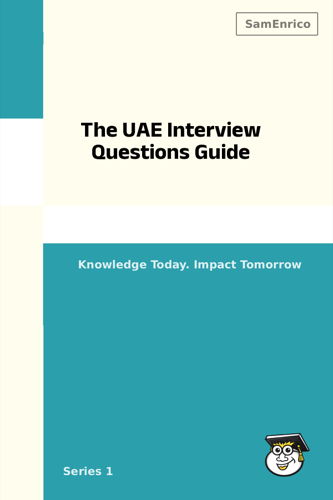
Non-FictionProfessional's Cheat SheetUAE
The UAE Interview Questions Guide eBook
Expects stability, family status, and loyalty to c
Expects stability, family status, and loyalty to company.
Formats
Free sample
Chapter 1: The High-Cost Hire--Every resume tells a story. In New York or London, a resume showing three jobs in five years might read as “ambitious,” “adaptable,” or “fast-track.” In the United Arab Emirates, that same document reads like a warning label. The difference is not a matter of opinion or cultural preference. It is a matter of dirhams and cents, visas and housing allowances, risk and reward. This chapter introduces the single most important concept you will learn in this book: the High-Cost Hire model.
Until you understand how much money an employer loses when you leave before three years, you will never understand why they ask the questions they ask, why they stare at you a little too long when you explain your short tenure, or why they seem more interested in your spouse’s job than your technical skills.Let us begin with a simple exercise. Imagine you are a hiring manager in Dubai. You have just approved a job offer for a mid-level marketing manager. Before that person writes a single email or attends a single meeting, your company has already spent approximately 45,000 to 60,000 AED. Where does that money go?
First, there is the visa processing fee, which includes security clearance, medical fitness tests, biometrics, and Emirates ID registration. Then there is the health insurance premium, often paid annually upfront. Then there is the housing allowance, typically paid as a lump sum or added to the first quarter’s salary. Then there are the flight tickets home, often provided for the employee and their dependents at the start of the contract. Then there is the recruitment agency fee, which in the UAE can reach 20 percent of the first year’s salary.
Then there are the soft costs: the hours your team spent interviewing, the lost productivity while the role sat vacant, the training ramp-up period of three to six months.This is the High-Cost Hire reality. In Western economies, hiring is relatively cheap and firing is relatively hard. Employers invest in recruitment but accept turnover as a natural cost of doing business. In the UAE, hiring is expensive and firing is surprisingly easy during the probation period, but the cost of replacement remains brutal. The result is a labor market that despises uncertainty.
Your resume is not a collection of achievements. It is a risk assessment. Every short job is a red flag. Every unexplained gap is a liability. Every vague answer about “seeking new challenges” is interpreted as “I will leave you as soon as a slightly better offer arrives.”This chapter will dismantle the assumptions you brought from other labor markets.
It will explain why UAE employers view stability as the highest virtue, why the phrase “I stayed for two years in a difficult role” is actually a flex, and why being a “safe bet” is more valuable than being a “star performer.” We will also introduce the distinction between Active Loyalty and Passive Loyalty, a framework that will appear throughout this book. By the end of this chapter, you will understand why your interview answers must change, and you will be ready to rewrite your narrative from “job seeker” to “long-term asset.”The Economics of Turnover in the UAELet us put actual numbers on the table. These figures are drawn from regional HR surveys and recruitment industry reports published between 2022 and 2025. While exact costs vary by sector and seniority, the order of magnitude is consistent across the market.For an entry-level professional earning 12,000 AED per month, the total cost of replacement ranges from 25,000 to 35,000 AED. This includes visa processing, medicals, a basic health insurance package, and recruiter fees.
For a mid-level manager earning 25,000 to 35,000 AED per month, the replacement cost jumps to 60,000 to 90,000 AED. For a senior leader earning 50,000 AED or more, replacement costs can exceed 200,000 AED when you factor in executive search fees, relocation allowances, housing deposits, and international moving expenses.Now consider what happens when an employee leaves before the two-year mark. The employer has not yet recouped their upfront investment. The recruitment cost is a sunk loss. The training investment – usually equivalent to three to six months of salary – is also lost.
The team’s productivity dips while the role is backfilled. Institutional knowledge walks out the door. In a small or medium-sized company, losing one key employee in the first 18 months can wipe out the department’s entire annual budget for professional development.This is why UAE employers are obsessed with tenure. Not because they are old-fashioned. Not because they want to trap you.
Because the math is unforgiving. A candidate who has held four jobs in five years has, in economic terms, cost those four employers a combined sum that could have funded a new company car, a major software implementation, or two additional junior hires. That candidate is not ambitious. They are expensive.The Golden Handcuffs: Your Visa Is Your Anchor Now flip the equation. It is not only expensive for the employer when you leave.
It is also expensive for you. This is the Golden Handcuffs phenomenon.In the UAE, your residency visa is tied to your employer. If you quit, you do not simply hand in your laptop and walk out. You trigger a cascade of administrative consequences. Your visa becomes invalid.
Your Emirates ID becomes linked to a cancelled status. Your bank accounts may be frozen or restricted. Your children’s school enrollment, which requires a valid parent visa, becomes precarious. Your housing lease, often tied to your employment contract, may be subject to early termination penalties. Your car registration, your utilities, your internet plan – all of these are anchored to your residency status.This creates a powerful psychological and financial incentive to stay.
Employers know this. They are not being cynical when they ask about your family status. They are calculating risk. A single, childless candidate in their twenties has few anchors. They can pack a suitcase, cancel their lease, and fly home within a week.
A married candidate with two children enrolled in a British curriculum school, a spouse employed locally, and a two-bedroom apartment in Dubai Marina has significant anchors. They are not leaving unless something goes very wrong.The Golden Handcuffs are not a trap. They are a structural feature of the UAE labor market. And once you understand them, you can use them to your advantage. When an interviewer asks, “Are you married?” or “Do you have children?” – and in the UAE, these questions are legal and common – they are not prying.
They are asking, “How anchored are you?” Your answer should reassure them that you are not a flight risk. We will cover the exact phrasing in Chapter 7. For now, understand the underlying logic: stability is measured in dependents, leases, and school enrollment forms.Active vs. Passive Loyalty: The Critical Distinction Before we go further, we must introduce a distinction that will appear throughout this book. It resolves a common confusion that has derailed many candidates and even some HR professionals.Active Loyalty is the choice to stay with an employer because you are engaged, growing, respected, and aligned with the company’s mission.
You are not trapped. You are not afraid to leave. You simply see no reason to leave because the relationship…
This is the end of the free sample. Get the eBook to keep going. Buy now
About this book
Details
- Author
- Prado Hermine
- Publisher
- SamEnrico
- Language
- English
- Genre
- Non-Fiction, Professional's Cheat Sheet, UAE
- Released
- 2026-06-09
- Pages (approx.)
- 156
- Available as
- eBook, Audiobook

Read better in the ZLOADR app
Your eBooks on your phone or tablet. Sign in with your SamEnrico account and start reading.
More by Prado Hermine
 Repairing Self-Worth in RecoveryPrado Hermine$11.99
 The Talent Myth DebunkedPrado Hermine$11.99
 Civil Engineering CreativityPrado Hermine$11.99
 Legitimization Of Paltry FavorsPrado Hermine$11.99
 The Fire Arrow Forges an Empire: The Inventor Who Changed Chinese WarfarePrado Hermine$11.99
 Commercial LenderPrado Hermine$11.99
 YC Energy Tech Africa GuidePrado Hermine$12.99
 UAE VAT Executive PrimerPrado Hermine$12.99
 Understanding Trisomy 2 MosaicismPrado Hermine$17.99
 How to Become a Piston MakerPrado Hermine$11.99
You may also like
 Hong Kong Handover 1997Dunn Johnnie$11.99
 Zumba For Postnatal Recovery CourseNeal Christian$11.99
 Zumba for BeginnersLadner Nikia$11.99
 YouTube Comment Mining GuideHumes Pandora$12.99
 Worry Box MeditationCarlin Rudy$11.99
 Workplace Stress MeditationNguyen Lynn$11.99
 Workplace Stress and Sleep RepairHawley Ivory$11.99
 Workplace Perfectionism CureDelaney Jeffry$11.99
 Workplace Injustice Anger GuideWallen Isabelle$11.99
 Work Addiction and Burnout LinkGreenwood Ester$11.99
 Women in Yoga and WellnessBeattie Galina$11.99
 Women in Stand Up ComedyChun Evangeline$11.99