
Non-FictionSelf-HelpDecision Making
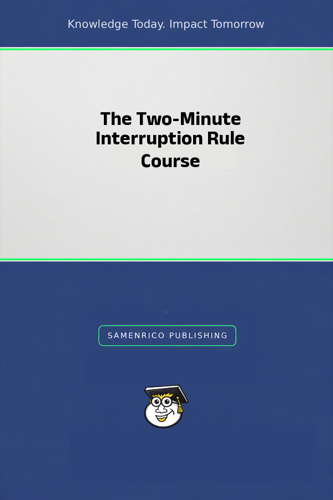
The Two-Minute Interruption Rule Course eBook
Adapts the two-minute rule for interruptions—how t
Adapts the two-minute rule for interruptions—how to handle quick disruptions without losing workflow momentum.
Formats
Free sample
Chapter 1: The Two-Minute Trap--–- The two-minute rule, popularized by David Allen in "Getting Things Done," is one of the most famous productivity principles in existence. And it is also one of the most misunderstood.Most people know the rule in its simplest form: "If a task takes less than two minutes, do it immediately." This is good advice for managing your to-do list. But when applied to interruptions—the constant stream of questions, notifications, requests, and self-distractions that punctuate every workday—the two-minute rule can become a trap. A trap that fragments your attention, multiplies your context switches, and leaves you exhausted at the end of a day in which you accomplished almost nothing.This chapter is about why the classic two-minute rule fails for interruptions, how to adapt it, and the framework that will replace it. By the end of this chapter, you will understand the difference between a two-minute task and a two-minute interruption, and you will have the foundation of a system that protects your focus without alienating the people around you.The Software Engineer Who Lost His Day Let me tell you about a software engineer named Marcus.
Marcus was good at his job—brilliant, actually. He could disappear into code for hours, emerging with elegant solutions to complex problems. But Marcus had a problem. He was popular. Colleagues stopped by his desk constantly.
His phone buzzed with Slack messages. His email pinged with updates from a dozen different threads.Marcus had heard of the two-minute rule. He prided himself on being responsive. When a colleague asked a question, he answered it immediately—ninety seconds, tops. When an email required a quick reply, he fired it off.
When a notification popped up, he checked it, because checking only took a few seconds, right?One day, Marcus decided to track his interruptions. He was horrified by what he found. Over the course of eight hours, he was interrupted twenty-two times. Each interruption took an average of ninety seconds to handle. By simple math, he had spent thirty-three minutes on interruptions—less than an hour.
Not great, but not catastrophic.But when Marcus tracked his deep work output—the complex coding tasks that required sustained concentration—he discovered something far worse. He had accomplished only two hours of meaningful work. The other six hours had been consumed not by the interruptions themselves, but by the recovery time between them.Each ninety-second interruption cost him an average of twenty-three minutes to fully regain his focus. Twenty-two interruptions times twenty-three minutes is over eight hours of recovery time. Marcus was spending his entire day recovering from interruptions, with almost no time left for actual work.This is the two-minute trap.
The interruption is short. The cost is not.Why the Classic Two-Minute Rule Fails for Interruptions The classic two-minute rule was designed for tasks, not interruptions. David Allen's original insight was about your to-do list: if you have a task that will take less than two minutes to complete, do it now rather than writing it down and processing it later. The overhead of capture and review exceeds the cost of just doing the thing.This is excellent advice for task management. It fails for interruptions because interruptions are not tasks.
They are disruptions to an existing cognitive state. When you are in the middle of focused work, your brain has assembled a complex mental model of the problem you are solving. You have loaded relevant information into working memory. You have suppressed irrelevant distractions. You are in flow.An interruption shatters that state.
Even a ten-second interruption—a glance at a notification, a quick question from a colleague—requires you to disengage from your mental model, shift attention to something else, and then, later, rebuild the model from scratch. The cost is not the ten seconds. The cost is the rebuilding.Research from Dr. Gloria Mark at the University of California, Irvine, has quantified this cost. Her team observed knowledge workers in their natural environments and measured how long it took them to return to their original task after an interruption.
The average recovery time was twenty-three minutes. That is not a typo. Twenty-three minutes to fully re-engage with the work that was interrupted.Let that sink in. A two-minute interruption can cost you twenty-three minutes of recovery. That is more than ten times the duration of the interruption itself.
And with twenty interruptions per day, the cumulative cost is devastating.The classic two-minute rule tells you to handle small interruptions immediately. The research tells you that handling small interruptions immediately is exactly the wrong thing to do. Each "quick" response is a time bomb that destroys the next twenty-three minutes of your cognitive capacity.The Two-Minute Trap in Action Let me walk you through a typical scenario. It is 10:00 AM. You are deep in concentration on a quarterly report that requires careful analysis.
Your brain has assembled a complex spreadsheet in your mind's eye. You are comparing numbers, noticing patterns, connecting dots. You are in flow.At 10:07, your colleague Sarah appears at your desk. "Quick question," she says. "Do you know where the Johnson file is?"You have two choices.
You can say, "Let me finish this thought and I will get back to you," which feels rude. Or you can answer the question. It will only take thirty seconds. You answer. "It is in the shared drive under Q3 files."Sarah thanks you and leaves.
The interruption lasted thirty seconds. No big deal, right?Wrong. Your mental model of the quarterly report is gone. The spreadsheet you had assembled in your mind has evaporated. The threads you were connecting have disconnected.
You look at your screen and feel a wave of confusion. What were you just doing? Where were you?You spend the next fifteen minutes reorienting yourself. You reread the last three sections. You try to remember the insight you were about to capture.
By 10:23, you are finally back to where you were at 10:07. You have lost sixteen minutes to a thirty-second interruption. And you have done this to yourself because you answered a question that could have waited.This is the two-minute trap. The interruption is short. The cost is enormous.
And the worst part is that you are likely doing this to yourself dozens of times per day without realizing it.The Adaptation: From Tasks to Interruptions If the classic two-minute rule fails for interruptions, what replaces it? The answer is not to ignore all interruptions. Some interruptions are genuinely important. Some carry information you need. Some come from people you care about and want to support.The answer is a framework that respects both the cost of interruptions and the reality that you cannot live in a bubble.
The answer is the Two-Minute Interruption Rule—not a rule about tasks, but a rule about the total time from interruption to return to functional focus.Here is the clarified definition that will guide this entire course: The Two-Minute Interruption Rule is a framework for evaluating and responding to any interruption with the goal of returning to functional focus within 120 seconds total. Not 120 seconds for the interruption itself. 120 seconds from the moment of…
This is the end of the free sample. Get the eBook to keep going. Buy now
About this book
Details
- Author
- Jorgensen Isela
- Publisher
- SamEnrico
- Language
- English
- Genre
- Non-Fiction, Self-Help, Decision Making
- Released
- 2026-06-10
- Pages (approx.)
- 137
- Available as
- eBook, Audiobook

Read better in the ZLOADR app
Your eBooks on your phone or tablet. Sign in with your SamEnrico account and start reading.
More by Jorgensen Isela
 Self Hypnosis for LiftersJorgensen Isela$11.99
 Senior Assertiveness TrainingJorgensen Isela$11.99
 Signal Privacy Obsession GuideJorgensen Isela$11.99
 Quetzalcoatl's Feathers: The Plumed Serpent's Divided HeartJorgensen Isela$11.99
 How to Become a Glue-mill OperatorJorgensen Isela$11.99
 How to Produce AdhesivesJorgensen Isela$11.99
 Employee Monitoring Ethics ManualJorgensen Isela$12.99
 Risk Manager (Gaming)Jorgensen Isela$11.99
You may also like
 Hong Kong Handover 1997Dunn Johnnie$11.99
 Zumba For Postnatal Recovery CourseNeal Christian$11.99
 Zumba for BeginnersLadner Nikia$11.99
 YouTube Comment Mining GuideHumes Pandora$12.99
 Worry Box MeditationCarlin Rudy$11.99
 Workplace Stress MeditationNguyen Lynn$11.99
 Workplace Stress and Sleep RepairHawley Ivory$11.99
 Workplace Perfectionism CureDelaney Jeffry$11.99
 Workplace Injustice Anger GuideWallen Isabelle$11.99
 Work Addiction and Burnout LinkGreenwood Ester$11.99
 Women in Yoga and WellnessBeattie Galina$11.99
 Women in Stand Up ComedyChun Evangeline$11.99