
Non-FictionSelf-HelpDecision MakingTime Management
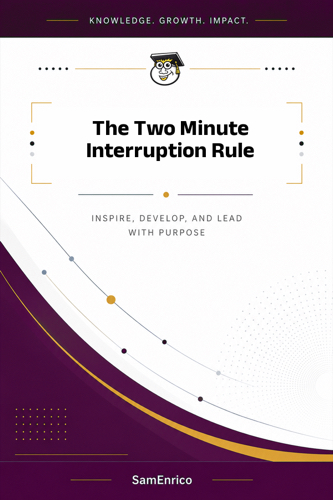
The Two Minute Interruption Rule eBook
Apply a simple triage system to quickly decide if
Apply a simple triage system to quickly decide if a disruption is worth your immediate attention.
Formats
Free sample
Chapter 1: The Eleven-Minute Thief...--–- The average professional is interrupted every eleven minutes. What happens next will cost you three hours of every single day—and you have no idea it's even happening.You are about to lose twenty minutes of your life. Not in a car crash or an argument or a boring meeting. You are going to lose it in a thousand tiny slices, each one so small you won't feel the blade. By the time you finish reading this chapter, the thief will have struck again.
And again. And again.Let us name the thief. Its name is The Unexpected Interruption.It arrives as a knock on your office door. A Slack message that makes your screen glow. A colleague who leans over your cubicle wall and says, "Got a second?" A phone call from your boss.
An email notification that pops up while you are deep in concentration. A tap on the shoulder. A question shouted across the room. A text message from your partner. A news alert.
A calendar reminder that has nothing to do with what you are doing right now.Each one of these interruptions lasts, on average, thirty seconds. Thirty seconds. That is nothing. That is the time it takes to tie your shoes or pour a cup of coffee. Surely, you can afford thirty seconds.You cannot.
And here is why.The Most Expensive Thirty Seconds in Your Workday In 2005, researchers at the University of California, Irvine, conducted a study that would change how we understand productivity forever. They shadowed information workers in their natural environment—cubicles, offices, open floor plans—and recorded every single interruption. What they found was startling. The average worker was interrupted every eleven minutes. Not every hour.
Not every thirty minutes. Every eleven minutes.But the real shock came when they measured what happened after the interruption. It took, on average, twenty-three minutes and fifteen seconds for that worker to return to their original task at full focus. Twenty-three minutes. For a thirty-second interruption.Let us do the math together.If you are interrupted every eleven minutes, and each interruption costs you twenty-three minutes of recovery time, you are spending more than two hours of every workday just trying to get back to where you were before someone knocked on your door.
That is not productivity. That is a tax on your attention, and you are paying it without ever seeing the bill.A more recent study published in the Journal of Clinical and Translational Science in 2021 confirmed and expanded these findings. Researchers found that even a brief disruption—a phone call, a question from a colleague, a notification ping—caused a measurable decrease in accuracy and speed on complex tasks. Participants who were interrupted made twice as many errors as those who worked uninterrupted. Twice as many.Think about that.
The work you do after an interruption is not just slower. It is worse. You are not merely losing time. You are losing quality.The Cognitive Lie We All Believe You have been told a lie your entire career. The lie is called multitasking, and it sounds like this: "I can do two things at once.
I am good at juggling. I am a natural multitasker."The truth, revealed by decades of cognitive neuroscience, is that the human brain cannot perform two attention-demanding tasks simultaneously. It cannot. What you call multitasking is actually something else entirely: rapid task-switching. Your brain toggles back and forth between Task A and Task B so quickly that you do not notice the gaps.
But the gaps are there. And they are expensive.When you are focused on a complex task—writing a report, analyzing data, solving a problem—your brain builds what cognitive scientists call a "mental model." This model holds all the relevant information in your working memory: where you are in the process, what you have already done, what you need to do next, what assumptions you are making, what constraints you are operating under. Building this model takes time and energy. It is like constructing a house of cards. Each card must be placed carefully, balanced precisely.Then someone interrupts you.
The knock comes. The notification pings. The question is asked.Your brain has two choices. Choice one: ignore the interruption and continue building. Choice two: save the current state of your mental model and switch to the interruption.
But here is the catch: saving a mental model is not like saving a Word document. You cannot just click a button and return exactly where you left off. Your brain has to perform a series of complex operations. It has to decide what to keep and what to discard. It has to tag the current location in the model.
It has to suppress the active neural networks that were processing the original task and activate new networks for the interruption.This process is called a "context switch," and it costs you.When you return to your original task, your brain has to reload the mental model. But the model has decayed in your absence. Some of the cards have fallen. You have to reconstruct them. You have to remember where you were, what you were doing, what you were about to do next.
You have to re-read the last paragraph, re-examine the last data point, re-orient yourself to the problem.This is why a thirty-second interruption costs twenty-three minutes. The interruption itself is not the thief. The thief is the context switch.The 2.5-Hour Heist Let us make this concrete.Imagine you arrive at work at 9:00 AM. You have a complex project on your desk—a proposal, a presentation, a piece of code, a financial model. You sit down, open your laptop, and begin to focus.
By 9:11 AM, you are in flow. Your mental model is fully built. You are making progress.Then the first interruption arrives. A coworker stops by your desk. "Hey, quick question." You turn away from your screen.
You answer the question. The coworker leaves. Thirty seconds have passed. But now you have lost your place. You stare at the screen for a moment, trying to remember what you were doing.
You re-read the last paragraph. You re-check the last calculation. You re-establish your mental model.It is now 9:34 AM. Twenty-three minutes have passed since the interruption. You have been working again for perhaps three of those minutes.
The other twenty were recovery.You work for another ten minutes. At 9:44 AM, a Slack message pops up from your boss. "Can you jump on a quick call?" You switch to Slack. You reply. You check your calendar.
You realize the call can wait. You close Slack. You return to your proposal.It is now 9:54 AM. Another ten minutes lost to context switching.At 10:05 AM, your phone buzzes with a text message. You glance at it.
It is your partner asking what you want for dinner. You do not reply immediately, but the glance alone is enough. Your attention fragments. You think about dinner for a moment. You wonder if you have groceries.
You return to your proposal.It is now 10:18 AM. Another thirteen minutes.By noon, you have been interrupted six or seven…
This is the end of the free sample. Get the eBook to keep going. Buy now
About this book
Details
- Author
- Mccaskill Micah
- Publisher
- SamEnrico
- Language
- English
- Genre
- Non-Fiction, Self-Help, Decision Making, Time Management
- Released
- 2026-06-08
- Pages (approx.)
- 149
- Available as
- eBook, Audiobook

Read better in the ZLOADR app
Your eBooks on your phone or tablet. Sign in with your SamEnrico account and start reading.
More by Mccaskill Micah
 The Batching Morning MethodMccaskill Micah$11.99
 Natural Disaster Loss GuideMccaskill Micah$11.99
 Cocaine Craving Surfing GuideMccaskill Micah$11.99
 Resume Keywords ExtractionMccaskill Micah$11.99
 Crystal Cave HealingMccaskill Micah$11.99
 CRE Renovation ROI CalculatorMccaskill Micah$11.99
 Helicopter Rescue PilotMccaskill Micah$11.99
 Jeff Bezos AmazonMccaskill Micah$11.99
 The Unseen Hand: The 1983 Brink's Heist and the FBI's Cover-UpMccaskill Micah$11.99
 The Blood of Worcester: Cromwell's Final TriumphMccaskill Micah$11.99
 Frozen Echoes: The Pacific’s Ice Age Secrets and the Scientists Who Unlocked ThemMccaskill Micah$11.99
 Understanding Alopecia Hypogonadism Extrapyramidal DisorderMccaskill Micah$17.99
You may also like
 Hong Kong Handover 1997Dunn Johnnie$11.99
 Zumba For Postnatal Recovery CourseNeal Christian$11.99
 Zumba for BeginnersLadner Nikia$11.99
 YouTube Comment Mining GuideHumes Pandora$12.99
 Worry Box MeditationCarlin Rudy$11.99
 Workplace Stress MeditationNguyen Lynn$11.99
 Workplace Stress and Sleep RepairHawley Ivory$11.99
 Workplace Perfectionism CureDelaney Jeffry$11.99
 Workplace Injustice Anger GuideWallen Isabelle$11.99
 Work Addiction and Burnout LinkGreenwood Ester$11.99
 Women in Yoga and WellnessBeattie Galina$11.99
 Women in Stand Up ComedyChun Evangeline$11.99