
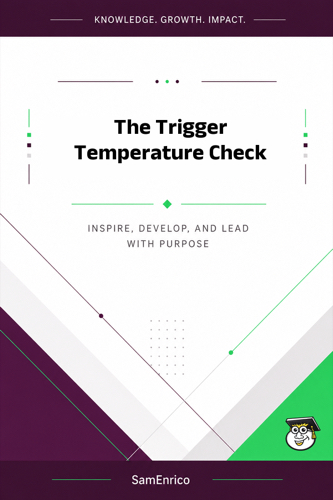
The Trigger Temperature Check eBook
Rates trigger intensity before, during, and after
Rates trigger intensity before, during, and after anger episode.
Formats
Free sample
Chapter 1: The Slowest Burn...--–- The first time Marcus threw his phone across the room, he told himself it was an accident. The second time, he blamed the stress at work. The third time, his five-year-old daughter was standing in the doorway, and there was no one left to blame but himself.The phone—a battered Samsung with a cracked screen that he had been meaning to replace for six months—hit the wall two inches above his daughter’s head. She did not cry. That was the worst part.
She did not flinch or scream or run to her mother. She simply stood there, perfectly still, with the flat, blank face of a child who had learned, somewhere along the way, that freezing was safer than feeling.Marcus lowered his arm. The adrenaline was still hot in his chest, buzzing behind his sternum like a trapped insect. His right hand throbbed from the impact of the throw. His ears were ringing.
And standing in the wreckage of his living room—overturned lamp, scattered papers, the shattered remnants of his phone—he had the first clear thought he had had in three days.I don’t know what just happened.Not why. Not how to stop it. Just the cold, hollow recognition that something had happened to him, not by him. He had been present in his body—he remembered the rise of heat, the pressure behind his eyes, the sudden irresistible urge to make something break—but he had not been in control. The anger had used him, not the other way around.If you had asked Marcus an hour later, sitting on the edge of his bed with his head in his hands, he would have told you he “snapped.” He would have used that exact word.
I don’t know what happened. I just snapped. It is the most common explanation people give for their own destructive anger, and it is almost always wrong.The Most Dangerous Word in the English Language The word “snap” implies a sudden, unpredictable fracture—a piece of stress or tension that has been building invisibly until, without warning, it breaks. It suggests that anger is a binary state: you are either fine, or you have lost your mind. There is no ramp-up, no progression, no series of small choices that lead to the larger explosion.
Just fine, and then not fine. Calm, and then rage.This is a comforting fiction. It is comforting because it absolves you of responsibility for the moments before the explosion. If you snapped, you did not choose to escalate. If you snapped, the anger was a natural disaster, not a pattern.
If you snapped, there is nothing to learn except perhaps to avoid whatever trigger made you snap in the first place.But the research tells a different story. Drawing on decades of clinical observation compiled in sources like the International Handbook of Anger, anger almost never happens “out of nowhere.” What looks like a sudden explosion is actually the final visible stage of a process that has been unfolding for minutes, hours, or sometimes days. The snap is not the beginning. The snap is the end.This chapter dismantles the myth of snapping and replaces it with something far more useful: a clear, evidence-based model of how anger actually moves through the human body and mind. You will learn to distinguish between two fundamental anger velocity profiles—the Slow Burn and the Flash Fire—and discover why understanding your personal velocity is the single most important leverage point for intervention.
By the end of this chapter, you will never again say “I snapped” without also being able to describe the ten, twenty, or two hundred small escalations that led you there.The Master Aggression Cycle: One Model to Rule Them All Throughout this book, we will return to a single unified framework called the Master Aggression Cycle. Unlike simpler models that show anger as a straight line from trigger to explosion, the Master Cycle reveals the hidden loops and feedback mechanisms that keep people stuck in patterns of destructive rage for years or decades.Here is the cycle in its simplest form:Chronic Stress → Higher Baseline Temperature → Smaller Trigger Needed → Escalation (with specific velocity) → Explosion → Shame → Suppression → Higher Baseline Let us walk through each stage using Marcus as our example.Stage One: Chronic Stress. For three months before the phone incident, Marcus had been living under a slow accumulation of pressures. His company was undergoing layoffs. His mother had been diagnosed with early-stage dementia.
His wife had started working night shifts, leaving him alone with their daughter for twelve hours at a stretch. None of these stressors alone would have caused an explosion. But together, they raised his baseline temperature—a concept we will explore in depth in Chapter 2. By the morning of the incident, Marcus was starting his day at a Level 3 (mild, persistent irritation) rather than a Level 1 (calm).Stage Two: Higher Baseline Temperature. Because his baseline was elevated, Marcus needed far less provocation to reach his Red Line (the temperature above which he could no longer reliably choose his responses, which we will define precisely in Chapter 2).
A dropped glass, a whining child, a text message from his wife canceling plans—each of these small triggers landed on ground that was already burning.Stage Three: Escalation with Specific Velocity. Marcus is what this chapter will define as a Slow Burn. His anger does not explode in seconds. It accumulates over hours or days, often masked as general irritability, withdrawal, or passive-aggressive comments. On the day of the incident, he had been escalating since 6:00 AM, when his daughter spilled cereal on the floor.
By noon, he was clenching his jaw (Level 4). By 3:00 PM, his shoulders were rigid and his breathing had shortened (Level 5). By 6:00 PM, when his daughter asked for the third time whether she could watch a cartoon, he was at Level 7—fury, voice rising, tunnel vision beginning. The throw was not a snap. It was the logical conclusion of twelve hours of unaddressed escalation.Stage Four: Explosion.
The throw itself lasted less than two seconds. But it was the visible peak of an invisible mountain.Stage Five: Shame. Within minutes of the explosion, Marcus’s adrenaline began to fall. In its place came a crushing wave of shame—not guilt (which focuses on the behavior: I did something bad), but shame (which attacks the self: I am bad). Shame is a critical part of the cycle because it does not lead to productive change.
It leads to suppression.Stage Six: Suppression. Unable to tolerate the shame, Marcus did what most people do: he pushed the entire incident down. He did not talk about it. He did not analyze it. He cleaned up the broken phone, put his daughter to bed, and went to sleep promising himself he would “do better tomorrow.” Suppression is not resolution.
Suppression is delay.Stage Seven: Higher Baseline. Because he suppressed rather than processed, Marcus’s baseline temperature did not return to its previous level. It actually increased. The unaddressed shame, the unresolved incident, the lingering fear of his own capacity for violence—all of these raised his starting…
This is the end of the free sample. Get the eBook to keep going. Buy now
About this book
Details
- Author
- Dempsey Vanna
- Publisher
- SamEnrico
- Language
- English
- Genre
- Non-Fiction, Self-Help, Intensity
- Released
- 2026-06-09
- Pages (approx.)
- 139
- Available as
- eBook, Audiobook

Read better in the ZLOADR app
Your eBooks on your phone or tablet. Sign in with your SamEnrico account and start reading.
More by Dempsey Vanna
 Menopause Restless Leg GuideDempsey Vanna$11.99
 Sugar Detox ProtocolDempsey Vanna$11.99
 SAS Escape and EvasionDempsey Vanna$11.99
 Persona Creation Team WorkshopDempsey Vanna$11.99
 Bark of the First MoonDempsey Vanna$11.99
 Frozen Echoes of the Sky: The Lost Viking Space Artifacts of the ArcticDempsey Vanna$11.99
 Cold Storage Production WorkersDempsey Vanna$11.99
 How to Start a Snowmobiling - Recreational BusinessDempsey Vanna$11.99
 Earn Out Negotiation HandbookDempsey Vanna$12.99
 ESL Prop Box CreationDempsey Vanna$12.99
 Understanding Gamborg–nielsen SyndromeDempsey Vanna$17.99