
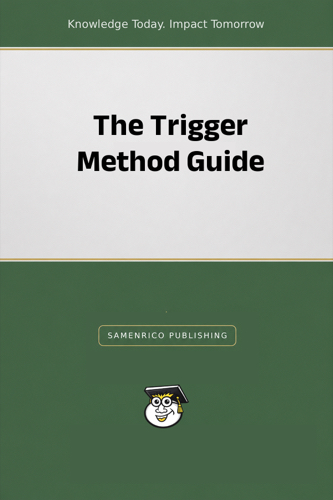
Non-FictionSelf-HelpRandom Trigger
The Trigger Method Guide eBook
Uses random words to spark associations.
Uses random words to spark associations.
Formats
Free sample
Chapter 1: The Pattern Trap--–- You are not out of ideas. You are trapped inside a pattern you cannot see.Imagine standing in the middle of a vast library. The shelves stretch in every direction, endless rows of books containing every solution you will ever need. You walk the aisles for hours, days, years. But you keep returning to the same five books.
You read them again and again. You memorize them. You convince yourself that the library contains nothing else.This is not a metaphor for a lack of imagination. It is a description of how your brain actually works.The human brain is the most sophisticated pattern-matching machine ever assembled. Every second, it processes eleven million bits of information from your senses.
It compresses that firehose of data into a manageable stream of recognition, prediction, and decision. It does this so efficiently that you never notice the work. You do not feel the thousands of tiny calculations that allow you to recognize a chair as a chair, a face as a friend, a problem as familiar.This efficiency is why you survived childhood. It is why you can drive a car without consciously steering every moment. It is why you can walk into a grocery store and find milk without re-learning the layout of a refrigerated section.But this same efficiency is also the single greatest barrier to original thinking.The Architecture of Habit Every time you solve a problem, your brain celebrates by building a neural pathway.
Think of it as a small dirt path in a forest. The first time you walk from Point A to Point B, you push aside branches and step over roots. It is slow. It requires attention. The second time is easier.
The tenth time, the path is visible. The hundredth time, it is a paved road.Your brain prefers paved roads. They require less energy. They are predictable. They feel correct not because they are right, but because they are familiar.This is called pattern completion.
When you encounter a situation that resembles a previous situation, your brain does not analyze it fresh. It reaches for the existing path. It fills in the gaps. It assumes that because the surface features look similar, the solution should be similar.This is why creative blocks feel so insurmountable. You are not failing to find a solution.
You are failing to see that you are walking the same road for the hundredth time and expecting a different destination.The Nine Dots Illusion Perhaps you have seen the classic puzzle. Nine dots arranged in a square, three by three. The instruction: connect all nine dots using four straight lines or fewer, without lifting your pen from the paper.Most people cannot solve it. Not because they lack intelligence. Because they draw an invisible box around the nine dots.
They assume the lines must stay within the perimeter of the dots themselves. That assumption is not stated anywhere in the instructions. It is supplied by the brain's pattern-completion machinery.The solution requires drawing lines that extend outside the imaginary boundary. Once you see it, the puzzle becomes trivial. But until someone shows you, the boundary feels real.This is the Pattern Trap in action.
Your brain creates rules that do not exist. It draws boxes that are not there. It then solves problems inside those boxes and congratulates itself for being efficient.The Cost of Efficiency Let me be precise about what is at stake. Pattern matching is not bad. It is essential.
You do not want to relearn how to tie your shoes every morning. You do not want to re-derive basic arithmetic every time you calculate a tip.But pattern matching becomes a trap when you apply it to problems that require novelty. When you ask a question that has not been answered before, your brain does not raise its hand and say, "I have no data on this." It reaches for the closest available pattern and pretends it fits.This is why brainstorming sessions generate the same ideas year after year. This is why organizations make the same strategic mistakes. This is why you have been stuck on the same problem for weeks.
You are not stuck because the problem is unsolvable. You are stuck because your brain keeps offering you the same three solutions, and you keep rejecting them, and then you conclude that there are no solutions.The pattern is the prison.Vertical Thinking vs. Lateral Thinking In the 1960s, psychologist Edward de Bono coined two terms that have become essential to understanding the Pattern Trap: vertical thinking and lateral thinking.Vertical thinking is what you were taught in school. You take a problem. You analyze its parts.
You apply logic. You move step by step toward a solution. Vertical thinking is deep, precise, and sequential. It is excellent for problems that have a single correct answer, like a math equation or a historical fact.But vertical thinking is also the loyal servant of the Pattern Trap. Because vertical thinking moves along existing pathways.
It assumes the framework is correct and works within it.Lateral thinking is different. Lateral thinking does not move step by step. It moves sideways. It questions the framework. It introduces irrelevant information deliberately.
It is uncomfortable, unpredictable, and often feels like wasting time.Here is the critical distinction: vertical thinking is for executing solutions. Lateral thinking is for finding them. You cannot logic your way out of a pattern you cannot see. You need disruption.The Random Word As A Key This book is about one specific disruption tool: the random word.The method is deceptively simple. You take a problem you are stuck on.
You draw a random word from a source outside your control. You force a connection between the word and the problem. And then you watch what happens.Most people dismiss this as gimmicky. They think creativity should come from inspiration or discipline or genius. They think random words are for children's games, not serious work.They are wrong.Random words work because they bypass the Pattern Trap entirely.
Your brain cannot apply an existing pathway to a word like zebra when you are trying to solve a customer retention problem. There is no neural highway connecting zebras to quarterly metrics. So your brain is forced to do something it hates: build a new path in real time.That discomfort is the mechanism. That moment of "what does this have to do with anything" is the exact moment the trap door opens.Why Not Just "Think Outside The Box"?You have heard that phrase a thousand times. "Think outside the box." It is meaningless.
No one has ever solved a difficult problem because someone told them to think outside the box. The instruction contains no method. It is the equivalent of telling a drowning person to swim.The Trigger Method is not a vague exhortation. It is a mechanical process. You do not wait for inspiration.
You do not hope for a breakthrough. You pull a random word. You build a chain. You force a connection. You generate an idea.
You repeat.Inspiration is the result, not the cause.The Two Types Of Structure Before we go further, I need to clarify…
This is the end of the free sample. Get the eBook to keep going. Buy now
About this book
Details
- Author
- Varela Shavon
- Publisher
- SamEnrico
- Language
- English
- Genre
- Non-Fiction, Self-Help, Random Trigger
- Released
- 2026-06-06
- Pages (approx.)
- 146
- Available as
- eBook, Audiobook

Read better in the ZLOADR app
Your eBooks on your phone or tablet. Sign in with your SamEnrico account and start reading.
More by Varela Shavon
 Women's Shelter Fraud Cases CourseVarela Shavon$11.99
 Guided Sleep MeditationVarela Shavon$11.99
 Conversation Repair GuideVarela Shavon$11.99
 Blue Zone Faith Community GuideVarela Shavon$11.99
 The Lion’s Gold: The Great Counterfeit Coin Heist of ZanzibarVarela Shavon$11.99
 How to Start a Photograph Colouring Business (Beginners Guide)Varela Shavon$11.99
 Barbenheimer: Summer of Cinema 2023Varela Shavon$11.99
 Founder Depression After AcquisitionVarela Shavon$12.99
 Paid Ads CAC OptimizationVarela Shavon$12.99
 Understanding Wolff–parkinson–white SyndromeVarela Shavon$17.99
You may also like
 Hong Kong Handover 1997Dunn Johnnie$11.99
 Zumba For Postnatal Recovery CourseNeal Christian$11.99
 Zumba for BeginnersLadner Nikia$11.99
 YouTube Comment Mining GuideHumes Pandora$12.99
 Worry Box MeditationCarlin Rudy$11.99
 Workplace Stress MeditationNguyen Lynn$11.99
 Workplace Stress and Sleep RepairHawley Ivory$11.99
 Workplace Perfectionism CureDelaney Jeffry$11.99
 Workplace Injustice Anger GuideWallen Isabelle$11.99
 Work Addiction and Burnout LinkGreenwood Ester$11.99
 Women in Yoga and WellnessBeattie Galina$11.99
 Women in Stand Up ComedyChun Evangeline$11.99