
Non-FictionSelf-HelpEnvironmental
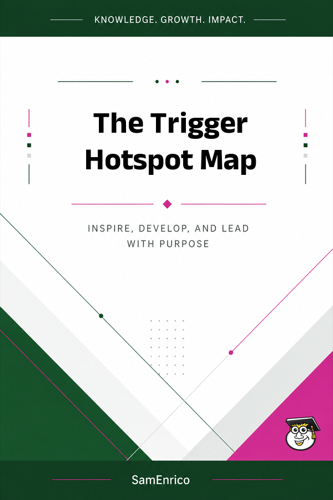
The Trigger Hotspot Map eBook
Pinpoints locations (home, work, car) where anger
Pinpoints locations (home, work, car) where anger most often occurs.
Formats
Free sample
Chapter 1: The Wrong Question--–- Every anger management book, every therapist, every well-meaning friend has asked you the same question. “What made you angry?” You’ve answered it a hundred times. The traffic. The email. The comment.
The mess. And yet, here you are, still angry, still blindsided, still wondering why you can’t seem to keep your lid on when everyone else appears to be coasting through life with serene smiles and unclenched jaws.The problem is not your answer. The problem is the question itself.For the past thirty years, the anger management industry has been built on a fundamental flaw. It has assumed that anger is primarily a matter of triggers—specific events, people, or comments that set you off. Find the trigger, the logic goes, and you can disarm it.
Breathe deeply. Count to ten. Walk away. These are not bad strategies. They are simply incomplete.
They treat anger as if it exists in a vacuum, as if the only thing that matters is the spark, not the gasoline-soaked rag sitting right next to it.This chapter introduces a radically different premise: your anger is not random, not a personality flaw, and not a mystery. It is location-based. Predictable. Mappable. And once you understand where your anger lives, you can stop being ambushed by it.The Case of the Kitchen Table Let me tell you about David.David was a project manager in his early forties.
He was successful, well-liked at work, and genuinely loved his family. He also screamed at them almost every single night. The trigger was always the same: dinnertime. His wife would ask a question—“How was your day?” or “What should we do this weekend?”—and David would explode. He would slam his fork down, push back from the table, and retreat to the garage to smoke a cigarette he didn’t even want.David had tried everything.
He had read three anger management books. He had tried counting to ten. He had even seen a therapist for six months. Nothing worked. The therapist had focused on his childhood, his relationship with his father, his stress at work.
All relevant. All true. And yet, every night, the same explosion at the same table.Then David started paying attention to something no one had asked him to track: location.He realized, almost by accident, that he never got angry at breakfast. Never at lunch. Never at the dinner table of a restaurant or a friend’s house.
Only at his own kitchen table. Only in the chair facing the cluttered counter. Only between 6:15 and 6:45 PM.This was not a coincidence. This was a pattern.David’s kitchen table was a Hotspot—a fixed, repeatable physical location where his brain had learned, over years of repetition, to pair the environment with an explosive emotional response. The trigger (his wife’s question) was just the match.
The Hotspot was the gasoline.When David finally understood this, everything changed. He didn’t need more therapy or better breathing techniques. He needed to move his chair.He did. He switched seats with his daughter, who had been sitting facing the window. Suddenly, his visual field was different.
The cluttered counter was behind him. He could see the backyard. His wife’s question sounded the same, but his response was different. The explosion didn’t come. Not that night, not the next, and not for the following thirty days.David was not an “angry person.” He was a person who had been repeatedly visiting an unmarked danger zone.
And no one had ever handed him a map.The Geography of Anger David’s story is not unusual. In fact, it is the rule, not the exception. After working with hundreds of clients and analyzing decades of anger research, a clear pattern emerges: the vast majority of people who believe they have “anger problems” do not explode randomly. They explode in the same places, over and over again.Let me prove this to you right now.Think back to the last three times you lost your temper. Not the small irritations—the real explosions.
The ones that left you feeling ashamed, exhausted, or confused. Now, as honestly as you can, answer these three questions:Where were you? (Be specific: the kitchen table, the driver’s seat of your car, your desk at work, the bathroom mirror.)What time of day was it?Who else was there, if anyone?If you are like ninety percent of the people who have taken this quiz, you will notice something startling. Your explosions did not happen in random locations. They happened in the same two or three places.
Maybe the commute home from work. Maybe the chair at the dinner table where you can see the mess. Maybe the desk where a particular coworker interrupts you at 3 PM every single day.These are your Hotspots. And until today, they have been invisible to you.This book introduces a new concept: Situational Anger Conditioning. It sounds technical, but it is actually quite simple.
Your brain is a prediction engine. It is constantly scanning your environment, looking for patterns, and preparing your body to respond. When you experience a strong emotion—especially anger—in a specific location, your brain begins to associate that location with that emotion. Over time, the location itself becomes a trigger, independent of whatever originally caused the anger.Think of it like a coffee cup stain on a blueprint. You can clean the cup (address the immediate trigger), but the stain remains on the map.
Every time you return to that location, your brain says, “Ah, this place again. Better get ready.” Your heart rate rises. Your jaw clenches. Your field of vision narrows. You haven’t even seen a trigger yet, and already your body is preparing for battle.This is why traditional anger management often fails.
It focuses on the cup, not the stain.The Hothead vs. The Hotspot Before we go any further, we need to make a critical distinction. Not all anger is the same. And not everyone who struggles with anger has the same underlying mechanism.Let me introduce you to two different people.First, meet Marcus. Marcus gets angry everywhere.
He yells at his kids in the morning, screams at drivers on the way to work, snaps at colleagues during meetings, and comes home to yell at his spouse about the dishes. Location doesn’t matter. Time doesn’t matter. His anger is a permanent, low-grade hum that escalates to explosion several times a day, in any environment.Marcus is a Hothead. His anger is global, random, and pervasive.
It is also relatively rare. Clinical research suggests that fewer than five percent of people who report anger problems fit this profile. Hotheads often have underlying neurological or psychiatric conditions—depression, intermittent explosive disorder, or complex trauma—that require professional treatment beyond self-help.Now meet Priya. Priya is a nurse. She is calm and competent at work.
She is patient with her colleagues and gentle with her patients. But every single night, within fifteen minutes of walking through her front door, she screams at her children. Not because they have done anything wrong—they are just…
This is the end of the free sample. Get the eBook to keep going. Buy now
About this book
Details
- Author
- Jolley Leonel
- Publisher
- SamEnrico
- Language
- English
- Genre
- Non-Fiction, Self-Help, Environmental
- Released
- 2026-06-11
- Pages (approx.)
- 132
- Available as
- eBook, Audiobook

Read better in the ZLOADR app
Your eBooks on your phone or tablet. Sign in with your SamEnrico account and start reading.
More by Jolley Leonel
 Menopause Metal Taste GuideJolley Leonel$11.99
 Creative Leadership Team GuideJolley Leonel$11.99
 The Workaholic's Decluttering GuideJolley Leonel$11.99
 SAS Falklands War MissionJolley Leonel$11.99
 Whispers in the Empty Quarter: The Djinn of the SandsJolley Leonel$11.99
 The Spice Road Chronicles: Dutch Explorers and the Secrets of the Ancient WorldJolley Leonel$11.99
 Cell Phone ForensicsJolley Leonel$11.99
 Understanding Functioning Pancreatic Endocrine TumorJolley Leonel$17.99
 How to Start a Printer and Monitor Connectors Business (Beginners Guide)Jolley Leonel$11.99
 Teaching English via WeChatJolley Leonel$12.99
 Cap Table Cleanup HandbookJolley Leonel$12.99
You may also like
 Hong Kong Handover 1997Dunn Johnnie$11.99
 Zumba For Postnatal Recovery CourseNeal Christian$11.99
 Zumba for BeginnersLadner Nikia$11.99
 YouTube Comment Mining GuideHumes Pandora$12.99
 Worry Box MeditationCarlin Rudy$11.99
 Workplace Stress MeditationNguyen Lynn$11.99
 Workplace Stress and Sleep RepairHawley Ivory$11.99
 Workplace Perfectionism CureDelaney Jeffry$11.99
 Workplace Injustice Anger GuideWallen Isabelle$11.99
 Work Addiction and Burnout LinkGreenwood Ester$11.99
 Women in Yoga and WellnessBeattie Galina$11.99
 Women in Stand Up ComedyChun Evangeline$11.99