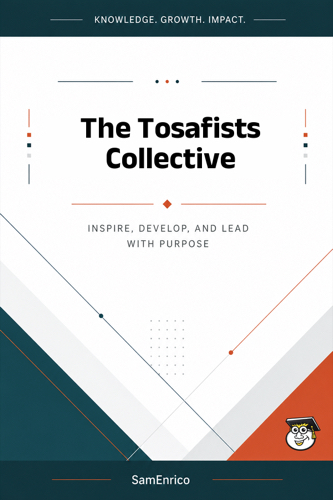
The Tosafists Collective eBook
Explores the French and German school of Talmudic
Explores the French and German school of Talmudic critics.
Formats
Free sample
Chapter 1: The Burning Question...--It begins, as so many great intellectual movements do, with a question that refuses to die. The question is simple enough to fit on a scrap of parchment, yet complex enough to consume a lifetime: What happens when your teacher is wrong? Not wrong about something trivial—not the proper way to tie a shoelace or the correct blessing over a questionable fruit—but wrong about the meaning of a sacred text. Wrong in a way that echoes across generations, shaping how thousands of Jews understand their obligations to God and to one another. The young men who gathered in the damp, candlelit study halls of 12th-century France and Germany asked this question every day.
They asked it in whispers, then in shouts, then in the margins of their manuscripts. Their answers would transform the Talmud from a closed book into an open question. Their answers would give birth to the Tosafot—the "additions" that are anything but incidental. This book is the story of those men, their collective, and the burning question that drove them.The world into which the Tosafists were born was not a world that encouraged questions. The late 11th and early 12th centuries were, for the Jews of Northern Europe, a time of devastation and dislocation.
The First Crusade of 1096 had swept through the Rhineland, leaving the Jewish communities of Mainz, Worms, and Speyer in ruins. Thousands had been murdered. Thousands more had chosen suicide over forced conversion, sanctifying God's name in an act of kiddush Hashem that was both heroic and horrifying. Those who survived did so in the shadow of church spires and castle walls, surrounded by a Christian majority that viewed them with suspicion at best and lethal hostility at worst. The Talmud—the vast, sprawling, Aramaic-Hebrew compendium of Jewish law, lore, and argument—was their anchor.
But the Talmud was also, for most Jews, nearly inaccessible. It had no punctuation, no standardized page numbers, no running commentary to explain its often cryptic reasoning. Studying Talmud without a guide was like navigating a forest without a compass.Enter Rashi. Rabbi Shlomo Yitzchaki, born in Troyes in 1040 and educated in the great German academies of Mainz and Worms, did something unprecedented. He wrote a running commentary on the entire Talmud that explained every difficult word, every missing premise, every implicit argument.
Rashi's commentary was a miracle of pedagogical clarity. He wrote in a clear, concise Hebrew that even advanced students could follow. He translated rare Aramaic terms into Old French (which he wrote in Hebrew characters, creating a unique linguistic hybrid). He provided the logical bridges that the Talmud's editors had left implied. By the time Rashi died in 1105, he had transformed the study of Talmud from an elite pursuit into a communal practice.
A Jew with a modest education could now open a tractate, read Rashi's commentary alongside the original text, and emerge with a genuine understanding of the legal discussion.But Rashi's very success created an unintended consequence—one that he could not have foreseen and might not have welcomed. As his commentary spread across the Jewish communities of France and Germany, students began to notice something troubling. Rashi's explanation of a passage in one tractate sometimes contradicted his explanation of a seemingly parallel passage in another tractate. His reading of a mishnah in Tractate Bava Metzia appeared to clash with his reading of a similar mishnah in Tractate Ketubot. His interpretation of a legal principle in the laws of Sabbath seemed at odds with his interpretation of the same principle in the laws of festivals.
These contradictions were not errors, exactly. They were the inevitable result of Rashi's pedagogical method. He explained each passage on its own terms, in its own context, without always reconciling his explanation with what he had written elsewhere. For Rashi, the goal was comprehension. For his students, the goal became consistency.Here is where our story truly begins.
The generation that followed Rashi—the generation that would become the Tosafists—faced a choice. They could accept the contradictions as the natural limitations of a human teacher. No one is perfectly consistent; why should Rashi be? Or they could attempt to resolve the contradictions, to demonstrate that underneath the surface disagreement lay a deeper harmony. They chose the latter.
And in that choice, they shifted the entire enterprise of Talmud study from commentary to criticism. Rashi had asked: What does this passage mean? The Tosafists asked: Why does this passage say this rather than that? How does it fit with every other passage on the same subject? What principle must we posit to make all the sources cohere?
This shift—from explanation to interrogation—was the birth of the Tosafist method.The word Tosafot itself is deceptively modest. It means "additions" or "supplements." But these were not mere footnotes to Rashi, not gentle corrections of the occasional oversight. The Tosafot were a new genre of writing altogether. They took the form of marginal glosses—short, dense, argumentative notes written in the margins of Talmud manuscripts, alongside Rashi's commentary. A typical tosafah (singular of Tosafot) begins not with a statement but with a question.
"Why does Rashi say X here when he says Y elsewhere?" Or: "The Talmud appears to contradict itself; how can we resolve it?" Or: "Our teacher Rabbenu Tam raised an objection; here is his answer." The tosafah assumes that the reader is already familiar with the basic text. It assumes that the reader wants more than comprehension; it wants coherence. It assumes that the truth is hidden beneath the surface and that the work of the student is to dig.This is not a small thing. The Tosafists were not merely improving on Rashi; they were redefining the purpose of Torah study. For Rashi, study was an act of preservation.
In the aftermath of the Crusades, when Jewish lives and Jewish books were being destroyed, Rashi's commentary made it possible for Jews to hold onto their tradition. For the Tosafists, study was an act of discovery. The tradition was not something to be preserved intact; it was something to be interrogated, tested, and ultimately understood at a deeper level. This was an audacious stance, especially in a culture that revered its elders and hesitated to contradict the great sages of the past. But the Tosafists were not iconoclasts.
They were not trying to tear down Rashi. On the contrary, they honored him by taking him seriously enough to disagree with him. As one Tosafist later wrote, "The words of the living God are in all of them"—meaning that even contradictory interpretations can be true if they reflect different facets of a single divine wisdom. The Tosafist project was not to choose between Rashi and the Talmud but to show that both could be right, if only one understood the underlying principle.The setting for this intellectual revolution was the beit midrash—the study hall. Unlike the formal, hierarchical academies of Babylonia, where students sat silently at the feet of a master, the French and German battei midrash were raucous, argumentative spaces.
Students sat on wooden benches or on the floor, their Talmuds open on slanted lecterns. The master—the rosh yeshivah—would lecture…
This is the end of the free sample. Get the eBook to keep going. Buy now
About this book
Details
- Author
- Holloway Sheldon
- Publisher
- SamEnrico
- Language
- English
- Genre
- Non-Fiction, Biography, Talmudic
- Released
- 2026-06-12
- Pages (approx.)
- 105
- Available as
- eBook, Audiobook

Read better in the ZLOADR app
Your eBooks on your phone or tablet. Sign in with your SamEnrico account and start reading.
More by Holloway Sheldon
 Murdoch New York Post TurnaroundHolloway Sheldon$11.99
 Cocaine Relapse Prevention Plan WorkbookHolloway Sheldon$11.99
 Family Taken TogetherHolloway Sheldon$11.99
 Adoptive Parental Anger InsightsHolloway Sheldon$11.99
 The Pink Panther’s Phantom: The 1976 Heist That Shocked MonacoHolloway Sheldon$11.99
 The Double Helix Conspiracy: How a Forgotten Scientist Cracked the Code of LifeHolloway Sheldon$11.99
 Understanding Bowen–conradi SyndromeHolloway Sheldon$17.99
 Executive Summary Metrics PlaybookHolloway Sheldon$12.99
 SAP Remote Business InternHolloway Sheldon$12.99
 Cisco InstructorsHolloway Sheldon$11.99
 Ultimate Handbook Guide to Qiongshan : (China) Travel GuideHolloway Sheldon$11.99