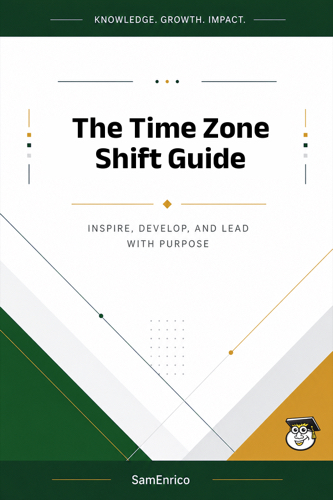
The Time Zone Shift Guide eBook
Adjust children's sleep to new time zones when tra
by Ibarra Inger
Adjust children's sleep to new time zones when traveling.
Formats
Free sample
Chapter 1: The Freight Train Lie--–- Every parent has heard it. You are standing in the airport, bleary-eyed, watching your three-year-old spin in circles at 11 PM while your six-month-old screams with the particular fury of a baby who should have been asleep four hours ago. A well-meaning traveler pats your shoulder and says, “Don’t worry. They’ll sleep when they’re tired.”It sounds like common sense. It sounds merciful.
It is, without exaggeration, one of the most dangerous lies in all of travel parenting.The truth is exactly the opposite. Children do not sleep when they are tired. They scream, they bounce off bulkheads, they ask for the seventh snack, they develop sudden passionate opinions about sock seams, and they laugh maniacally while you disintegrate inside. Then, when they finally crash, they wake up forty-five minutes later as if shot from a cannon. This is not bad behavior.
This is biology. And until you understand why it happens, you will keep losing the battle against time zones.Let me tell you about the first time I learned this lesson the hard way. My family flew from New York to London with our then-two-year-old daughter. I had done everything the internet said. I had booked a night flight.
I had packed pajamas. I had a portable white noise machine. I was so confident that I actually high-fived my husband as we boarded. “She’ll sleep the whole way,” I said. “We’ll land at 8 AM London time, and she’ll be fresh as a daisy.”She slept forty-three minutes.
Then she woke up, looked around the dark cabin with the expression of a tiny dictator who has just discovered a betrayal, and proceeded to sing “Wheels on the Bus” at full volume for the next six hours. Every time she dozed off during descent, the pressure change woke her screaming. By the time we landed, she had been awake for fourteen of the previous sixteen hours. She was not tired. She was a feral creature running on fumes and fury.
And then, because biology is cruel, she refused to sleep that night because she was, in the cruelest paradox of all, too exhausted to fall asleep.That is the freight train lie. The belief that exhaustion leads to sleep is true for adults. It is spectacularly false for most children under seven. This chapter will explain why, and it will give you the first essential tool for the rest of this book: understanding your child’s unique sleep biology so you can stop fighting it and start working with it.The Overtiredness Paradox: Why Exhausted Children Cannot Sleep Let us start with a concept that will appear throughout this book. I call it the overtiredness paradox, though sleep scientists call it something far less catchy: “paradoxical excitation.” Here is what happens inside a young child’s nervous system when they become overly tired.When an adult is exhausted, the body releases sleep-promoting chemicals like adenosine.
The brain gets heavy. The eyelids droop. Sleep comes like a slow tide. In a child, however, the immature nervous system interprets extreme fatigue as a threat. The brain’s alarm system—the amygdala—fires.
Cortisol and adrenaline surge. The child’s body says, essentially, “We are too tired to be safe, so we must stay awake at all costs.”This is an evolutionary hangover from infancy, when falling asleep in a dangerous environment could mean death. A tired baby who cried stayed near the caregiver. A tired baby who slept through a predator’s approach did not. Your child’s brain is not being difficult.
It is being ancient.The result is a child who looks wired, not tired. They may laugh hysterically, then cry, then throw a toy, then ask for a hug, all in sixty seconds. They may run in circles. They may fight every attempt at comfort. This is not manipulation.
This is a nervous system on fire.Here is the kicker: once a child crosses the overtiredness threshold, it becomes genuinely difficult for them to fall asleep. Even when they finally do, the sleep is fragmented. They wake more often. They wake earlier. The sleep they get is poor quality, which makes them more tired the next day, which makes the problem worse.
It is a downward spiral, and it is the single most common reason parents tell me, “We tried everything, and nothing worked.”The solution is not more sleep training or stricter schedules. The solution is preventing the overtiredness spiral before it starts. That means you cannot wait for your child to act tired. By the time they are acting tired, you have already lost. You must learn to read the early signs—the first subtle deceleration, the glazed eyes, the sudden stillness—and you must act immediately.
On a plane, in a new time zone, at 2 AM in a hotel room, this is the difference between a difficult night and a catastrophic one.The Internal Train Schedule: A Metaphor You Will Use Forever Throughout this book, I am going to ask you to picture your child’s circadian rhythm as a freight train. Not a passenger train that can switch tracks easily. A mile-long, fully loaded freight train barreling down a fixed track at sixty miles per hour.Your child’s internal clock is not flexible. It is rigid. It does not care about your vacation itinerary, your flight schedule, or your desperate need for coffee.
It runs on a track laid down by thousands of years of evolution, and that track expects light in the morning, darkness at night, food at predictable intervals, and sleep at very specific windows.When you cross time zones, you are asking that freight train to switch tracks instantly. It cannot. It will not. If you try to force it—by keeping a child awake too long, by putting them to bed too early, by expecting them to nap on command—you will derail the train. And a derailed freight train does not gently rerail itself.
It causes a spectacular, multi-car pileup that can take days to untangle.The only way to move a freight train to a new track is to nudge it. A few degrees at a time. You do not slam on the brakes and hope for the best. You ease the throttle. You let the momentum carry it gradually onto the new line.
This is exactly how you must treat your child’s sleep across time zones.The nudges come in three forms: light, food, and movement. Those are the only safe, drug-free levers you have. No supplement, no amount of willpower, no clever sleep sack will override the basic biology of the circadian system. But those three levers, used correctly and consistently, are extraordinarily powerful. They are the entire engine of this book.Light is the most important.
Your child’s brain reads light as the single most reliable signal for “day” and “night.” Morning light tells the brain to suppress melatonin and raise cortisol. Evening light does the opposite. Food is second: the gut has its own clock, and eating at the wrong time confuses the entire system. Movement is third but essential: physical activity…
This is the end of the free sample. Get the eBook to keep going. Buy now
About this book
Details
- Author
- Ibarra Inger
- Publisher
- SamEnrico
- Language
- English
- Genre
- Non-Fiction, Health & Wellness, Jet Lag
- Released
- 2026-06-07
- Pages (approx.)
- 132
- Available as
- eBook, Audiobook

Read better in the ZLOADR app
Your eBooks on your phone or tablet. Sign in with your SamEnrico account and start reading.
More by Ibarra Inger
 Psychological Safety For Group Creativity CourseIbarra Inger$11.99
 Innocence Project Idaho CasesIbarra Inger$11.99
 Chile Energy Efficiency LawIbarra Inger$11.99
 Strength Training for Weight LossIbarra Inger$11.99
 The Ballot Rebellion: How One City Defied a GovernorIbarra Inger$11.99
 The Heart Whisperer: Dr. Denton Cooley and the Birth of Artificial HeartsIbarra Inger$11.99
 How to Become a Cabin-equipment SupervisorIbarra Inger$11.99
 Understanding Chromosome 22, Monosome MosaicIbarra Inger$17.99
 Website Launch in One WeekIbarra Inger$12.99
 Customer Interview Script GuideIbarra Inger$12.99
 Hospital Maintenance MechanicIbarra Inger$11.99