
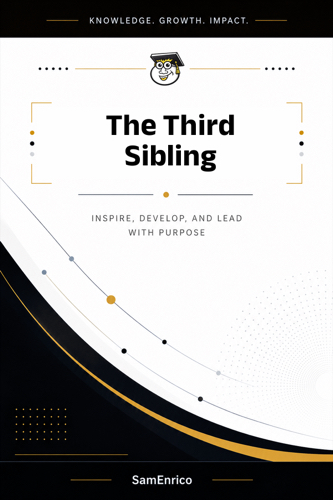
The Third Sibling eBook
The youngest child copes by becoming invisible, es
The youngest child copes by becoming invisible, escaping the rage aimed at the older two.
Formats
Free sample
Chapter 1: The Ghost Strategy...–- Every family has a storyteller. Most believe theirs is the truth. But the youngest child knows a secret the others don’t: the story they all tell—about the angry parent, the difficult oldest, the peacemaking middle—leaves out one character entirely. Her name is not mentioned because she learned, before she could tie her shoes, that being forgotten was the only way to survive.The family is not primarily a system of love. This is the first myth that must fall.
The family is a system of emotional regulation, and in some families, the regulating force is not affection but rage. Rage becomes the weather. It is not an event but a climate. Children born into this climate do not learn love first; they learn threat detection, strategic disappearance, and the geography of a parent’s fury. Among these children, one will learn a particular lesson so early and so thoroughly that it becomes not a choice but a reflex: the safest place to be is nowhere at all.That child is the third sibling.Not every third sibling.
Not every family. But in a specific, recognizable, and surprisingly common family configuration, the youngest child does not become the pampered baby of lore. She does not charm her way out of trouble. She does not demand attention or throw tantrums for the last cookie. Instead, she becomes invisible.
Not metaphorically—operationally. She learns to reduce her footprint. She learns to breathe quietly, to want nothing aloud, to need no one visibly. She learns that between her older siblings and their explosive parent, there is a small pocket of air where no one looks. She climbs into that pocket and stays there.This chapter introduces the core concept of The Third Sibling: the Ghost Strategy.
It is not a personality. It is not a choice. It is a passive survival adaptation developed before the age of five, encoded in the implicit memory of the nervous system, and reinforced by thousands of small moments in which being unseen proved safer than being seen. We will examine the three-sibling archetype system, the birth order trap, and the single most important distinction this book makes: invisibility works as short-term survival but fails as long-term development. Both statements are true.
Healing requires holding both without collapsing into either.The Three Sibling Archetypes In a high-rage family system—where a parent’s anger is chronic, unpredictable, and frightening—siblings do not relate to each other as equals. They are assigned, or more accurately they fall into, distinct survival roles. These roles are not chosen. They emerge from the intersection of birth order, temperament, opportunity, and the parent’s own history. The three archetypes described here are ideal types.
Real siblings will show mixtures, variations, and exceptions. But the pattern is recognizable enough to be useful.The Oldest: The Scapegoat. The firstborn in a rage-driven family often becomes the primary target. She arrived before the parent’s emotional collapse or before the parent developed any coping mechanisms. She was the first experiment in parenting, and when the parent’s own unresolved trauma or mental illness emerged, she was there to receive it.
The oldest remembers active rage: yelling, name-calling, physical punishment, threats, blame. She is told she is “too much,” “difficult,” “just like your father/mother.” Her rebellion, when it comes, is overt. She fights back, runs away, or collapses into visible self-destruction. Her trauma is legible. Teachers see it.
Relatives whisper about it. She is the problem child, the one everyone watches.The Middle: The Rescuer. The second child arrives into an already volatile system. She learns quickly that the oldest absorbs the worst of it, but that does not mean safety. The middle child develops a different strategy: she tries to manage the parent’s mood.
She becomes the mediator, the peacekeeper, the one who tells jokes at dinner to defuse tension, who cleans the kitchen before the parent comes home, who volunteers information to distract from the oldest’s latest offense. She is praised as “the easy one,” “so mature for her age,” “no trouble at all.” But this is not maturity. It is hypervigilance disguised as helpfulness. The middle sibling often grows into an adult who cannot tolerate conflict, who rushes to fix other people’s emotions, and who resents silently while smiling brightly.The Youngest: The Ghost. The third child enters a system where rage is already normalized.
The oldest has been scapegoated. The middle has become the rescuer. The parent’s pattern is established. The youngest does not need to be told to be careful—she feels it in the air. But she also notices something the others cannot see because they are too busy fighting or fixing: the parent’s rage is not infinite.
It has a target threshold. It focuses on the oldest, sometimes on the middle, but rarely on the youngest—if the youngest does nothing to attract it. The youngest learns, implicitly, that visibility is the variable. If she can make herself small enough, quiet enough, absent enough, the rage will pass her by. She becomes the Ghost.The Birth Order Trap The phrase “birth order trap” refers to the way family position masquerades as personality.
Families tell stories about their children: the responsible oldest, the flexible middle, the spoiled youngest. These stories are not neutral descriptions. They are instructions. A child who hears “you’re the baby” may learn to act helpless. A child who hears “you’re the strong one” may learn never to cry.
The birth order trap is the process by which a survival adaptation becomes a fixed identity.For the youngest in a high-rage family, the trap is particularly insidious. The family story often goes like this: “The oldest is difficult. The middle is the peacemaker. The youngest? Oh, she’s fine.
She never causes any trouble.” This sounds like praise. It is not. It is erasure. The youngest is “fine” because she has learned to produce no data. She has no needs that register, no emotions that leak out, no desires that inconvenience anyone.
She has perfected the art of taking up no space.The trap is that this adaptation becomes who she thinks she is. “I’m just a quiet person,” she tells herself. “I don’t like attention. I prefer to listen. I’m low-maintenance.” These are not personality traits.
They are the residue of survival. And they will, if left unexamined, shape every relationship, every job, every moment of her adult life.Invisibility as Passive Survival, Not Active Choice A critical distinction must be made here, and it must be made clearly. The youngest child does not decide to become invisible. This is not a strategy she researches, selects, and implements. It is not a conscious choice at all.Invisibility emerges from implicit learning.
The nervous system is a prediction machine. It takes in data from the environment—sounds, smells, facial expressions, vocal tones, the rhythm of footsteps—and builds a model of what is likely to happen next. A child growing up with a rageful parent collects thousands of data points: the parent yells, the oldest cries, the middle intervenes, the parent yells…
This is the end of the free sample. Get the eBook to keep going. Buy now
About this book
Details
- Author
- Dixon Brendan
- Publisher
- SamEnrico
- Language
- English
- Genre
- Non-Fiction, Sibling Dynamics
- Released
- 2026-06-08
- Pages (approx.)
- 122
- Available as
- eBook, Audiobook

Read better in the ZLOADR app
Your eBooks on your phone or tablet. Sign in with your SamEnrico account and start reading.
More by Dixon Brendan
 Wholesaling Escrow Process GuideDixon Brendan$11.99
 Mindful Stress Reduction for LawyersDixon Brendan$11.99
 Vertical Merger EnforcementDixon Brendan$11.99
 Rejection Resilience at WorkDixon Brendan$11.99
 Fabric Burn Test GuideDixon Brendan$11.99
 Rib Fracture Return to SportDixon Brendan$11.99
 Low Socioeconomic Childhood WorthDixon Brendan$11.99
 Behavioral Economics ReadingDixon Brendan$11.99
 The Jungle Whisperers: Alfred Russel Wallace and the Secrets of BorneoDixon Brendan$11.99
 Fenrir's Bane: The Wolf Who Shaped the GodsDixon Brendan$11.99
 The Vanishing of the SS Marine Sulphur QueenDixon Brendan$11.99
 How to Start a Hobby in GamblingDixon Brendan$11.99