
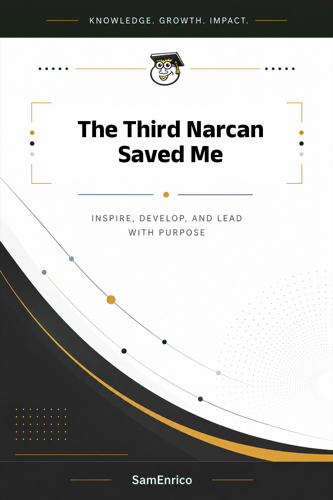
Non-FictionBiographyRelapse and Recovery
The Third Narcan Saved Me eBook
Repeated overdose survivor shares the brutal reali
Repeated overdose survivor shares the brutal reality of opioid relapse cycles.
Formats
Free sample
Chapter 1: The Warmth Before the Fall...--The first time I felt the ghost, I was lying on a twin bed in my childhood bedroom, the room still papered with the same blue-and-white striped wallpaper my mother had put up when I was nine. The orthopedic surgeon had told me to rest. The physical therapist had given me a list of exercises. The prescription bottle on my nightstand said: Take one tablet every four to six hours as needed for pain.I was nineteen years old. I had never missed a deadline, never failed a class, never even gotten detention.
I was the kind of kid who mowed the lawn without being asked, who showed up to family dinners with a bottle of wine for my mother, who held the door for strangers and said "yes sir" to my high school basketball coach. I was not the kind of kid who would spend the next fifteen years chasing a chemical ghost through gas station bathrooms and dealer apartments and the back of an ambulance.But that is the thing about ghosts. They do not announce themselves. They slip in through the cracks.I had torn my meniscus during a late-season practice—a jump shot, a bad landing, a pop I felt more than heard. The surgery was routine.
The recovery was supposed to be six weeks. I was supposed to be back on the court by March, in time for the community college playoffs. But I was not thinking about the playoffs when I swallowed that first pill. I was thinking about the warmth.The pill was a 5mg Percocet—the smallest dose they make. I took it with a glass of water, sitting up in bed, my leg propped on a pillow.
For the first forty minutes, nothing happened. I scrolled through my phone. I watched a video of a dog opening a refrigerator. I checked the score of a game I was not playing in. I felt the familiar low-grade disappointment of being exactly where I was.Then the warmth came.It started in my stomach, a slow bloom of heat like the first sip of coffee on a winter morning, but deeper, softer, more insistent.
It spread upward into my chest, loosening a knot I had not known was tight. It spread outward into my arms, my legs, my fingertips, until I could feel the pulse in my wrists, slow and steady, like the ticking of a clock I had forgotten to wind. My shoulders dropped. My jaw unclenched. For the first time in as long as I could remember, I stopped thinking.I did not feel high.
I did not feel euphoric. I did not feel the rush that people describe in movies, the needle-drop and the eyes-roll-back and the collapse into a velvet darkness. I felt okay. I felt the way I imagined normal people felt all the time—calm, present, unbothered by the million tiny anxieties that usually filled my skull. The voice that asked am I doing this right?
do they like me? what comes next? went silent. The room felt softer. The light from the window felt warmer.
I exhaled a breath I did not know I had been holding.I lay there for two hours, not moving, not wanting to move. I was not happy. I was not sad. I was simply enough.That is the trap. That is the ghost.The Neurological Lie I am not a scientist.
I barely passed chemistry in high school. But I have spent fifteen years learning about the way opioids work inside the human brain, because understanding the chemistry is the only way to forgive myself for the choices I made. Let me tell you what I have learned.The human brain has a reward system. It is ancient, evolutionarily conserved, designed to keep you alive. When you eat food, have sex, or win a competition, your brain releases a neurotransmitter called dopamine.
Dopamine is not pleasure itself. Dopamine is anticipation—the signal that says this is good, do this again. It is the reason you check your phone for notifications. It is the reason you eat the second slice of pizza.Most natural rewards produce a modest, sustainable dopamine release. A good meal might raise your dopamine levels by fifty percent above baseline.
Winning a game might double it. Cocaine raises dopamine by roughly three hundred percent. Methamphetamine by over a thousand.Opioids are different.Opioids do not primarily work on dopamine. They work on the brain's endogenous pain system—the mu-opioid receptors, which are scattered throughout the brain and spinal cord. When you take an opioid, it binds to these receptors and mimics the action of endorphins, the body's natural painkillers.
This produces two effects: physical pain is suppressed, and a sense of well-being is generated. But opioids also indirectly increase dopamine release in the nucleus accumbens, the brain's reward center. The result is a double hit—pain relief and reward—that no natural experience can replicate.That first Percocet raised my dopamine levels to roughly two hundred percent above baseline. But more importantly, it flooded my mu-opioid receptors with a synthetic agonist that felt, to my nineteen-year-old brain, like the solution to every problem I had ever had.Here is the cruel part: the brain adapts.Within hours of that first dose, my brain began downregulating its own opioid receptors. It pulled some of them back into the cell membrane, making them less available.
It reduced the efficiency of my endogenous endorphin system. It started to assume that this flood of external opioids was the new normal, and it adjusted accordingly.By the time I took the second Percocet the next morning, my brain was already less sensitive to opioids than it had been twenty-four hours earlier. I needed slightly more to feel the same effect. This is tolerance. It happens to everyone who takes opioids for more than a few days.
It is not a moral failing. It is neurobiology.The ghost I am chasing—the ghost I have been chasing for fifteen years—is not the first high. The first high is gone. It vanished the moment the second pill dissolved on my tongue. What I am chasing is the memory of that first high, a memory that grows more distorted and more desirable with every failed attempt to recapture it.
The ghost is not real. But the ghost is the most powerful thing I have ever known.The Prescription Phase For the next eighteen months, I was a functioning opioid user. I say "functioning" because no one knew. Not my mother, who worked double shifts as a nurse and came home too exhausted to notice the way my pupils narrowed after dinner. Not my younger brother, who was fifteen and preoccupied with his own adolescence, his own friends, his own escape routes.
Not my boss at the landscaping company, where I loaded trucks and mowed lawns and showed up on time every day because I needed the money to buy more pills.I got my opioids from three sources.The first was leftovers. My surgery gave me thirty Percocet. I finished them in a week. But my mother had Vicodin from…
This is the end of the free sample. Get the eBook to keep going. Buy now
About this book
Details
- Author
- Ziegler Winnie
- Publisher
- SamEnrico
- Language
- English
- Genre
- Non-Fiction, Biography, Relapse and Recovery
- Released
- 2026-06-10
- Pages (approx.)
- 135
- Available as
- eBook, Audiobook

Read better in the ZLOADR app
Your eBooks on your phone or tablet. Sign in with your SamEnrico account and start reading.
More by Ziegler Winnie
 Foreign Service Exam GuideZiegler Winnie$11.99
 Airline to Air Force PilotZiegler Winnie$11.99
 MDD Differential DiagnosisZiegler Winnie$11.99
 Career Transition for Construction WorkersZiegler Winnie$11.99
 Psychological Resilience Against RelapseZiegler Winnie$11.99
 Emotionally Neglected ChildhoodZiegler Winnie$11.99
 Disappointment In EducationZiegler Winnie$11.99
 Atomic Bomb Shelters and Civil DefenseZiegler Winnie$11.99
 The Last Broadcast: Naxalite Siege of the Indian ParliamentZiegler Winnie$11.99
 Love Letters from the trenches: The Secret Correspondence of a WWI Soldier and His PoetessZiegler Winnie$11.99
 The Silent Sands of Ice: Bedouin Guides in Antarctica's Frozen WildernessZiegler Winnie$11.99
 Understanding Argininosuccinic AciduriaZiegler Winnie$17.99
You may also like
 Hong Kong Handover 1997Dunn Johnnie$11.99
 Zumba For Postnatal Recovery CourseNeal Christian$11.99
 Zumba for BeginnersLadner Nikia$11.99
 YouTube Comment Mining GuideHumes Pandora$12.99
 Worry Box MeditationCarlin Rudy$11.99
 Workplace Stress MeditationNguyen Lynn$11.99
 Workplace Stress and Sleep RepairHawley Ivory$11.99
 Workplace Perfectionism CureDelaney Jeffry$11.99
 Workplace Injustice Anger GuideWallen Isabelle$11.99
 Work Addiction and Burnout LinkGreenwood Ester$11.99
 Women in Yoga and WellnessBeattie Galina$11.99
 Women in Stand Up ComedyChun Evangeline$11.99