
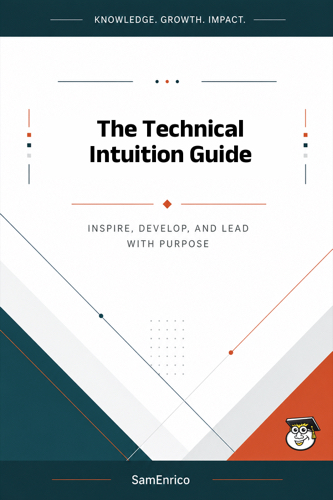
The Technical Intuition Guide eBook
Trust and develop gut feelings for design decision
by Hewitt Tresa
Trust and develop gut feelings for design decisions without abandoning engineering rigor.
Formats
Free sample
Chapter 1: The Lie You Were Taught--It begins in engineering school, usually in the second year, sometime between Thermodynamics and Mechanics of Materials. You are staring at a problem set. The numbers are clean. The assumptions are stated in bold. The answer, you know, is waiting somewhere at the back of the professor's solution manual, precise and singular.
You solve it. You get an A. You graduate. And somewhere in that process, without anyone ever saying it out loud, you absorb a dangerous lesson: If you cannot calculate it, it does not count.This is the lie.Not that calculation matters. It does.
Cathedrals stand because someone did the math. Bridges carry traffic because someone checked the load paths. Airplanes fly because someone verified the stress margins. Calculation is the floor beneath every reliable structure ever built. The lie is not that analysis is important.
The lie is that analysis is sufficient.Walk into any engineering firm and ask the senior engineers, the ones with thirty years of grey hair and cracked safety glasses, how they really make decisions. They will tell you stories that never appear in textbooks. They will tell you about the time they looked at a design that passed every simulation and thought, Something is wrong. They will tell you about the feeling in their chest when a vendor proposed a cheaper material, the unease that made them run one more test, the test that saved millions. They will tell you about the engineer's paradox: they knew the answer before they could prove it.The technical world has a dirty secret.
The people who design the most reliable systems in existence—nuclear plants, spacecraft, medical devices—do not rely exclusively on math. They rely on a faculty that engineering schools systematically atrophy. They rely on intuition.But not the fuzzy, mystical, "I feel it in my bones" kind of intuition that gets dismissed in design reviews. Something harder. Something earned.
Something that can be tested, verified, and trusted without abandoning the rigor that keeps the lights on and the bridges standing.This book is about building that faculty.The Cult of Pure Analysis How did we get here? How did a profession built by cathedral builders, bridge designers, and machine inventors come to distrust one of its most essential tools?The answer begins in the scientific revolution, when Galileo and Newton demonstrated that mathematics could predict the physical world with stunning accuracy. For the first time, an engineer could calculate the stress on a beam before it cracked, the trajectory of a cannonball before it landed, the pressure in a boiler before it burst. This was magic. This was power.
And it was rightfully celebrated.But power calcifies. What began as a tool became a dogma. By the twentieth century, engineering education had transformed into a religion of pure analysis. The curriculum emphasized mathematical rigor at the expense of everything else. Drawing was demoted from a core skill to an elective.
Hands-on shop experience became optional. The messy, intuitive, visual reasoning that had built the pyramids and the Roman aqueducts was swept aside in favor of differential equations and finite element analysis.The historian Eugene Ferguson, in his essential book Engineering and the Mind's Eye, called this transformation a kind of amputation. He argued that by privileging analytical thinking over visual and intuitive reasoning, engineering education had cut off a vital cognitive limb. The result, Ferguson warned, was a generation of engineers who could calculate anything but understand nothing—professionals who trusted their models more than their eyes.Consider the case of the Kansas City Hyatt Regency walkway collapse in 1981. Two overhead walkways crashed onto a tea dance floor, killing 114 people and injuring 216 more.
The disaster was not caused by a failure of calculation. The calculations were correct. The failure was a failure of intuition—a failure to look at a design change and feel the wrongness of it. A simple change in rod connections doubled the load on critical nuts, but no engineer stopped and said, "This feels dangerous." The math said it worked. The math was wrong because the assumptions were wrong.
But no one's gut raised the alarm loudly enough to override the spreadsheet.That is the cost of the lie. Not just millions of dollars. Lives.The Engineer's Paradox Here is a strange fact about expertise: the more you know, the less you can explain how you know it.Chess masters cannot fully articulate why they choose one move over another. They simply see it. Experienced firefighters cannot always describe why they order an evacuation before a building collapses.
They feel it. And engineers, despite their protestations, are no different.I have interviewed dozens of senior engineers across aerospace, civil, software, and mechanical disciplines. I asked each of them the same question: "Tell me about a time you made a correct design decision that you could not fully justify with data at the time you made it."Every single one had a story.A structural engineer described looking at a steel connection detail and thinking, "That weld is going to crack," even though the code said it was fine. She ordered an ultrasound inspection. The inspection revealed micro-fractures.
The fabricator had used the wrong filler metal. The engineer saved a building. When asked how she knew, she shrugged. "I just knew. I'd seen it before."A software architect described reviewing a distributed database design that passed every performance benchmark.
He felt uneasy about the replication strategy. He could not articulate why. He pushed the team to run a chaos engineering test, simulating network partitions. The database failed catastrophically. The fix took two weeks.
Without his unease, it would have failed in production at three in the morning. "My subconscious had noticed something my conscious mind hadn't processed yet," he said. "It felt like a pattern I'd seen in a different system five years earlier."A mechanical engineer described a gearbox design that met all torque requirements. Something about the tooth profile bothered him. He spent a weekend building a simple physical model out of LEGOs and testing it by hand.
The model jammed at a specific load. He went back to the calculations and discovered a second-order harmonic effect that the original model had missed. "I couldn't have found that without the LEGOs," he said. "And I wouldn't have built the LEGOs without the feeling."This is the Engineer's Paradox: the most experienced practitioners frequently report that a solution feels right long before they can prove it mathematically. They are not psychic.
They are not irrational. They are performing high-speed, subconscious pattern recognition based on thousands of prior experiences—a database of failures and successes that no spreadsheet can replicate.The paradox is only a paradox if you believe that all valid knowledge must be explicit and articulable. It is not. Some of the most valuable knowledge an engineer possesses is tacit, visual, and intuitive. The job of this book is to help you honor that knowledge without abandoning the verification processes that prevent catastrophic failure.What This Book Is Not Before we go further, let me clear up some potential misunderstandings.This book is not an argument against calculation.
I am not suggesting that you should close your spreadsheet and "go with your feelings." The engineers who trusted their…
This is the end of the free sample. Get the eBook to keep going. Buy now
About this book
Details
- Author
- Hewitt Tresa
- Publisher
- SamEnrico
- Language
- English
- Genre
- Non-Fiction, Self-Help, Intuition
- Released
- 2026-06-07
- Pages (approx.)
- 140
- Available as
- eBook, Audiobook

Read better in the ZLOADR app
Your eBooks on your phone or tablet. Sign in with your SamEnrico account and start reading.
More by Hewitt Tresa
 The Alligarh Movement Pre 1857Hewitt Tresa$11.99
 House Dreams For ChildrenHewitt Tresa$11.99
 Work Addiction Recovery For WomenHewitt Tresa$11.99
 Melatonin Dream Effects LogHewitt Tresa$11.99
 Malian Tuareg EscapeHewitt Tresa$11.99
 Morning Walking RitualHewitt Tresa$11.99
 The Orphan Dream FigureHewitt Tresa$11.99
 Riding The Pain WaveHewitt Tresa$11.99
 The Volturno Line: Italy's Forgotten Stand (1943)Hewitt Tresa$11.99
 The Last Song of the Vodyanoy: A Slavic River’s LamentHewitt Tresa$11.99
 From Rags to Riches: The Unlikely Rise of SpanxHewitt Tresa$11.99
 Understanding Acute Necrotizing Ulcerative GingivitisHewitt Tresa$17.99
You may also like
 Hong Kong Handover 1997Dunn Johnnie$11.99
 Zumba For Postnatal Recovery CourseNeal Christian$11.99
 Zumba for BeginnersLadner Nikia$11.99
 YouTube Comment Mining GuideHumes Pandora$12.99
 Worry Box MeditationCarlin Rudy$11.99
 Workplace Stress MeditationNguyen Lynn$11.99
 Workplace Stress and Sleep RepairHawley Ivory$11.99
 Workplace Perfectionism CureDelaney Jeffry$11.99
 Workplace Injustice Anger GuideWallen Isabelle$11.99
 Work Addiction and Burnout LinkGreenwood Ester$11.99
 Women in Yoga and WellnessBeattie Galina$11.99
 Women in Stand Up ComedyChun Evangeline$11.99