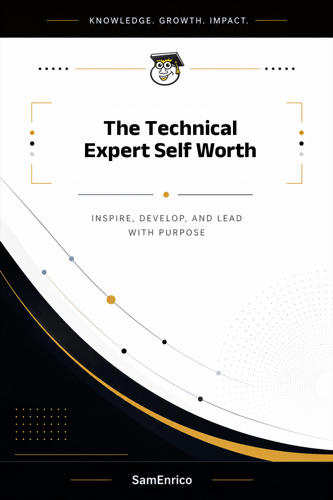
The Technical Expert Self Worth eBook
Confidence for engineers and IT professionals.
Confidence for engineers and IT professionals.
Formats
Free sample
Chapter 1: The Compilation Error--–- Sarah had been a senior backend engineer for exactly four years, eleven months, and three days when she froze. The occasion was not a production outage, not a security breach, not a impossible deadline. It was a code review. A junior developer had submitted a pull request with a small but significant logic error in a sorting algorithm. Sarah knew the error instantly.
She knew the fix instantly. She opened her mouth to explain it, and nothing came out. Not because she had forgotten the answer. Because in that split second between knowing and speaking, her brain whispered: What if you are wrong? What if everyone realizes you have been guessing for five years?
What if this is the moment they discover you are a fraud?She closed her mouth. She approved the pull request without comment. The error went to production. A week later, the sorting bug caused a cascading failure in a reporting dashboard. No one traced it back to Sarah.
She traced it back to herself every single night for the next three months.If you have never experienced this kind of moment, this book is not for you. Put it down and go do something else. But if you have felt that cold spike of terror in a meeting, a code review, a performance evaluation, or even just staring at your own IDE, then you already know something that most self-help books refuse to admit: Traditional confidence advice was not written for analytical brains.Why "Fake It Till You Make It" Fails Engineers Let us examine the most common confidence advice in circulation: Fake it till you make it. Pretend to be confident. Adopt the posture of certainty.
Speak as if you know. Eventually, the fiction becomes reality.For an engineer, this advice is not merely unhelpful. It is actively destructive. Here is why.Your brain has been trained—by years of debugging, testing, and verifying—to detect logical inconsistencies. When you try to "fake" confidence, your mind immediately runs a validation check.
It asks: Is this claim supported by evidence? If the answer is no—and it almost always is, because confidence cannot be manufactured without evidence—your brain flags the attempt as a logical error. You do not become confident. You become more acutely aware that you are pretending. And pretending, for someone who values truth and accuracy, feels like lying.The engineer's mind is wired for rigorous self-assessment.
That is not a flaw. It is the source of your technical excellence. You catch edge cases because you think systematically. You find bugs because you question assumptions. You write reliable code because you test before you trust.
These same cognitive habits, when turned inward, become the engine of imposter syndrome.Consider the difference between a marketer and an engineer facing uncertainty. A marketer might say: "I believe this campaign will perform well." If asked for evidence, they might gesture at past trends, intuition, market research. The standard of proof is probabilistic. An engineer, asked to justify a technical decision, is expected to produce replicable evidence, test results, edge case analysis. The standard of proof is empirical.When you apply that empirical standard to your own competence, you will always find gaps.
Always. Because no engineer knows everything. The field is too vast. The pace of change is too rapid. The depth of any single subdomain is too deep.
If you require complete, verifiable knowledge before you allow yourself to feel confident, you will never feel confident. That is not a personal failing. That is a mathematical certainty.The Compilation Error Model Let me introduce a framework that will guide this entire book. I call it The Compilation Error Model of self-worth.Imagine your brain as a compiler. You write a program called "I am a competent engineer." You run the compiler.
The compiler checks for syntax errors, missing dependencies, undefined variables. It finds one small unknown—a framework you have not used, a concept you cannot explain, a bug you failed to solve. The compiler throws an error.In a healthy system, you would examine the error, fix the specific line of code, and recompile. But the imposter syndrome compiler does not work that way. When it hits an error, it does not flag the line.
It flags the entire codebase. It says: Compilation failed. The whole program is invalid. You are not a competent engineer. You are not an engineer at all.
Start over from scratch.This is why the more you learn, the more inadequate you feel. Every new piece of knowledge reveals ten new unknowns. Every solved problem exposes ten harder problems. A fixed mindset interprets this as evidence of insufficiency. A growth mindset—and we will talk extensively about Carol Dweck's work in this book—interprets this as the natural shape of learning.But even a growth mindset is not enough on its own.
You need a specific, repeatable, technical method for distinguishing between legitimate knowledge gaps and emotional fear masquerading as fact. That method is coming next.The Core Distinction: Self-Worth vs. Self-Trust Before we go further, I need to resolve a potential contradiction that sharp readers will notice. Throughout this book, I will sometimes speak as if your self-worth is stable, unchanging, and not dependent on your achievements. Other times, I will give you exercises for building confidence, accumulating evidence, and earning self-trust.
Which is it? Is worth innate or earned?The answer is both. And the distinction matters more than almost anything else in this book.Self-worth is your stable core. It is the irreducible fact of your dignity as a human being and as a technical professional. It does not fluctuate with your successes or failures.
It is not diminished by a bug, a bad review, or a gap in your knowledge. It is the main branch of your identity—always there, always versioned, never deleted.Self-trust is your dynamic surface. It is built and rebuilt daily through kept promises, completed actions, and evidence of reliability. When you say you will open the IDE for five minutes and you do it, your self-trust increases by one unit. When you say you will learn Kubernetes and you do not, your self-trust decreases.
Self-trust is the feature branch of your identity—changed by every commit, merged or rejected based on your actions.Here is why this distinction saves you from contradiction: Imposter syndrome attacks your self-trust, not your self-worth. But because you have never learned to separate the two, you experience an attack on your self-trust as an attack on your very worth. When you fail to solve a bug, you do not think "I have temporarily lost trust in my problem-solving abilities." You think "I am a fraud and everyone will find out."This book focuses on rebuilding self-trust because that is the part you can actually change. Your worth was never broken. It does not need fixing.
But your trust in yourself—your ability to rely on your own mind, your own skills, your own judgment—that may be shattered. And it can be rebuilt, one small commit at a time.The Feynman Technique for Self-Assessment Richard Feynman, the Nobel Prize-winning physicist, had a…
This is the end of the free sample. Get the eBook to keep going. Buy now
About this book
Details
- Author
- Mcgovern Verona
- Publisher
- SamEnrico
- Language
- English
- Genre
- Non-Fiction, Self-Help, Tech Careers
- Released
- 2026-06-05
- Pages (approx.)
- 130
- Available as
- eBook, Audiobook

Read better in the ZLOADR app
Your eBooks on your phone or tablet. Sign in with your SamEnrico account and start reading.
More by Mcgovern Verona
 Creator Community BuildingMcgovern Verona$11.99
 Hospital Initiation of MATMcgovern Verona$11.99
 GDPR Enforcement Year ReviewMcgovern Verona$11.99
 Kissi Nomoli Art GuideMcgovern Verona$11.99
 John Singer Sargent: The Portraitist Who Captured Gilded Age AmericaMcgovern Verona$11.99
 Understanding Prader–willi SyndromeMcgovern Verona$17.99
 Collecting MatchboxesMcgovern Verona$11.99
 Ticket Resale GuideMcgovern Verona$12.99
 GA4 User Acquisition ReportMcgovern Verona$12.99
 How to Become a Optical-effects-camera OperatorMcgovern Verona$11.99