
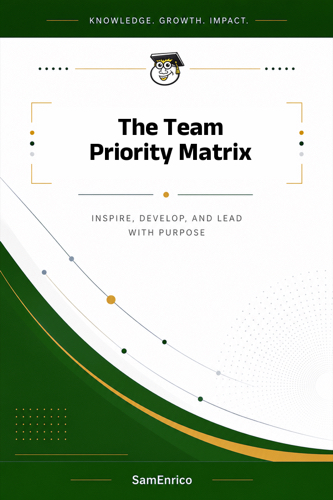
The Team Priority Matrix eBook
Use Eisenhower quadrant for collaborative task man
Use Eisenhower quadrant for collaborative task management and delegation.
Formats
Free sample
Chapter 1: The Busyness Trap--–- Sarah had done everything right. She had hired the best talent, invested in team-building retreats, and championed an “open door” policy that encouraged transparency. Her team of twelve marketing specialists regularly worked late, answered emails on weekends, and never missed a deadline. By every traditional measure, they were exemplary. Yet when the quarterly results arrived, Sarah felt the floor drop beneath her.
Revenue had flatlined. Customer engagement had slipped. And the signature product launch she had promised the board was delayed—again. The numbers were undeniable: her “hero” team was failing while working harder than ever.This contradiction—high effort, low impact—is the central crisis of modern teamwork. It is not a problem of laziness, incompetence, or poor intention.
It is a problem of signal failure. When every team member operates on their own private definition of “urgent” and “important,” the group does not move in one direction. It fragments. Some pull toward client crises. Others chase internal projects.
Still others spend their days responding to the loudest voice in the room. The result is not collaboration but collision. And the hardest truth is this: most leaders do not see it happening until the damage is already done.This book exists because that damage is preventable. The solution is not to work harder, longer, or faster. It is to replace individual judgment with a shared framework—a single, visual, collaborative tool that answers one question for every task: Does this move our agreed-upon strategic goal forward?
That tool is the Team Priority Matrix. And before we build it, we must first understand why your team is likely trapped in the very condition this matrix was designed to cure: the Busyness Trap.The Performance Paradox: Why Hard Work Fails The Busyness Trap has a specific anatomy. It begins with good intentions. A leader asks for more output. A team responds by saying “yes” to everything.
Deadlines tighten. Meetings multiply. The culture begins to celebrate the visible signs of effort—late-night Slack messages, full calendars, quick responses. Activity becomes the proxy for productivity. And because everyone is moving, no one questions whether they are moving in the right direction.This is the Performance Paradox: the harder a team works without a shared prioritization system, the worse their strategic results become.
Academic research on team effectiveness confirms this counterintuitive pattern. A landmark study of 442 teams across industries found that the strongest predictor of poor strategic outcomes was not low effort or low skill—it was what researchers called “undifferentiated urgency.” Teams that treated every task as equally important completed more tasks but achieved fewer meaningful goals. They were busy. They were not effective.Consider the difference between activity and productivity. Activity is responding to every email, attending every meeting, saying yes to every request, and measuring progress by hours logged or boxes checked.
Productivity is completing a project milestone that meaningfully advances a strategic objective, solving a problem that directly impacts customer retention, or building a capability that reduces future firefighting. Activity feels good. Productivity delivers results. The Busyness Trap confuses the former for the latter.Sarah’s team exemplified this confusion. Her content specialist, Marcus, produced three blog posts per week—a grueling pace.
But the posts were reactive, responding to competitor moves rather than a strategic content calendar. Her social media manager, Priya, ran five daily campaigns but had no visibility into which campaigns actually drove conversions. Her project manager, David, attended eleven recurring meetings weekly, spending twenty-two hours in rooms where decisions were rarely made. Every person was busy. No one was aligned.The trap has three psychological springs that keep it shut.The Three Springs of the Busyness Trap Spring One: The Urgency Bias Human brains are wired to prioritize immediate threats over future opportunities.
This is called the urgency bias, and it served our ancestors well when the threat was a predator. But in a modern team environment, the urgency bias creates a systematic distortion: tasks with close deadlines feel more important than tasks with strategic weight, regardless of their actual value.When a client sends an email marked “urgent,” your brain releases a small pulse of cortisol. When a colleague pings you on Slack, the notification triggers a dopamine anticipation loop. These physiological responses are not signs that the task matters. They are signs that the task is near.
The Busyness Trap exploits this bias by rewarding the loudest, closest, most recent demand—not the most important one.In Sarah’s team, the urgency bias manifested as a “last in, first done” culture. The most recent email or Slack message became the team’s top priority, regardless of whether it aligned with quarterly goals. Strategic projects with distant deadlines languished while reactive firefighting consumed every hour. By the time the launch deadline arrived, the team had spent so much time on “urgent” client requests that they had neglected the foundational work required to launch at all.Spring Two: The Visibility Fallacy Teams often celebrate what they can see rather than what matters. This is the visibility fallacy: work that produces visible artifacts (emails sent, meetings attended, reports produced) is rewarded over work that produces invisible but strategic outcomes (problem prevention, system improvement, relationship building).A team member who sends fifty emails appears productive.
A team member who prevents a crisis by fixing a root cause appears to do nothing. A manager who attends ten meetings appears committed. A manager who declines eight meetings to protect strategic time appears disengaged. The Busyness Trap systematically rewards visible activity and punishes invisible strategic work.Sarah realized this fallacy when she reviewed her own calendar. She had attended forty-seven meetings in the previous month.
She could remember only three that produced a clear decision. The rest were status updates, information pushes, or recurring blocks that no one had questioned in years. She looked busy. She was not leading.Spring Three: The Hero Incentive Most team cultures have an unspoken hero incentive: the person who works late, answers weekend emails, and sacrifices personal time receives praise, promotions, and recognition. The hero incentive feels like a reward for dedication.
In practice, it is a penalty for efficiency.When a team member works sixty hours to complete what could be done in forty, the culture learns that slow work is virtuous. When a leader personally solves a crisis instead of delegating, the culture learns that dependence is rewarded. When a team celebrates the person who responds fastest rather than the person who responds most thoughtfully, the culture learns that speed matters more than substance.The hero incentive is seductive because heroes are easy to see. They are the ones staying late, skipping lunch, and answering emails from vacation. But heroes are also bottlenecks.
Every task that passes through a hero’s hands is a task that no one else learned to do. Every crisis the hero solves is a crisis whose root cause remains unaddressed. Heroes keep teams busy. Heroes do not keep teams strategic.Sarah’s team had three heroes, and she was the biggest one. She reviewed every piece of content before publication, answered every client escalation personally, and stayed on calls until every question was resolved.…
This is the end of the free sample. Get the eBook to keep going. Buy now
About this book
Details
- Author
- Redman Garland
- Publisher
- SamEnrico
- Language
- English
- Genre
- Non-Fiction, Self-Help
- Released
- 2026-06-07
- Pages (approx.)
- 134
- Available as
- eBook, Audiobook

Read better in the ZLOADR app
Your eBooks on your phone or tablet. Sign in with your SamEnrico account and start reading.
More by Redman Garland
 DBT For Depression SkillsRedman Garland$11.99
 Workaholism for VeteransRedman Garland$11.99
 Teacher Who Changed LivesRedman Garland$11.99
 Breath Awareness For ChildrenRedman Garland$11.99
 Interstitial Cystitis GuideRedman Garland$11.99
 Rudolf Steiner AnthroposophyRedman Garland$11.99
 Pomodoro Deep Work IntegrationRedman Garland$11.99
 The Diamond Run: Moscow's Gold Heist in the Heart of AfricaRedman Garland$11.99
 Baba Yaga’s Enchanted Quest: The Knight Who Rode the NeedleRedman Garland$11.99
 How to Produce Hair WreathsRedman Garland$11.99
 How to Produce Straight PinsRedman Garland$11.99
 Citing Translations GuideRedman Garland$12.99
You may also like
 Hong Kong Handover 1997Dunn Johnnie$11.99
 Zumba For Postnatal Recovery CourseNeal Christian$11.99
 Zumba for BeginnersLadner Nikia$11.99
 YouTube Comment Mining GuideHumes Pandora$12.99
 Worry Box MeditationCarlin Rudy$11.99
 Workplace Stress MeditationNguyen Lynn$11.99
 Workplace Stress and Sleep RepairHawley Ivory$11.99
 Workplace Perfectionism CureDelaney Jeffry$11.99
 Workplace Injustice Anger GuideWallen Isabelle$11.99
 Work Addiction and Burnout LinkGreenwood Ester$11.99
 Women in Yoga and WellnessBeattie Galina$11.99
 Women in Stand Up ComedyChun Evangeline$11.99