
Non-FictionSelf-HelpKnowledge Management
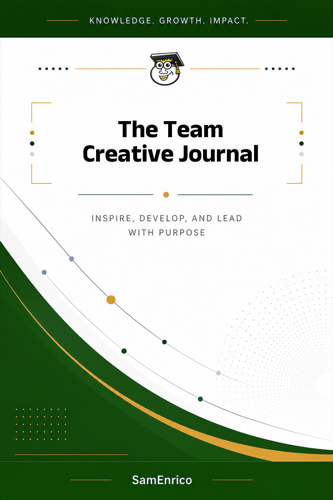
The Team Creative Journal eBook
Shared log of ideas, experiments, and creative lea
Shared log of ideas, experiments, and creative learnings over time.
Formats
Free sample
Chapter 1: The Lost Idea Tax...-- A software team spends three days debugging a production issue. On the fourth day, a junior developer says, “Actually, we solved this exact problem eight months ago. It’s in a Slack thread somewhere.” Two hours of searching later, they find it. The fix takes ten minutes. That is the lost idea tax.
It is not a tax on money—though money is certainly lost. It is a tax on attention, on momentum, on the slow erosion of confidence that happens when a team realizes they cannot trust their own collective memory. Every team pays this tax. Most never calculate the bill.This chapter is an intervention. Before we build the journal, before we design the workflows or train the habits, we must first understand the problem we are solving.
The lost idea tax is not a minor inconvenience. It is a structural inefficiency embedded in how most creative teams operate. By the end of this chapter, you will be able to calculate what this tax is costing your team in real terms. More importantly, you will see why a shared creative journal is not a nice-to-have artifact but a competitive necessity.The Anatomy of a Lost Idea Ideas are not born fully formed. They begin as fragments: a half-sentence in a meeting, a scribble on a whiteboard, a Slack message sent at 11:47 PM, a verbal agreement made in the hallway, a hypothesis tested but never documented.
Each of these fragments contains potential energy. But potential energy that is not captured is energy that will be spent again.Let us define what we mean by a lost idea. An idea is lost when it meets three conditions. First, someone on the team thought it. Second, it was not recorded in a place where the team can reliably find it later.
Third, the team later needed that same idea again. The gap between the second and third condition is the tax. It is the labor of rediscovery, the cost of rethinking, the friction of re-explaining.Consider the most common graveyards of lost ideas:Slack threads. A typical team of eight people generates approximately 1,200 messages per week. Of those, roughly 15 percent contain some form of insight—a decision, a discovery, a warning, a clever workaround.
But Slack is a firehose, not an archive. Messages scroll into oblivion within 48 hours. Searching Slack is possible but unreliable. People use different keywords. Threads get buried.
Links expire. According to a 2022 study by the productivity analytics firm Fathom, the average knowledge worker spends 1.8 hours per week searching for information that exists somewhere but cannot be found. Extrapolate that to a ten-person team, and you lose nearly 900 person-hours per year—more than twenty full workweeks—to the simple act of looking for something you already knew.Meeting recordings and transcripts. Many teams record meetings. Few ever rewatch them.
A recorded meeting is not a captured insight; it is a bet that someone will have the patience to sit through forty-five minutes of discussion to find the one relevant sentence. That bet almost never pays off. Transcripts are marginally better but still require searching, scrolling, and interpreting. The problem is not that meetings lack value. The problem is that value is embedded in an unusable format.Sticky notes and whiteboards.
There is a specific tragedy unique to creative work. A team spends an hour mapping out a complex problem on a whiteboard. The diagram is beautiful. It captures relationships, trade-offs, uncertainties. Then the meeting ends.
Someone takes a photo with their phone. That photo sits in a camera roll among hundreds of other photos. It is never tagged, never transcribed, never integrated. A week later, no one can find it. Or they find it but cannot remember what the orange arrow meant or why that circle was dotted.
The whiteboard is erased. The insight is gone.Verbal agreements. The most dangerous lost ideas are the ones that never become text at all. A designer and an engineer agree in a hallway conversation that they will revisit a feature after the next release. No one writes it down.
Two weeks later, the designer asks why the feature has not changed. The engineer has no memory of the conversation. Neither does the product manager, who was not there. The agreement evaporates, and with it, the alignment.Personal notes and private documents. Some team members are diligent.
They keep their own notebooks, their own text files, their own personal wikis. This is better than nothing, but it creates a new problem: fragmentation. When insights live in individual silos, the team cannot benefit from them collectively. The senior engineer who documented a workaround leaves the company. The workaround leaves with them.
The remaining team members rediscover the same problem six months later. The tax is paid again.Idea Debt: The Silent Accumulator The concept of technical debt is familiar to anyone who has worked in software development. It is the cost of choosing a quick, imperfect solution today that will require rework later. The lost idea tax operates on the same principle, but it applies to knowledge rather than code. Call it idea debt.Idea debt accumulates whenever a team learns something but does not record it in a shareable, searchable, structured format.
Every undiscovered insight becomes an interest payment waiting to happen. The longer the insight remains unrecorded, the more likely the team is to encounter the same problem again—and the more time they will waste rediscovering what they already knew.Here is how idea debt grows. Imagine a team of five people working on a product. In week one, they learn three things: a particular API has a hidden rate limit, a certain color combination fails accessibility standards, and a competitor is launching a feature that changes the market landscape. None of these insights are logged in a shared journal.
They exist only in the team’s short-term memory and scattered notes.By week four, those three insights have faded. The team has had fifteen more meetings, made forty more decisions, and generated dozens of new fragments. The probability that anyone remembers the API rate limit is now low. The probability that someone will trigger that rate limit and spend hours debugging it is now high. That debugging time—two hours, four hours, maybe a full day—is the interest payment on the original unrecorded insight.Now multiply that across an entire organization.
A study by Panopto (2020) surveyed 1,000 knowledge workers and found that the average employee spends 5.3 hours per week waiting for information from colleagues or recreating information that already exists. That is 265 hours per year per person. For a fifty-person company, that is 13,250 hours—more than six full-time employees’ worth of labor—spent not on creating new value but on rediscovering old knowledge.The lost idea tax is not a rounding error. It is a line item on your profit and loss statement that you have never bothered to measure.Three Stories of Tax Paid Let us make this concrete with three anonymized stories from real organizations. The names have been changed, but the numbers are accurate.Story One: The E-Commerce Checkout A mid-sized e-commerce company had a team of six engineers…
This is the end of the free sample. Get the eBook to keep going. Buy now
About this book
Details
- Author
- Tabor Calandra
- Publisher
- SamEnrico
- Language
- English
- Genre
- Non-Fiction, Self-Help, Knowledge Management
- Released
- 2026-06-10
- Pages (approx.)
- 151
- Available as
- eBook, Audiobook

Read better in the ZLOADR app
Your eBooks on your phone or tablet. Sign in with your SamEnrico account and start reading.
More by Tabor Calandra
 Law Student Stress HandbookTabor Calandra$11.99
 HGH and Cellular SenescenceTabor Calandra$11.99
 Gestalt Dream WorkTabor Calandra$11.99
 Public Speech Peg SystemTabor Calandra$11.99
 NFL Quarterback Decision TreesTabor Calandra$11.99
 Toxic Shock Syndrome PreventionTabor Calandra$11.99
 Retirement Assets and QCDTabor Calandra$11.99
 Hostage Master GuideTabor Calandra$11.99
 The Last Voyage of the SS Andrea Doria: The Unsinkable Ship That SankTabor Calandra$11.99
 The Quantum Alchemists: Black Pioneers Who Unlocked the Secrets of MatterTabor Calandra$11.99
 Inanna and the Forbidden Descent: A Love That Defied the UnderworldTabor Calandra$11.99
 The Dancer's Guide to KozachokTabor Calandra$11.99
You may also like
 Hong Kong Handover 1997Dunn Johnnie$11.99
 Zumba For Postnatal Recovery CourseNeal Christian$11.99
 Zumba for BeginnersLadner Nikia$11.99
 YouTube Comment Mining GuideHumes Pandora$12.99
 Worry Box MeditationCarlin Rudy$11.99
 Workplace Stress MeditationNguyen Lynn$11.99
 Workplace Stress and Sleep RepairHawley Ivory$11.99
 Workplace Perfectionism CureDelaney Jeffry$11.99
 Workplace Injustice Anger GuideWallen Isabelle$11.99
 Work Addiction and Burnout LinkGreenwood Ester$11.99
 Women in Yoga and WellnessBeattie Galina$11.99
 Women in Stand Up ComedyChun Evangeline$11.99