
Non-FictionForecast & OutlookHR Tech
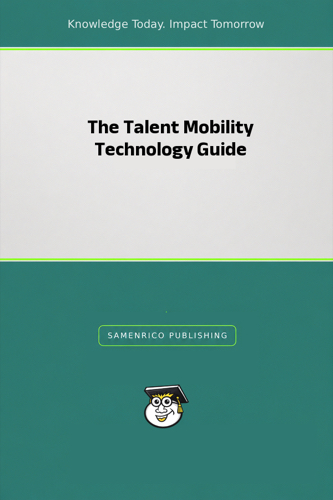
The Talent Mobility Technology Guide eBook
Forecast how AI and platforms enable global workfo
by Rice Rhonda
Forecast how AI and platforms enable global workforce movement.
Formats
Free sample
Chapter 1: The Ladder Was a Lie...--For most of your working life, you have been told a story. It is a simple story, elegant in its structure and seductive in its promise. The story says that if you work hard, stay loyal, and hit your targets, you will climb. You will move from associate to senior associate, from senior associate to manager, from manager to director, from director to vice president. Each rung of the ladder is higher than the last.
Each rung brings more money, more status, more control. The story says that the people who climb fastest are the winners. The people who climb slowly are the losers. And the people who stop climbing? They have failed.This story is a lie.It is not a harmless lie.
It is not a white lie told to motivate you on difficult days. It is an expensive, destructive, deeply embedded lie that has cost the global economy trillions of dollars in lost productivity, preventable turnover, and human potential left to rot. The career ladder is not a natural law. It is not even a particularly good way to organize work. It is a relic of the industrial era, designed for factories and bureaucracies where people were interchangeable parts and the only direction of progress was up or out.
That world is gone. But the ladder remains. And every day that you keep using it, your best people are updating their Linked In profiles, answering recruiter emails, and planning their escape.The great unspoken secret of modern work is that your employees do not actually want to climb your ladder. They want to grow. And growth and climbing are not the same thing.The Anatomy of a Broken Promise Let us start with a story.
It is a true story, though the names and identifying details have been changed to protect the innocent and the embarrassed.Maria joined a multinational financial services firm as a financial analyst in 2018. She was twenty-six years old, freshly minted from a good MBA program, and hungry to prove herself. In her first year, she exceeded every target. Her models were accurate. Her presentations were crisp.
Her manager, a harried vice president named David, gave her a "strongly exceeds expectations" rating and a 4% raise. Maria was grateful. She liked David. She liked the work. She thought, for a moment, that she had found a home.By her second year, Maria was bored.She had mastered the analyst role.
She could build a discounted cash flow model in her sleep. She knew the firm's financial systems better than the people who had trained her. She started asking David for new challenges. Could she work on a cross-border merger? Could she sit in on client meetings?
Could she spend two weeks with the product team to understand how the firm's software actually made money?David said yes to everything. But "yes" did not translate into action. The merger team was too busy. Client meetings were for senior people only. The product team was in another city and there was no budget for travel.
Maria understood. She was patient. She was a team player. She waited.By her third year, Maria was actively unhappy.Her performance reviews were still excellent. Her raises were still modest.
She watched colleagues who had joined after her get promoted into roles she wanted, not because they were smarter or harder working, but because they had been visible to the right people at the right time. Maria's work was invisible. She was excellent at her job, but excellence in her role was defined as making things run smoothly. And when things run smoothly, no one notices the person who made them run.In her fourth year, Maria updated her Linked In profile. She did not tell anyone.
She set her status to "open to work" but visible only to recruiters. Within two weeks, she had three interview requests. Within six weeks, she had an offer from a competitor: a 25% raise, a title bump to senior analyst, and a signing bonus. She took it.When Maria resigned, David was shocked. "But you were doing so well," he said.
"Your reviews were excellent. I was planning to promote you next year." Maria smiled politely and handed over her laptop. She did not say what she was thinking: Next year is too late. Next year has been too late for three years.Six months after Maria left, her old firm finally posted her replacement. The role took four months to fill.
The new hire cost 15% more than Maria had been making and took another six months to reach her level of proficiency. The firm lost Maria's institutional knowledge, her client relationships, and her quiet efficiency. David got a bonus for hitting his headcount targets. No one was ever held accountable for losing Maria.This story happens thousands of times every day, in every industry, in every country. It is the story of the broken career ladder.
And the ladder is broken not because it is too hard to climb, but because it is too narrow.The Limits of Vertical Thinking The career ladder is a vertical structure. You go up or you do not go. There is no third direction. This creates three fundamental problems that no amount of good management can fully solve.Problem One: Finite Rungs Every organization has a pyramid shape. There are many entry-level roles, fewer mid-level roles, even fewer senior roles, and vanishingly few leadership roles.
This is not a bug. It is a feature of hierarchy itself. No matter how talented your workforce, no matter how fast your company grows, the majority of your employees will eventually hit a ceiling. They cannot all become vice presidents. They cannot all become directors.
The math does not work.When a talented employee realizes they have hit their ceiling, they have two choices: stay and stagnate, or leave and climb somewhere else. Too many choose the second option. And when they leave, you lose not just their labor but their accumulated wisdom, their relationships, and their knowledge of how your organization actually works. You then spend months and considerable expense training a replacement who may never reach the same level of effectiveness.Problem Two: The Peter Principle in Reverse The Peter Principle says that people rise to their level of incompetence. They keep getting promoted until they land in a job they cannot do, and then they stay there, mediocre and miserable.
But there is an equally destructive problem that gets far less attention. Call it the Reverse Peter Principle. It says that people who are excellent at their current jobs are often terrible at the jobs above them. The skills that make a great software engineer—deep focus, analytical rigor, preference for solo work—are not the skills that make a great engineering manager. Yet the only way to give that engineer more money and status is to promote them into management, where they will likely fail.This creates a brutal choice for both the employee and the employer.
The employee must decide between doing work they love (and being underpaid) or doing work they hate (and being fairly compensated). The employer must…
This is the end of the free sample. Get the eBook to keep going. Buy now
About this book
Details
- Author
- Rice Rhonda
- Publisher
- SamEnrico
- Language
- English
- Genre
- Non-Fiction, Forecast & Outlook, HR Tech
- Released
- 2026-06-09
- Pages (approx.)
- 149
- Available as
- eBook, Audiobook

Read better in the ZLOADR app
Your eBooks on your phone or tablet. Sign in with your SamEnrico account and start reading.
More by Rice Rhonda
 Personal Ing For Success Personal VisionRice Rhonda$11.99
 Intuitive Eating For Chronic Dieters CourseRice Rhonda$11.99
 Opioid Induced HyperalgesiaRice Rhonda$11.99
 Free Clinic to Med SchoolRice Rhonda$11.99
 The Vanishing of Flight 447: The Black Box ConspiracyRice Rhonda$11.99
 Binary Apocalypse: The Forgotten Code That Almost Doomed CivilizationRice Rhonda$11.99
 Ultimate Handbook Guide to Ramallah and Gaza : (State of Palestine) Travel GuideRice Rhonda$11.99
 Merging Multiple Non Resident LLCsRice Rhonda$12.99
 Indian IT Degree DominanceRice Rhonda$12.99
 SalesmanRice Rhonda$11.99
 Understanding Bindewald–ulmer–muller SyndromeRice Rhonda$17.99
You may also like
 Hong Kong Handover 1997Dunn Johnnie$11.99
 Zumba For Postnatal Recovery CourseNeal Christian$11.99
 Zumba for BeginnersLadner Nikia$11.99
 YouTube Comment Mining GuideHumes Pandora$12.99
 Worry Box MeditationCarlin Rudy$11.99
 Workplace Stress MeditationNguyen Lynn$11.99
 Workplace Stress and Sleep RepairHawley Ivory$11.99
 Workplace Perfectionism CureDelaney Jeffry$11.99
 Workplace Injustice Anger GuideWallen Isabelle$11.99
 Work Addiction and Burnout LinkGreenwood Ester$11.99
 Women in Yoga and WellnessBeattie Galina$11.99
 Women in Stand Up ComedyChun Evangeline$11.99