
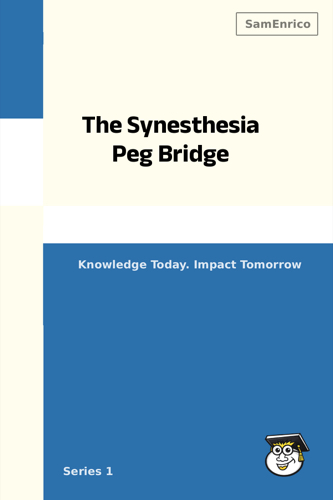
Non-FictionSelf-HelpSynesthetic Memory
The Synesthesia Peg Bridge eBook
Use number-color and number-shape synesthesia for
Use number-color and number-shape synesthesia for enhanced peg recall.
Formats
Free sample
Chapter 1: The $100,000 Bet...–- The fluorescent lights of the neuroscience lab hummed a low, sterile frequency as Edward Cooke, a twenty-something with an unassuming smile and a mind like a steel trap, placed a shuffled deck of playing cards face-down on the table. Across from him, Dr. James Thompson, a tenured professor of cognitive neuroscience with a wall of framed diplomas and a skeptical squint, checked his stopwatch. Between them lay a folded piece of paper, already signed. It was a legally binding agreement for one hundred thousand dollars.
Cooke, who had no formal training in neuroscience and no exceptional scores on any memory aptitude test, had just bet a renowned expert on the nature of human recall that he could do something that, according to every peer-reviewed paper Thompson had ever published, should be neurologically impossible.The challenge was brutally simple. Thompson would press a button on a random number generator, which would produce a sequence of fifty-two cards—a full deck, completely randomized. Cooke would have precisely sixty seconds to look at each card, one by one. Then, without looking back, he would recite the entire sequence in perfect order: two of hearts, seven of clubs, king of spades, and so on, all the way to the final card. No tricks.
No gimmicks. No hidden earpieces. Just his brain against the machine. Thompson had run the numbers. The probability of guessing a full deck by chance was one in eight followed by sixty-seven zeros—a number so vast it has no name.
In the entire history of psychological research, there was no documented case of an untrained individual achieving this feat. Thompson was so confident he would win that he had not even bothered to check Cooke's references.Yet Cooke sat calmly, almost bored, as Thompson shuffled the deck one final time and placed it in a card shoe. The professor pressed a key on his laptop. The first card appeared on a large monitor: the nine of diamonds. Cooke glanced at it for less than a second, then looked away.
He closed his eyes briefly, nodded, and said, "Next." Thompson, visibly irritated by the lack of drama, clicked to the second card: the four of clubs. Another glance, another nod. "Next." This continued for fifty-two repetitions. Cooke never spent more than one second on any card. He did not write anything down.
He did not mutter to himself. He simply looked, closed his eyes, and moved on. At the fifty-second card, the queen of hearts, he let out a small exhale and leaned back in his chair. "Done," he said. "I'm ready."Thompson set the stopwatch.
Fifty-eight seconds had elapsed. The professor then opened a second window on his laptop, revealing the original random sequence. He turned the monitor so Cooke could see it. "Recite," he said. Cooke began.
"Nine of diamonds, four of clubs, ace of spades, eight of hearts, three of clubs, queen of diamonds..." He did not hesitate. He did not stumble. His voice was flat, almost mechanical, as if he were reading from an internal teleprompter. At card thirty, Thompson felt a chill run down his spine. At card forty, he stopped checking the screen because he already knew Cooke was correct.
At card fifty-two, Cooke said, "Queen of hearts," and the room fell silent. Fifty-two cards. Fifty-eight seconds. Zero errors. Thompson reached for the folded paper, then stopped.
He did not want the money. He wanted to know how. He asked Cooke to lie down inside the functional magnetic resonance imaging (f MRI) machine in the adjacent room. For the next hour, Thompson scanned Cooke's brain while he repeated similar memory tasks. He expected to find something—an enlarged hippocampus, unusual neural density, some physiological explanation for what he had just witnessed.He found nothing.
Cooke's brain was utterly, unremarkably normal.The Anatomy of a Miracle This is not a story about a savant. It is not a story about a genetic anomaly, a childhood head injury, or a lifetime of monastic training. Edward Cooke was, at the time of the bet, a twenty-four-year-old with a degree in English literature and a part-time job tutoring high school students. He had no exceptional memory as a child. He could not, unprompted, tell you what he had for breakfast on a random Tuesday three years ago.
By every conventional measure, he was an average guy with an average brain who had stumbled upon an average-breaking secret. The secret was not a pill, a diet, or a meditation technique. It was a strategy—a specific, teachable, replicable method for transforming abstract, forgettable information into vivid, unforgettable sensory experiences. Cooke had not been born with a better memory. He had simply learned to paint.The f MRI scan, which Thompson later published in a footnote of a paper on neuroplasticity, showed something far more interesting than a biological abnormality.
It showed that while Cooke was memorizing the cards, his visual cortex—the part of the brain responsible for processing images, colors, and spatial relationships—was lighting up like a Christmas tree. His auditory cortex, responsible for sound, was also active, even though the room was silent. His amygdala, the brain's emotional center, was firing as well. In other words, Cooke was not "storing" the cards as abstract symbols (nine of diamonds, four of clubs). He was translating them into a multisensory, emotionally charged movie that he played inside his head.
The nine of diamonds became a specific image—say, a giant nine-foot-tall clown juggling diamond-shaped ice cubes while standing on a melting glacier. The four of clubs became a four-armed gorilla swinging a golf club at a neon-green golf ball. Each image was absurd, vivid, and emotionally ridiculous. And because the brain evolved to remember absurd, vivid, ridiculous things (more on this in Chapter 10), Cooke could recall the entire sequence hours, days, or even weeks later without significant decay. He was not a genius.
He was a director.The Myth You Have Believed Your Entire Life Let me pause here and address the lie that has been sold to you since childhood. You have been told, explicitly or implicitly, that memory is a fixed trait. You have heard phrases like "I have a bad memory" or "She has a photographic memory" or "He's just good with names" as if memory were a genetic endowment, like eye color or height. You have been graded on memorization in school (spelling tests, history dates, multiplication tables) without ever being taught how to memorize. The implicit message was that some people have the gift and some people do not.
If you struggled, you were told to "try harder" or "pay attention" or "use flashcards"—as if effort alone could overcome a fundamentally flawed strategy. This is not merely unhelpful. It is scientifically false.The modern science of memory, built on decades of research by cognitive psychologists like Elizabeth Loftus, Alan Baddeley, and Endel Tulving, has established three bedrock truths. First, human long-term memory has no known storage limit. You will never run out of space.
The problem is not capacity; it is access. Second, forgetting is not a failure of storage but a failure of encoding—the initial process of translating…
This is the end of the free sample. Get the eBook to keep going. Buy now
About this book
Details
- Author
- Johns Carissa
- Publisher
- SamEnrico
- Language
- English
- Genre
- Non-Fiction, Self-Help, Synesthetic Memory
- Released
- 2026-06-10
- Pages (approx.)
- 136
- Available as
- eBook, Audiobook

Read better in the ZLOADR app
Your eBooks on your phone or tablet. Sign in with your SamEnrico account and start reading.
More by Johns Carissa
 Restless Leg Syndrome ReliefJohns Carissa$11.99
 Mindfulness Meditation for BIPOC PractitionersJohns Carissa$11.99
 Emotional Intelligence For Grief GuideJohns Carissa$11.99
 The Note Taking Stress GuideJohns Carissa$11.99
 US France Remote Tax GuideJohns Carissa$11.99
 Dark Therapy for Bipolar ManiaJohns Carissa$11.99
 SNRI Neuropathic PainJohns Carissa$11.99
 Dominic System Memory CourseJohns Carissa$11.99
 The Twitter Files: Unseen HandsJohns Carissa$11.99
 The Dragon’s Last Lullaby: A Medieval Ballad of Fire and SorrowJohns Carissa$11.99
 Samson François: The Virtuoso Who Conquered Europe's Classical StageJohns Carissa$11.99
 Growing Epimedium (Barrenwort)Johns Carissa$11.99
You may also like
 Hong Kong Handover 1997Dunn Johnnie$11.99
 Zumba For Postnatal Recovery CourseNeal Christian$11.99
 Zumba for BeginnersLadner Nikia$11.99
 YouTube Comment Mining GuideHumes Pandora$12.99
 Worry Box MeditationCarlin Rudy$11.99
 Workplace Stress MeditationNguyen Lynn$11.99
 Workplace Stress and Sleep RepairHawley Ivory$11.99
 Workplace Perfectionism CureDelaney Jeffry$11.99
 Workplace Injustice Anger GuideWallen Isabelle$11.99
 Work Addiction and Burnout LinkGreenwood Ester$11.99
 Women in Yoga and WellnessBeattie Galina$11.99
 Women in Stand Up ComedyChun Evangeline$11.99