
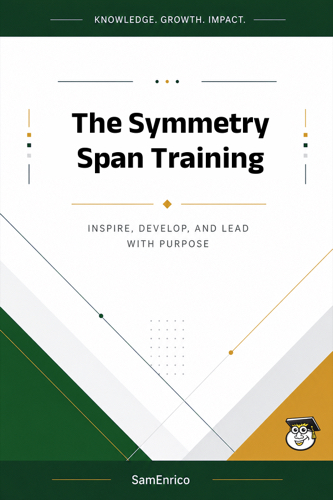
The Symmetry Span Training
Judge visual symmetry while remembering spatial lo
Judge visual symmetry while remembering spatial locations for dual training.
Formats
About this book
Free sample
Chapter 1: The Lost Map...–- Every morning, millions of people perform a quiet ritual of loss. They pat their pockets for keys, squint at crowded parking lots searching for their car, retrace steps through a grocery store looking for an item they just saw, or open a dozen browser tabs trying to find the article they were reading thirty seconds ago. These are not failures of intelligence. They are failures of spatial memory—and they are the first warning signs that a fundamental cognitive faculty is being neglected.Consider the last time you walked into a room and forgot why. That disorienting feeling—standing blankly in a doorway, staring at the walls, knowing you intended to do something but unable to retrieve the thought—is a spatial memory failure dressed in the clothes of absent-mindedness.
The doorway itself is the culprit. Psychologists have documented the “doorway effect”: passing through a doorway creates an event boundary that resets your spatial working memory, causing you to forget the goal you formulated in the previous room. Your brain treats the new room as a fresh spatial context, and information tied to the old location is flushed out.This is not a design flaw. It is a feature—one that reveals just how deeply spatial intelligence is woven into the fabric of human cognition.The Hidden Pillar of Intelligence For more than a century, the concept of intelligence has been dominated by verbal and mathematical abilities. Alfred Binet’s original intelligence test, developed in 1904 for the French Ministry of Education, focused on language, reasoning, and arithmetic because those were the skills deemed necessary for academic success.
The Stanford-Binet and Wechsler scales that followed cemented this bias. Even today, when people say someone is “smart,” they usually mean the person speaks well, reads quickly, or solves equations with ease.But there is a third pillar of intelligence that has been systematically undervalued: spatial intelligence.Spatial intelligence is the brain’s ability to generate, retain, retrieve, and transform visual images and spatial relationships. It is what allows an orthopedic surgeon to see a fractured bone in two dimensions on…
This is the end of the free sample. Get the eBook to keep going. Buy now
Contents
- Chapter 1
- Chapter 2
- Chapter 3
- Chapter 4
- Chapter 5
- Chapter 6
- Chapter 7
- Chapter 8
- Chapter 9
- Chapter 10
- Chapter 11
- Chapter 12
Details
- Author
- Prado Mabelle
- Publisher
- SamEnrico
- Language
- English
- Genre
- Non-Fiction, Self-Help
- Released
- 2026-06-07
- Pages (approx.)
- 134
- Available as
- eBook, Audiobook

Read better in the ZLOADR app
Your eBooks on your phone or tablet. Sign in with your SamEnrico account and start reading.
More by Prado Mabelle
 Gambling Addiction and Gambling Disorder DiagnosisPrado Mabelle$11.99
 Boardroom Conflict ResolutionPrado Mabelle$11.99
 The Shame Addiction LinkPrado Mabelle$11.99
 Twitter Comparison RecoveryPrado Mabelle$11.99
 Interruption Apps GuidePrado Mabelle$11.99
 Creative Legacy ProjectsPrado Mabelle$11.99
 The Labors of Heracles: A Hero’s Unseen StrugglesPrado Mabelle$11.99
 Grimnir's Last Lesson: The Dragon-Slaying Mentor of the NorthPrado Mabelle$11.99
 How to Produce Motor Vehicle SeatingPrado Mabelle$11.99
 How to Produce Industrial Air ConditionersPrado Mabelle$11.99
 Micromanaging Boss Cheat SheetPrado Mabelle$12.99
 AI Blog Post Production HandbookPrado Mabelle$12.99
You may also like
 Hong Kong Handover 1997Dunn Johnnie$11.99
 Zumba For Postnatal Recovery CourseNeal Christian$11.99
 Zumba for BeginnersLadner Nikia$11.99
 YouTube Comment Mining GuideHumes Pandora$12.99
 Worry Box MeditationCarlin Rudy$11.99
 Workplace Stress MeditationNguyen Lynn$11.99
 Workplace Stress and Sleep RepairHawley Ivory$11.99
 Workplace Perfectionism CureDelaney Jeffry$11.99
 Workplace Injustice Anger GuideWallen Isabelle$11.99
 Work Addiction and Burnout LinkGreenwood Ester$11.99
 Women in Yoga and WellnessBeattie Galina$11.99
 Women in Stand Up ComedyChun Evangeline$11.99