
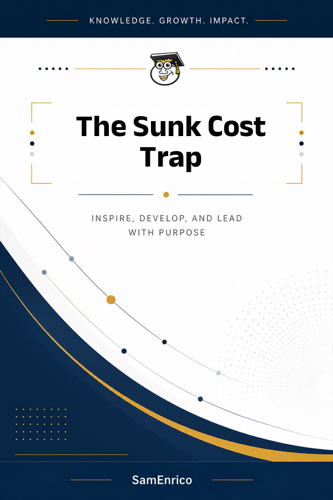
Non-FictionBusiness BriefDecision
The Sunk Cost Trap eBook
Recognize when past investment clouds future decis
Recognize when past investment clouds future decisions and avoid escalation.
Formats
Free sample
Chapter 1: The Billion-Dollar Ghost--–- On a rainy November evening in 1962, British Minister of Aviation Julian Amery stood before a packed House of Commons and made a promise that would cost his nation billions. He announced that Britain and France would jointly build the world's first supersonic passenger jet, the Concorde. The project, he declared, would cement Europe's place at the forefront of aviation technology. The costs would be shared equally. The timeline was ambitious but achievable.
And the economic returns, once the supersonic fleet was flying, would be substantial.Every single one of those claims turned out to be wrong. But here is what makes the Concorde story not just a historical footnote but a psychological landmark: even after every prediction failed, even after the costs ballooned past ten times the original estimate, even after it became mathematically impossible for the plane to ever turn a profit, both governments continued pouring money into the project for nearly three more decades. They kept building planes that nobody wanted to buy, kept designing features that airlines refused to pay for, kept subsidizing flights that bled cash. Why? Because, as one parliamentary defender put it in 1979, "We have already invested so much.
It would be a waste to stop now."That sentence—"We have already invested so much"—is the most expensive collection of words in the history of decision-making. It is the phrase that launches a thousand failed projects, a thousand unhappy marriages, a thousand dead-end careers. It is the sentence that turns a bad bet into a catastrophe. And it is the sentence that this book exists to erase from your vocabulary.The Fallacy Named After a Plane Economists and psychologists call this pattern the Concorde Fallacy. It is a specific form of a broader cognitive error known as the sunk cost fallacy.
The name matters because naming something gives you power over it. You cannot fight an enemy you cannot see. But once you know the Concorde Fallacy exists, once you have a label for the experience of throwing good money after bad, you have taken the first step toward breaking its grip.The sunk cost fallacy, in its simplest formulation, is this: human beings have a powerful tendency to let unrecoverable past costs influence their current decisions, even though rational decision-making requires ignoring those costs entirely. The money is gone. The time is spent.
The effort is over. None of it can be brought back by continuing. And yet, the very fact that the money, time, and effort are gone makes us more likely to continue, not less.This is not a minor cognitive quirk. It is not a rounding error in the human mind. The sunk cost fallacy is one of the most robust, replicable, and consequential biases ever documented in behavioral science.
It has been observed in every culture studied, across every age group, in laboratory experiments and real-world disasters. It affects novice investors and Wall Street legends, first-time managers and Fortune 500 CEOs, newlyweds and couples who have been married for decades. It is, quite literally, universal.The Two-Headed Monster Before we go further, we need to distinguish between two related but distinct phenomena. Most books and articles treat them as the same thing. They are not.
Understanding the difference is crucial for breaking free.The first is the Sunk Cost Fallacy itself. This is a cognitive error. It happens inside your head. It is the mistake of treating past costs as if they were relevant to a current decision. You know, intellectually, that the hundred dollars you spent on the concert ticket is gone.
But when you are lying on your couch with a fever on the night of the concert, you think, "I can't waste that money," and drag yourself to the venue. That is the fallacy. You are using the wrong information.The second is Escalation of Commitment. This is a behavioral pattern. It happens over time.
It is the tendency to respond to negative feedback not by withdrawing, but by increasing investment. You put ten million into a project. It fails. So you put twenty million more. It fails again.
So you put fifty million more. With each round, the commitment escalates, not because the evidence is getting better, but because your psychological need to justify the prior investment is getting stronger.Here is the crucial insight: the Sunk Cost Fallacy can happen without Escalation of Commitment. You might inherit a failing project from someone else and still fall for the fallacy, simply because you see the money already spent. But Escalation of Commitment almost never happens without the Sunk Cost Fallacy. Escalation is the fallacy repeated over time, deepened by personal responsibility, and amplified by ego.
It is the difference between a single mistake and a pattern of destruction.The Psychology of Irrational Persistence Why do we do this? Why do intelligent, educated, successful people consistently throw good money after bad? The answer is not stupidity. The answer is that our brains are wired for a world that no longer exists.In the ancestral environment—the world of small tribes, immediate threats, and scarce resources—persistence was usually a virtue. If you spent a day hunting in a particular valley, the fact that you had already invested that day was actually useful information.
It meant you knew the terrain. It meant you had already done the hard work of tracking. Abandoning that valley for another one meant starting over, and starting over was costly.But in the modern world, persistence is often a vice. The terrain changes too fast. The investments are too large.
The opportunity costs are too hidden. And the psychological mechanisms that once helped us survive now conspire to destroy us.Three psychological mechanisms are particularly important.Cognitive Dissonance: The Mind's Insistence on Consistency Leon Festinger, one of the most important psychologists of the twentieth century, discovered that human beings have a deep need for consistency among their beliefs, attitudes, and actions. When inconsistencies arise, we experience a state of psychological discomfort called cognitive dissonance. And we will go to remarkable lengths to reduce that discomfort—often by changing our beliefs rather than our actions.Here is how cognitive dissonance creates the sunk cost trap. Imagine you are a manager who approved a ten-million-dollar project.
A year later, the project is failing badly. You now hold two conflicting beliefs: "I am a competent manager" and "I approved a failing project." The simplest way to resolve the dissonance is to change your belief about the project: it is not really failing, it is just going through a difficult phase; it needs more time; the metrics are misleading; the competition is unfair; the market will turn around.Dissonance reduction does not require evidence. It requires only the motivation to feel consistent. And that motivation is powerful. In Festinger's classic study, members of a doomsday cult who had sold their homes and quit their jobs in anticipation of a flood that never came did not admit they had been fooled.
They concluded that their faith had saved the world. The flood did not happen because they had believed so strongly. That is dissonance reduction at work.The same mechanism drives every escalation…
This is the end of the free sample. Get the eBook to keep going. Buy now
About this book
Details
- Author
- Kuykendall Janelle
- Publisher
- SamEnrico
- Language
- English
- Genre
- Non-Fiction, Business Brief, Decision
- Released
- 2026-06-08
- Pages (approx.)
- 138
- Available as
- eBook, Audiobook

Read better in the ZLOADR app
Your eBooks on your phone or tablet. Sign in with your SamEnrico account and start reading.
More by Kuykendall Janelle
 Female Ruler Crisis Leadership WorkbookKuykendall Janelle$11.99
 Leadership Emotional RegulationKuykendall Janelle$11.99
 Stress Management for VeterinariansKuykendall Janelle$11.99
 The Lens That Captured Glory: Eadweard Muybridge and the Birth of Sports PhotographyKuykendall Janelle$11.99
 Appliance Dolly OperationKuykendall Janelle$11.99
 Mileage Tracking Automation WorkbookKuykendall Janelle$12.99
 How to Produce Art and Crafting Tool AccessoriesKuykendall Janelle$11.99
 How to Become a Paper-bag-press OperatorKuykendall Janelle$11.99
You may also like
 Hong Kong Handover 1997Dunn Johnnie$11.99
 Zumba For Postnatal Recovery CourseNeal Christian$11.99
 Zumba for BeginnersLadner Nikia$11.99
 YouTube Comment Mining GuideHumes Pandora$12.99
 Worry Box MeditationCarlin Rudy$11.99
 Workplace Stress MeditationNguyen Lynn$11.99
 Workplace Stress and Sleep RepairHawley Ivory$11.99
 Workplace Perfectionism CureDelaney Jeffry$11.99
 Workplace Injustice Anger GuideWallen Isabelle$11.99
 Work Addiction and Burnout LinkGreenwood Ester$11.99
 Women in Yoga and WellnessBeattie Galina$11.99
 Women in Stand Up ComedyChun Evangeline$11.99