

Non-FictionSelf-HelpTime Management
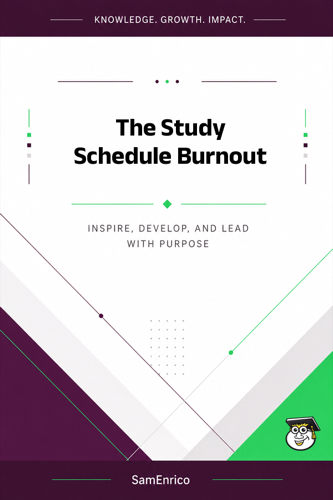
The Study Schedule Burnout eBook
Design realistic study timetables that prevent exh
by Smoot Fidela
Design realistic study timetables that prevent exhaustion and overload.
Formats
Free sample
Chapter 1: The Overload Myth--–- Maya’s hand trembled over the mouse. On her screen, the exam score glared back: 54 percent. She had studied for ten hours straight the day before. She had highlighted every chapter, rewritten her notes twice, and skipped dinner to review flashcards in the library’s basement carrel. She had done everything her planner demanded.
And still, she failed.Maya is not lazy. She is not undisciplined. She is not “bad at school.” Maya is a victim of the Overload Myth—the quiet, cruel belief that if you are exhausted, you simply haven’t worked hard enough.This chapter dismantles that lie.The Shame Spiral You Did Not Deserve Before we design a single study block, before we touch your calendar or your phone or your color-coded highlighters, we have to clear the wreckage of what you have been told about yourself.Look at your recent past. Have you ever:Collapsed after an exam and felt relief, not accomplishment?Stared at a textbook for an hour and absorbed nothing?Cancelled plans with friends because you were “too behind,” then spent that time doom-scrolling instead of studying?Felt guilty for sleeping?If you answered yes to any of these, you have been caught in the shame spiral. And shame is not a motivator.
Shame is a paralytic.Here is what the self-help industry does not tell you: most students who feel like failures are not failing because they are lazy. They are failing because they are running on a broken operating system. They have been given schedules designed for robots, not human beings. And when their human brains inevitably crash, they are told to try harder.This chapter is your permission slip to stop trying harder. We are going to try smarter, yes.
But first, we are going to try kinder.The Birth of the Overload Myth Let us travel back to 1971. A psychologist named Mihaly Csikszentmihalyi (pronounced “chick-sent-me-high-ee”) began studying what made people happy while working. He interviewed artists, chess players, surgeons, and assembly line workers. He discovered a state he called “flow”—total absorption in a task where challenge meets skill.That research was revolutionary. But something went wrong on its journey to your study desk.Somewhere along the way, “flow” got twisted into “grind.” The idea that deep focus was pleasurable mutated into the idea that pain was proof of virtue.
The more exhausted you were, the more you must have cared. The more you sacrificed sleep, social life, and sanity, the more points you earned in some invisible moral ledger.This is the Overload Myth: the cultural story that burnout is a badge of honor, not a warning sign.You can see it everywhere. Inspirational quotes on Instagram about “hustling while they sleep.” Study influencers filming 12-hour sessions with time-lapse cameras. Parents who brag that their child “never stops working.” Universities that hand out free coffee and energy drinks during finals week as if caffeine is a substitute for rest.The message is clear: if you are not exhausted, you are not trying.That message is poison.The Science of the Stuck Stress Cycle To understand why the Overload Myth is so destructive, we need to look under the hood. Not at your schedule, but at your nervous system.Emily and Amelia Nagoski, in their landmark book Burnout, explain something most productivity guides ignore: the human body has a stress cycle that must be completed to return to baseline.
Think of it like a toilet flushing. Stress hormones (cortisol and adrenaline) flood your system when you perceive a threat. That threat could be a tiger. It could also be a professor announcing a surprise quiz. Biologically, your brain does not distinguish between the two.Once the stress hormones are released, they need to be metabolized and discharged.
Your body needs a signal that the threat is over. That signal comes in the form of physical completion: running, fighting, crying, laughing, or even creative expression.Here is the problem for students. Your threat is not a tiger you can outrun. Your threat is a semester. A stack of assignments.
A final exam six weeks away. These threats do not disappear in a single burst of physical activity. They linger. They accumulate.And so your stress cycle never completes.You wake up with cortisol already in your veins. You attend class, adding more.
You study, adding more. You think about the assignment you did not finish, and your body primes itself for a fight that never comes. By midnight, you are exhausted but cannot sleep because your system is still screaming “danger.”That is not laziness. That is biology.Incomplete tasks act as open loops in the brain. Every unfinished problem set, every unread email, every looming deadline is an open loop.
Your brain keeps a mental tab on each one, consuming cognitive resources even when you are trying to relax. A 2005 study by the University of Florida found that people who had unfinished tasks performed 50 percent worse on subsequent tasks compared to those who had completed their work, even when the unfinished tasks were completely unrelated.You are not failing because you are weak. You are failing because you have too many open loops, and no system to close them.The Self-Assessment You Have Been Avoiding Before we go any further, I want you to take a brutally honest inventory. Not of your grades. Of your symptoms.Rate each statement from 1 (never) to 5 (daily):I feel tired when I wake up, even after 7+ hours of sleep.I procrastinate on tasks that I know are important.I study for hours but cannot remember what I read.I feel guilty when I am not actively working.I have cancelled social plans to study, then not studied.My phone is within arm’s reach during study sessions.I have pulled an all-nighter in the past 30 days.I feel irritable or short-tempered with friends and family.I have lost interest in hobbies I used to enjoy.I secretly wish I could just “disappear” for a week.Scoring:10–20: You are functioning, but your system is fragile.21–30: You are in the yellow zone.
Burnout is not inevitable, but it is approaching.31–40: You are in the red zone. Your current schedule is harming you.41–50: This is an emergency. Please put down this book and talk to someone you trust.Here is what that score does not mean: it does not mean you are broken. It means your system is broken. And systems can be redesigned.Why Time Management Is a Trap Most study advice falls into a category I call Time Management Porn.
It promises that if you just use the right app, the right calendar, the right color-coded system, everything will fall into place.Here is the uncomfortable truth: time management does not work for exhausted students.Time management assumes you have an unlimited supply of energy to allocate across your hours. It assumes that if you schedule a three-hour study block, you will have the focus, motivation, and biological capacity to execute that block. It assumes you are a machine.You are not a machine.You are a vertebrate mammal with a limbic system and a prefrontal cortex that tires like a muscle.…
This is the end of the free sample. Get the eBook to keep going. Buy now
About this book
Details
- Author
- Smoot Fidela
- Publisher
- SamEnrico
- Language
- English
- Genre
- Non-Fiction, Self-Help, Time Management
- Released
- 2026-06-07
- Pages (approx.)
- 124
- Available as
- eBook, Audiobook

Read better in the ZLOADR app
Your eBooks on your phone or tablet. Sign in with your SamEnrico account and start reading.
More by Smoot Fidela
 High School Exam Prep GuideSmoot Fidela$11.99
 Disappointment In AdoptionSmoot Fidela$11.99
 Career Transition for Administrative AssistantsSmoot Fidela$11.99
 Higher Power Concept for SkepticsSmoot Fidela$11.99
 Marine Corps PilotSmoot Fidela$11.99
 Depression Psychomotor IssuesSmoot Fidela$11.99
 Scapegoat Child Recovery GuideSmoot Fidela$11.99
 Aircraft Carrier Radar DirectionSmoot Fidela$11.99
 Paddling the Nile: The Epic Kayak Journey That Mapped Africa's Greatest RiverSmoot Fidela$11.99
 The Last Great Polar Expedition: Shackleton's Epic Rescue MissionSmoot Fidela$11.99
 The Healers of Meroë: Surgeons of the Kushite KingdomSmoot Fidela$11.99
 Willow Oak HarvestingSmoot Fidela$11.99
You may also like
 Hong Kong Handover 1997Dunn Johnnie$11.99
 Zumba For Postnatal Recovery CourseNeal Christian$11.99
 Zumba for BeginnersLadner Nikia$11.99
 YouTube Comment Mining GuideHumes Pandora$12.99
 Worry Box MeditationCarlin Rudy$11.99
 Workplace Stress MeditationNguyen Lynn$11.99
 Workplace Stress and Sleep RepairHawley Ivory$11.99
 Workplace Perfectionism CureDelaney Jeffry$11.99
 Workplace Injustice Anger GuideWallen Isabelle$11.99
 Work Addiction and Burnout LinkGreenwood Ester$11.99
 Women in Yoga and WellnessBeattie Galina$11.99
 Women in Stand Up ComedyChun Evangeline$11.99