
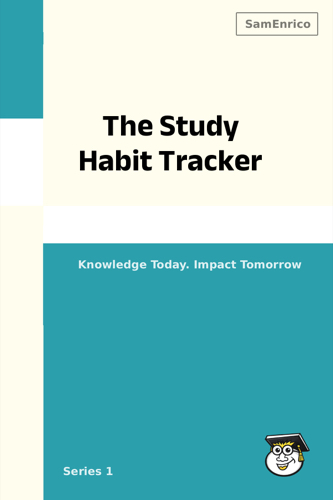
The Study Habit Tracker eBook
Build daily study habits with streak tracking and
Build daily study habits with streak tracking and rewards.
Formats
Free sample
Chapter 1: The Identity Vote--–- Every student I have ever coached begins in the same place. They sit across from me, usually in a coffee shop or a library, and they say some version of the same thing. “I know I need to study more.” “I have a huge exam coming up.” “I just can’t seem to make myself sit down and do the work.” They pull out their phones and show me their calendars, their to-do lists, their color-coded study schedules that look like they were designed by a perfectionist astronaut planning a mission to Mars. And then they point to the long, empty stretches of unmarked days, the checkboxes left blank, the streaks that never made it past three. “I don’t understand,” they say.
“I know what I need to do. I just don’t do it.”I used to believe this was a motivation problem. For years, I thought these students simply didn’t want it badly enough. If they could just find the right inspirational quote, the right You Tube video, the right pep talk from a parent or professor, something would click and they would transform into the disciplined, focused scholars they dreamed of becoming. But after working with hundreds of students across high schools, universities, and graduate programs, I have come to a different conclusion.
The problem is not a lack of motivation. The problem is a confusion of identity.When a student says “I need to study more,” they are speaking from a place of obligation. When they say “I am a student who studies every day,” they are speaking from a place of identity. These two statements feel similar, but they are separated by an enormous psychological distance. One is a goal.
The other is a declaration of who you are. And as every major work on habit formation from the last decade has shown, goals are for people who care about winning once. Identity is for people who care about winning forever.This book, and especially this first chapter, is built on a single, transformative idea: Your study tracker is not a log of what you have done. It is a ballot box. And every day, you cast a vote for the type of student you are becoming.Most students approach habit tracking as a record-keeping exercise.
They check a box, draw an X, or tap a button in an app because they want to see how much work they have completed. This is backward. The tracker is not a rearview mirror. It is a steering wheel. Every time you mark a successful study session, you are not merely adding data to a spreadsheet.
You are saying to yourself, “I am the kind of person who studies when it is hard. I am the kind of person who shows up even when I don’t feel like it. I am a student.”And every time you skip a day, you are casting a vote in the other direction. You are saying, “I am the kind of person who procrastinates. I am the kind of person who lets urgent things crowd out important things.
I am not really a student.”This might sound harsh. But it is also liberating. Because if the problem is simply that you have been voting for the wrong identity, then the solution is not to hate yourself into change. The solution is to start casting different votes.The Myth of the Cram Session Let me tell you about a student named Maya. She was a junior in college, pre-med, carrying a heavy course load in organic chemistry and physiology.
When she came to me, she was exhausted and ashamed. She would study for ten hours straight on Sundays—ten hours of rereading chapters, highlighting textbooks, and rewriting her notes in beautiful, multicolored handwriting. Then she would crash on Monday, do nothing on Tuesday, feel guilty on Wednesday, cram for three hours on Thursday, and barely scrape by on her Friday quizzes. Her tracker, when she bothered to use one, showed a pattern of feast and famine: huge spikes of activity followed by long, barren deserts of nothing.“I study so much,” she told me. “I don’t understand why I’m not getting A’s.”I asked her a question that made her uncomfortable.
“How many days last week did you study for thirty minutes or more?”She paused. “Sunday. And Thursday.”“Two days,” I said. “Out of seven.”“But Sunday was ten hours,” she protested.Here is the uncomfortable truth that Maya had to learn, and that you must learn as well: Your brain does not care about your total hours. Your brain cares about your consistency.
A ten-hour cram session feels productive. You close the book exhausted, proud of your effort, convinced that you have earned a reward. But from the perspective of your neural pathways, of the habit loops we will explore in the next chapter, that ten-hour session is almost useless for building a lasting study habit. Habits are not built in marathon bursts. They are built in daily votes.Maya had been voting for the identity of a crammer.
Her tracker, when she used it, showed a pattern of heroic effort followed by collapse. She was not a daily student. She was a weekend warrior who had convinced herself that intensity could substitute for consistency. And it was not working.We made a simple change. I asked her to throw away her ten-hour Sunday plan entirely.
In its place, I asked her to commit to thirty minutes of active study every single day. Not ten hours on Sunday and three hours on Thursday. Thirty minutes. Seven days a week. That was her only goal.She looked at me like I had suggested she drop out of school.
“But I have so much material to cover,” she said. “Thirty minutes isn’t enough.”“You are probably right,” I said. “Thirty minutes is not enough to cover your entire organic chemistry curriculum. But that is not the point. The point is that thirty minutes every day is enough to change who you are.
Once you become the kind of person who studies every day without exception, we can increase the duration. But first, you have to stop voting for the crammer identity.”Three weeks later, Maya sent me a message. She had not missed a single day. Her Sunday sessions were still shorter than they used to be—forty-five minutes, an hour, never more than ninety minutes. But her Tuesday and Wednesday and Friday sessions, which used to be zeros, were now consistent.
Her quiz scores had improved. And more importantly, she told me, “I no longer feel like I’m always behind. I just feel like a person who studies.”That last sentence is everything. Maya did not change her schedule because she found more willpower. She changed her identity.
She stopped asking “How much do I need to cram?” and started asking “What would a daily student do right now?” The tracker was not recording her hours. The tracker was recording her votes. And once she started casting the right votes, everything else followed.Outcome Goals versus Identity Goals To understand…
This is the end of the free sample. Get the eBook to keep going. Buy now
About this book
Details
- Author
- Ragland Victorina
- Publisher
- SamEnrico
- Language
- English
- Genre
- Non-Fiction, Self-Help, Habits
- Released
- 2026-06-09
- Pages (approx.)
- 152
- Available as
- eBook, Audiobook

Read better in the ZLOADR app
Your eBooks on your phone or tablet. Sign in with your SamEnrico account and start reading.
More by Ragland Victorina
 Pet Loss and New PetRagland Victorina$11.99
 Montgomery Bus Boycott PlaybookRagland Victorina$11.99
 Cleveland Coroner FalsificationRagland Victorina$11.99
 The Retirement Housing Swap StrategyRagland Victorina$11.99
 Meditation Goal TrackerRagland Victorina$11.99
 Five AM Club EssentialsRagland Victorina$11.99
 Nap Temperature GuideRagland Victorina$11.99
 The Scholars of Timbuktu: Guardians of the Golden KnowledgeRagland Victorina$11.99
 The Ink of Freedom: Olaudah Equiano’s Unseen Screenplay for AbolitionRagland Victorina$11.99
 How to Produce VarnishRagland Victorina$11.99
 How to Start a Cooker (gas) Business (Beginners Guide)Ragland Victorina$11.99
 How to Produce a Kitchener RangeRagland Victorina$11.99
You may also like
 Hong Kong Handover 1997Dunn Johnnie$11.99
 Zumba For Postnatal Recovery CourseNeal Christian$11.99
 Zumba for BeginnersLadner Nikia$11.99
 YouTube Comment Mining GuideHumes Pandora$12.99
 Worry Box MeditationCarlin Rudy$11.99
 Workplace Stress MeditationNguyen Lynn$11.99
 Workplace Stress and Sleep RepairHawley Ivory$11.99
 Workplace Perfectionism CureDelaney Jeffry$11.99
 Workplace Injustice Anger GuideWallen Isabelle$11.99
 Work Addiction and Burnout LinkGreenwood Ester$11.99
 Women in Yoga and WellnessBeattie Galina$11.99
 Women in Stand Up ComedyChun Evangeline$11.99