
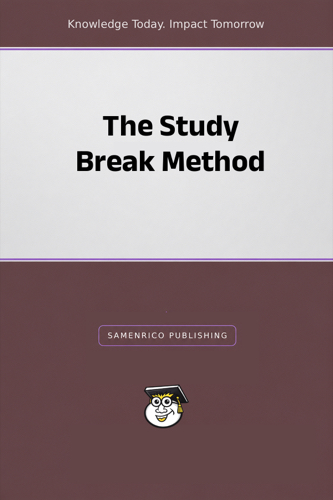
The Study Break Method eBook
Optimizes rest intervals to maximize focus and red
by Wade Elias
Optimizes rest intervals to maximize focus and reduce stress.
Formats
Free sample
Chapter 1: The 47-Second Trap--–- It begins, as it always does, with a timer. Not the one on your phone, not the countdown on your study app, not the Pomodoro clock you downloaded with such high hopes last semester. No, this timer is older than that. It is the timer ticking inside your skull, counting down the seconds between the moment you truly focus and the moment your brain, without asking permission, decides to check something else.The average knowledge worker, according to research conducted by Gloria Mark at the University of California, Irvine, focuses for approximately forty-seven seconds before being interrupted or self-distracting. Let me repeat that number because your brain will try to reject it.
Forty-seven seconds. Less than one minute. By the time you have read this paragraph, the average reader has already experienced one full cycle of focus, distraction, guilt, and refocus. And you are not even studying yet.This chapter is not here to make you feel bad. It is here to make you feel free.
Because the forty-seven-second statistic is not evidence that you are broken, lazy, addicted, or undisciplined. It is evidence that you have been operating without a structured rest system, and your brain is responding exactly as evolution designed it to respond. The problem is not your willpower. The problem is that no one ever taught you how to rest strategically.The Myth of the Marathon Let us begin by executing a sacred cow. I want you to imagine the archetypal study session as it is portrayed in movies, memes, and the Instagram accounts of people who claim to have woken up at 4 AM.
A student sits at a desk. Books are stacked in neat towers. Highlighters in six colors are arranged by wavelength. There is a mug of coffee, now cold, and the student has been there for four hours. Their brow is furrowed in concentration.
They are grinding. They are hustling. They are doing the work.Now let me tell you what is actually happening during that four-hour marathon, based on cognitive load theory and decades of research in educational psychology.For the first twenty-five to thirty minutes, something resembling productive study occurs. The brain encodes information into working memory, manipulates it, and begins the process of transferring it to long-term storage. Error rates are low.
Retention is reasonable. This is the golden window. But then something shifts. The brain, which is an organ of energy efficiency, begins to protest. Glucose levels in the prefrontal cortex—the region responsible for attention, impulse control, and complex reasoning—start to drop.
Neural firing becomes less efficient. The default mode network, which we will explore in Chapter 6, begins to intrude on task-focused networks.By the forty-five-minute mark, error rates have increased by approximately thirty percent. By the sixty-minute mark, retention of material from the first fifteen minutes has already begun to decay. By the ninety-minute mark, the student is essentially performing a ritualized imitation of studying. They are moving their eyes across text.
They are highlighting sentences. They are rewriting notes. But the cognitive engine has left the building.Here is the truth that no productivity influencer will tell you: after ninety minutes of continuous study, the marginal benefit of each additional minute approaches zero. After one hundred twenty minutes, it becomes negative. You are not learning.
You are unlearning. You are reinforcing fatigue, training your brain to associate studying with misery, and building a tolerance for inefficient work that will take weeks to reverse.The Anatomy of the Forty-Seven Second Trap The forty-seven-second figure is not a measure of how long people can focus. It is a measure of how long they do focus under natural conditions without structured rest. And what is fascinating is what happens in those forty-seven seconds.Mark's research, conducted using sophisticated computer logging software that tracked every window switch, every tab opening, every moment of self-interruption, revealed a predictable cycle. It goes like this:Phase one: hyper-focus.
For approximately fifteen to twenty seconds, the person is genuinely engaged. They are reading, writing, solving, or calculating. Neural activity is synchronized. Task-positive networks are online. This is the good part.Phase two: micro-distraction.
An internal trigger fires. It might be a memory of a text message. It might be a worry about an upcoming deadline. It might be a sudden urge to check email, or a random question that seems urgent in the moment ("What year was that actor born?"). The brain, which is wired to seek novelty because novelty was survival-relevant on the savanna, treats this trigger as a priority.
The person switches tasks. They open a new tab. They check their phone.Phase three: guilt. Within a few seconds, the person realizes they have been distracted. The superego activates.
A self-critical thought arises: "Why can't I focus? What is wrong with me? I am so lazy." This guilt is not neutral. It consumes additional cognitive resources. It triggers a stress response.
Cortisol rises.Phase four: forced refocus. The person yanks their attention back to the task. They may even stare at the screen with exaggerated intensity as if to punish themselves for having looked away. But here is the cruel irony: forced refocus is metabolically expensive. It requires the brain to suppress the distraction, reorient attention, retrieve the previous context, and resume processing—all of which takes energy and time.Then, after approximately fifteen to twenty seconds of forced refocus, the cycle repeats.Over the course of an hour, this cycle burns more neurological energy than actual studying.
The student ends the hour tired, frustrated, and convinced they have a focus disorder. In fact, they have a rest disorder.The Hard Problem of Rest If the solution were simply to tell people to rest more, no one would need this book. The challenge is that rest has been culturally coded as the opposite of success. We have inherited a Protestant work ethic that treats tiredness as a virtue and breaks as moral failings. Consider the language we use.
We talk about "powering through." We talk about "grinding." We talk about "no days off." Elite athletes, who understand recovery better than any other profession, would laugh at this vocabulary. They know that the athlete who never rests is not a champion. They are an injury waiting to happen.But students and desk workers do not operate like athletes. They operate like factory workers trying to impress a foreman who is not there. And the result is a population that is chronically fatigued, cognitively impaired, and convinced that the solution is more caffeine, more hours, more discipline.Here is the hard problem: rest is not the absence of work.
Rest is a different kind of work. Strategic rest requires intention, structure, and practice. It requires you to override the cultural voice that says breaks are weak. It requires you to learn the difference between active recovery and passive distraction, a distinction we will spend all of Chapter 5 exploring. And it requires you to believe something that feels counterintuitive: that the fastest way to get more done is to deliberately stop doing things.The Cognitive Load Trap To understand why structured rest is not optional, we need to understand…
This is the end of the free sample. Get the eBook to keep going. Buy now
About this book
Details
- Author
- Wade Elias
- Publisher
- SamEnrico
- Language
- English
- Genre
- Non-Fiction, Self-Help, Time Management
- Released
- 2026-06-08
- Pages (approx.)
- 144
- Available as
- eBook, Audiobook

Read better in the ZLOADR app
Your eBooks on your phone or tablet. Sign in with your SamEnrico account and start reading.
More by Wade Elias
 Mindfulness Meditation for Beginners WorkbookWade Elias$11.99
 Meditation for Weekend AnxietyWade Elias$11.99
 Loci for Legal MemoryWade Elias$11.99
 Benzo Withdrawal GuideWade Elias$11.99
 Religious Trauma Self WorthWade Elias$11.99
 Great Lakes Talent FlowWade Elias$11.99
 Metta For CustomersWade Elias$11.99
 Imagery Association GuideWade Elias$11.99
 The Double Agent Who Saved the WorldWade Elias$11.99
 The Stone and the Crown: How Kings and Builders Shaped Medieval EuropeWade Elias$11.99
 The Maori Maestros: A Love That Shattered the Sound of AotearoaWade Elias$11.99
 The Mineral Guide to CoesiteWade Elias$11.99
You may also like
 Time Boundary MasteryVinson Iesha$11.99
 Time Blocking For Students WorkbookWhatley Nancie$11.99
 The Workaholic's Time Audit GuideBeaulieu Waltraud$11.99
 Pomodoro for Interruption ManagementPannell Deandre$11.99
 Pomodoro Distraction Control CourseLively Cammy$11.99
 Mindfulness for Stress ReductionHartley Mathilda$11.99
 Leave Earlier to Reduce Road RageNorris Lloyd$11.99
 Leave Earlier Reduce RageBurrows Jeanett$11.99
 Impossible Deadlines Coping GuideGivens Sherrill$11.99
 Eisenhower Matrix Quadrant GuideMaddox Lorina$11.99
 Daily Reset Ritual GuideNation Jolanda$11.99
 Active Listening Under Time PressureLemke Blair$11.99