
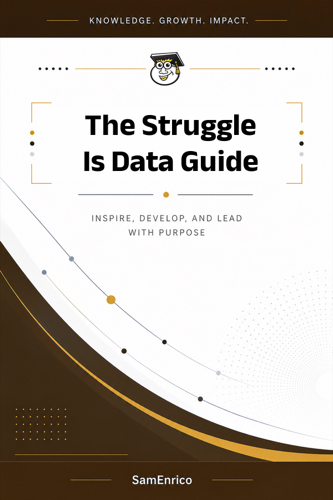
Non-FictionSelf-HelpProblem Solving
The Struggle Is Data Guide eBook
Teaches interpreting difficulty as information abo
by Battle Kirby
Teaches interpreting difficulty as information about what to practice, not about ability.
Formats
Free sample
Chapter 1: The Verdict Reflex--–- The first time I realized struggle was trying to tell me something, I was sitting on a worn-out yoga mat in a lukewarm studio, watching a sixty-two-year-old grandmother balance on one hand while I could barely touch my shins. Her name was Margaret. She had survived two hip replacements and a decade of arthritis. I was thirty-four, ran three times a week, and had no medical excuses for my rigidity. Yet there I was, red-faced and frustrated, while Margaret smiled through a pose that looked like a human pretzel.
After class, I did what any reasonable person would do: I apologized to the instructor for being terrible. The instructor, a patient woman named Priya, said something that cracked open everything I thought I knew about difficulty. She said, “You aren’t terrible. You’re just reading the data wrong.”I had no idea what she meant. Data?
I was trying to touch my toes. But Priya explained that my hamstrings were tight not because I was “inflexible” as an identity, but because I had spent fifteen years sitting in office chairs. The struggle I felt—that burning, frustrating limit—was not a verdict on my worth as a human being. It was a specific piece of information about exactly which muscles needed attention. The tightness was not the problem.
The tightness was the map.That conversation changed how I understood every difficulty that followed. It turned out that the same principle applied to math anxiety, public speaking dread, relationship arguments, creative blocks, and even the way I parented my children. Every time I hit a wall, I had been translating “this is hard” into “I am not enough.” But what if that translation was not only wrong but backward? What if the difficulty itself contained the precise coordinates for what to practice next?This book is built on that single inversion. The struggle is not the verdict.
The struggle is the data.The Translation Error That Runs Your Life Let me name the hidden mechanism that causes most of the suffering around learning, growth, and change. I call it The Verdict Reflex.The Verdict Reflex is an automatic, split-second translation that your brain performs whenever you encounter difficulty. It takes the raw sensation of struggle—frustration, confusion, slowness, awkwardness, failure—and instantly converts it into a statement about your fixed identity. The formula looks like this:Difficulty + The Verdict Reflex = “I am not a [blank] person.”I am not a math person.I am not a public speaker.I am not a patient parent.I am not a writer.I am not coordinated enough.I am not smart enough.I am not disciplined enough.Notice what happens in that translation. The specific, temporary, solvable problem (I don’t understand this equation, I feel nervous before a crowd, I lost my temper yesterday) becomes a permanent, global, unsolvable indictment of your core self.
You cannot change “not a math person” because that sounds like a genetic fact, like having brown eyes or being left-handed. But you can change “I haven’t learned this equation yet.” The Verdict Reflex closes the door before you even try the knob.Here is the research that haunts me every time I think about this. Psychologist Carol Dweck spent decades studying how students respond to difficulty. In one famous study, she gave fifth graders a set of puzzles. Some were easy.
Some were very hard. After the hard puzzles, one group of students said things like “I’m not good at this” or “I’ve never been good at puzzles.” Those students gave up faster, chose easier puzzles afterward, and showed declining performance. The other group said things like “I almost got it” or “I need to try a different strategy.” Those students persisted longer, chose harder puzzles, and improved. The same difficulty. Two different translations.
Completely different trajectories.The first group had activated the Verdict Reflex. The second group had not.Here is what makes this insidious: The Verdict Reflex feels like self-knowledge. It feels like honesty. “I’m just being realistic,” people tell me. “I know my limits.” But that’s the trap.
The Verdict Reflex disguises itself as humility when it is actually a self-fulfilling prophecy. You conclude you are not a math person, so you stop practicing math, so you never improve at math, which proves you were right about not being a math person. The reflex creates the evidence for its own accuracy. It is a closed loop.The Difference Between Performance and Learning To break the loop, we need a new distinction. This distinction is the foundation of everything that follows in this book.Performance is what you can do right now, in this moment, with your current level of skill.Learning is the process of updating your internal software so that future performance improves.These two things feel completely different.
Performance feels smooth, automatic, confident. Learning feels awkward, slow, mistake-ridden. The problem is that most of us have been trained to value performance and avoid learning. Schools grade performance. Work rewards performance.
Social media displays performance. Learning, by contrast, looks bad. It looks like failure. It looks like being a beginner.But here is the truth that changes everything: You cannot improve without making performance temporarily worse.Every time you learn something new, you have to dismantle an old habit or build a new pathway. That process is inefficient.
It feels like going backward. A pianist learning a new fingering pattern will sound worse for weeks before sounding better. A manager learning to delegate instead of control will make messes before things run smoothly. A writer learning a new structure will produce awkward sentences before finding flow. The feeling of struggle is not a sign that you are doing something wrong.
It is the friction of updating.Think about your computer. When it installs an operating system update, what happens? It slows down. Fans spin up. Programs become unresponsive.
The screen flickers. If you didn’t know what was happening, you might think your computer was breaking. But the slowdown is not a malfunction. It is the cost of upgrading. Your brain works the same way.
When you are learning something that matters, your mental fans spin up. You feel slow, confused, and clumsy. That is not evidence of broken hardware. That is evidence that new software is being written.The Verdict Reflex mistakes the slowdown for a crash. It says “See?
You can’t do this.” But the data point—the actual information contained in the struggle—is simply “Update in progress.”Why Effort Is Not the Enemy (But Also Not the Whole Answer)At this point, someone usually raises their hand and says, “So you’re saying I just need to try harder?” No. That is a common misunderstanding, and I want to be very clear about it from the beginning.Angela Duckworth’s research on grit, which I admire deeply, showed that effort predicts achievement above and beyond talent. In her studies at West Point, the National Spelling Bee, and Chicago public schools, the grittier students outperformed the more naturally talented ones. Effort counts twice: effort builds skill, and effort makes skill productive.But grit without direction is just thrashing.…
This is the end of the free sample. Get the eBook to keep going. Buy now
About this book
Details
- Author
- Battle Kirby
- Publisher
- SamEnrico
- Language
- English
- Genre
- Non-Fiction, Self-Help, Problem Solving
- Released
- 2026-06-10
- Pages (approx.)
- 158
- Available as
- eBook, Audiobook

Read better in the ZLOADR app
Your eBooks on your phone or tablet. Sign in with your SamEnrico account and start reading.
More by Battle Kirby
 Nutrition for Brain RecoveryBattle Kirby$11.99
 Automation Engineering CreativityBattle Kirby$11.99
 Fluency Persuasion TechniqueBattle Kirby$11.99
 The Italian Longevity DietBattle Kirby$11.99
 The Silent Senator: The Untold Story of Hiram Rhodes RevelsBattle Kirby$11.99
 Customer Engagement ManagerBattle Kirby$11.99
 YC African Startup Pitch DeckBattle Kirby$12.99
 VAT Automation ToolsBattle Kirby$12.99
 Understanding Tuberculous MeningitisBattle Kirby$17.99
 How to Start a Camels (dromedary) Raising and Breeding Business (Beginners Guide)Battle Kirby$11.99
You may also like
 Hong Kong Handover 1997Dunn Johnnie$11.99
 Zumba For Postnatal Recovery CourseNeal Christian$11.99
 Zumba for BeginnersLadner Nikia$11.99
 YouTube Comment Mining GuideHumes Pandora$12.99
 Worry Box MeditationCarlin Rudy$11.99
 Workplace Stress MeditationNguyen Lynn$11.99
 Workplace Stress and Sleep RepairHawley Ivory$11.99
 Workplace Perfectionism CureDelaney Jeffry$11.99
 Workplace Injustice Anger GuideWallen Isabelle$11.99
 Work Addiction and Burnout LinkGreenwood Ester$11.99
 Women in Yoga and WellnessBeattie Galina$11.99
 Women in Stand Up ComedyChun Evangeline$11.99