
Non-FictionHealth & WellnessExercise Science
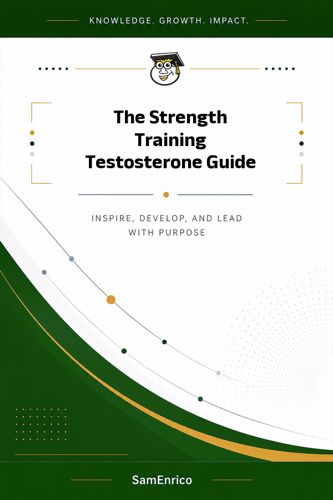
The Strength Training Testosterone Guide eBook
Shows how heavy compound lifts naturally increase
Shows how heavy compound lifts naturally increase T levels.
Formats
Free sample
Chapter 1: The Ghost in the Gym--–- The man who walked into my office that Tuesday morning didn’t look sick. He looked like a ghost. Forty-two years old, father of two, vice president at a regional bank, six feet tall, 220 pounds. By every external metric, he was successful. But when he sat down across from me, he couldn’t look me in the eye.
His shoulders were rounded forward from fourteen years of desk work. His hands trembled slightly—not from nerves, but from the third cup of coffee he’d already had that morning just to stay awake. And when he spoke, his voice carried the particular flatness of someone who has given up hoping for a different answer.“I don’t know what happened to me,” he said. “I used to be… different.”His name was Mark. And Mark was the reason I wrote this book.Three years earlier, Mark had been what he called “a normal guy.” Not an athlete, not a bodybuilder, but functional.
He played pickup basketball on weekends. He carried his daughters up the stairs when they fell asleep on the couch. He woke up most mornings with energy and, yes, with the kind of drive that made his wife smile when he reached for her in the dark. Then, somewhere between his thirty-ninth and fortieth birthdays, the floor dropped out. He started needing a nap after lunch.
His gym membership went unused for months at a time. The weekend basketball games became spectating events. His libido didn’t disappear so much as it went into hibernation—present in theory, absent in practice.His doctor ran bloodwork. The results came back: total testosterone, 287 ng/d L.The reference range on the lab report said 300 to 1,000 was “normal.” Mark was below normal. His doctor used the phrase “low testosterone” and offered him a prescription for a topical gel.
Mark declined. Not because he was opposed to medication, but because he couldn’t shake the feeling that something about this was wrong. He wasn’t old. He wasn’t sick. He hadn’t been in a car accident or suffered some catastrophic illness.
He had simply… faded. And now a doctor wanted to put him on a lifelong prescription? For what? For having a desk job? For being tired?That’s when Mark found me.
And that’s when I told him something no doctor had said, something no men’s health website had mentioned, something that would fundamentally change not just his body but the way he understood himself.“Mark,” I said, “you don’t need testosterone replacement. You need to start a fight.”He looked confused. “A fight? With who?”“With gravity. With the floor.
With a loaded barbell. You need to start fighting something heavy, twice a week, for the rest of your life. Not because you want to be a bodybuilder. Because you want your body to remember that it’s alive.”He thought I was joking. I was not.Three months later, Mark’s total testosterone was 468 ng/d L.
No gel. No injections. No magic supplement. Just a barbell, a squat rack, and the willingness to be uncomfortable for forty-five minutes, three days a week. By the end of a year, his testosterone had stabilized at 512 ng/d L—well within the healthy range for a man his age.
More importantly, the ghost was gone. He looked me in the eye again. His shoulders were back. His voice had weight.“I didn’t know I was allowed to feel like this,” he told me.This book exists because most men don’t know they’re allowed to feel like this. They’ve been told that low testosterone is a natural part of aging.
They’ve been told that the only solutions are prescriptions, patches, or expensive supplements that don’t work. They’ve been told that feeling tired, weak, and emotionally flat is just what happens when you hit forty. And they’ve been told—implicitly or explicitly—that the gym is for young men, for bodybuilders, for people who already know what they’re doing.Every single one of those messages is a lie.The truth is that the vast majority of low testosterone cases in men under sixty are not medical problems at all. They are adaptation problems. Your body has adapted to a sedentary, low-stimulus, high-stress environment.
It has downregulated your testosterone production because, from your body’s perspective, you have signaled that you don’t need it. You sit instead of squat. You click instead of carry. You scroll instead of lift. And your endocrine system, which evolved over millions of years to respond to physical demands, has simply followed your lead.This chapter is your diagnostic.
It will not tell you to start lifting heavy weights yet—that comes in Part II. First, you need to understand exactly what has happened to your body, why it happened, and why the solution is not a prescription but a reset. You need to distinguish between a real medical condition and a lifestyle-induced suppression. You need to understand the concept of anabolic resistance—the reason your body stopped listening to exercise. And you need to hear the promise that drives this entire book: that the mechanical force of heavy lifting triggers a process called mechanotransduction, which can wake up your dormant testosterone production faster than any pill on the market.By the end of this chapter, you will know whether you are a candidate for this protocol.
And you will understand that the man in the mirror has not disappeared. He has simply been waiting for you to send a different kind of signal.The Numbers Don’t Lie: The Low-T Epidemic Let’s start with the data, because the data is both alarming and liberating. Alarming because it reveals the scope of the problem. Liberating because it proves that the problem is not you—it’s the environment.Between 1980 and 2020, average testosterone levels in American men declined by approximately 25 to 30 percent, even after controlling for age, body mass index, and other known confounders. A landmark 2007 study in the Journal of Clinical Endocrinology & Metabolism analyzed data from over 1,500 men and found that a sixty-year-old man in 2000 had significantly lower testosterone than a sixty-year-old man in 1980.
The decline was not age-related. It was generation-related. Something in the modern environment was systematically suppressing male androgen production.What is that something? The short answer is: everything.The long answer includes the following major contributors, all of which will be addressed in detail throughout this book:Sedentary Behavior: The average American man sits for 9.5 hours per day. Prolonged sitting has been shown to reduce levels of lipoprotein lipase (an enzyme that breaks down fat) by up to 90 percent, increase systemic inflammation, and directly suppress the hypothalamic-pituitary-gonadal axis.
Your body was designed to move, to load, to struggle against gravity. When you stop doing those things, your endocrine system reads that as a signal that reproduction and vitality are no longer priorities.Obesity and Body Fat: Adipose tissue (fat cells) contains an enzyme called aromatase, which converts testosterone into estrogen. The more body fat you carry, the more of your testosterone is being…
This is the end of the free sample. Get the eBook to keep going. Buy now
About this book
Details
- Author
- Shrader Lamont
- Publisher
- SamEnrico
- Language
- English
- Genre
- Non-Fiction, Health & Wellness, Exercise Science
- Released
- 2026-06-05
- Pages (approx.)
- 152
- Available as
- eBook, Audiobook

Read better in the ZLOADR app
Your eBooks on your phone or tablet. Sign in with your SamEnrico account and start reading.
More by Shrader Lamont
 Finance Essay PromptsShrader Lamont$11.99
 Smart Watch Distraction Management HandbookShrader Lamont$11.99
 Jamaican BPO Tax Incentive GuideShrader Lamont$11.99
 Corporate Boardroom Anger ProtocolShrader Lamont$11.99
 The Charge of the Light Brigade: Courage and Catastrophe at BalaclavaShrader Lamont$11.99
 Electronic Components M&AShrader Lamont$12.99
 YouTube Community Tab GuideShrader Lamont$12.99
 Bird Survey Crew LeadShrader Lamont$11.99
 Understanding PoliosophobiaShrader Lamont$17.99
 How to Become a Nurse-midwifeShrader Lamont$11.99
You may also like
 Hong Kong Handover 1997Dunn Johnnie$11.99
 Zumba For Postnatal Recovery CourseNeal Christian$11.99
 Zumba for BeginnersLadner Nikia$11.99
 YouTube Comment Mining GuideHumes Pandora$12.99
 Worry Box MeditationCarlin Rudy$11.99
 Workplace Stress MeditationNguyen Lynn$11.99
 Workplace Stress and Sleep RepairHawley Ivory$11.99
 Workplace Perfectionism CureDelaney Jeffry$11.99
 Workplace Injustice Anger GuideWallen Isabelle$11.99
 Work Addiction and Burnout LinkGreenwood Ester$11.99
 Women in Yoga and WellnessBeattie Galina$11.99
 Women in Stand Up ComedyChun Evangeline$11.99