
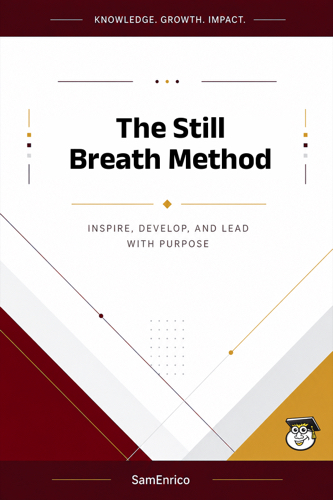
Non-FictionSelf-HelpAdvanced Meditation
The Still Breath Method eBook
Observes breath when it becomes so subtle it nearl
Observes breath when it becomes so subtle it nearly disappears.
Formats
Free sample
Chapter 1: The Breath You’ve Never Taken...--–- You are about to discover that you have been breathing incorrectly your entire life. Not dangerously—your body is too intelligent for that. But inefficiently. The breath that has kept you alive has also, paradoxically, been keeping you trapped in a low-grade state of anxiety, distraction, and fatigue. You have never taken a still breath.
And that single fact explains more about your daily stress than you realize.This is not another book about “taking a deep breath.” The wellness industry has sold you a comfortable lie: that more air is better air, that deep breathing is the answer to everything from panic attacks to productivity. But what if the opposite were true? What if the most powerful breath you could take was the one you barely noticed? What if the space between your breaths—the pause you have been rushing past—was actually the gateway to a level of calm you have only glimpsed in rare, accidental moments?The Still Breath Method is built on a paradox that will take the entirety of this book to unfold: the less you do with your breath, the more your breath does for you. When you stop forcing, controlling, and “optimizing” your respiration, something remarkable emerges.
The breath becomes so subtle, so feather-light, that it nearly disappears. And in that disappearance, you discover something you have been seeking through meditation apps, yoga classes, and self-help books: a mind that is quiet not because you silenced it, but because it finally has nothing to react to.This chapter will introduce you to the radical idea that you have been “breath-blind” your entire life. You will learn why most people operate in a chronic state of over-breathing, why “deep breathing” can actually make anxiety worse, and how a single diagnostic exercise will reveal your personal breath baseline. Most importantly, you will meet the four levels of the Witnessing Ladder—the framework that will guide you from forceful, effortful breathing to the effortless stillness that is your birthright.The Breath-Blindness Epidemic Walk into any coffee shop, airport, or office, and observe the people around you. Look at their upper chests.
Notice the slight, rapid rise and fall—shallow, incomplete, rushed. Watch their shoulders. They are subtly lifted, as if preparing for a blow that never comes. Listen closely, and you might hear the faint sighing that punctuates their speech, the unconscious gasp that follows a stressful email, the held breath that accompanies concentration.This is the face of breath-blindness: the inability to perceive one’s own breathing except in moments of extreme distress or deliberate attention. Most human beings take between 15 and 20 breaths per minute.
They inhale through their mouths, drawing air into the upper lungs only. They never fully exhale—each breath leaves a residue of stale air in the bottom of the lungs, like a room that is never fully ventilated.The consequences are not merely physiological. They are psychological, emotional, and even spiritual. A breath that is rapid, shallow, and irregular signals to the nervous system that danger is present. The brainstem, that ancient sentinel at the base of your skull, cannot distinguish between a genuine threat (a predator, a falling object) and a chronic breathing pattern.
It only knows the data it receives: rapid inhalation, incomplete exhalation, a chest that never fully relaxes.So it keeps your sympathetic nervous system—the fight-or-flight response—on low but constant alert. Your cortisol levels remain elevated. Your heart rate stays slightly too high. Your digestion slows. Your immune system operates at reduced capacity.
And you feel it as a vague, background hum of anxiety that you have come to accept as normal. “I’m just a stressed person,” you tell yourself. “That’s just how I am.”But what if it isn’t? What if the hum is not your personality but your breathing pattern?The Myth You Have Been Sold Before we go further, we must dismantle a belief so pervasive that it has become invisible: the idea that “deep breathing” is always beneficial.Open any wellness blog, listen to any meditation app, attend any yoga class. You will hear the same instruction: “Take a deep breath.” The assumption is that more air equals more calm, that a larger inhale equals a larger release of tension.
This is not merely oversimplified. It is, in many cases, exactly wrong.Here is what actually happens when you take a forced, conscious deep breath. You engage your accessory breathing muscles—the scalenes, the sternocleidomastoid, the upper trapezius. These are not designed for primary respiration. They are emergency muscles, recruited only when the body genuinely needs more oxygen.
By using them voluntarily, you are simulating a state of respiratory distress.Your brain receives this signal. It cannot read your intention. It only reads the data: unusual muscle recruitment, rapid movement of the rib cage, a sudden drop in blood CO2 (a condition called hypocapnia). And it interprets this data the only way it knows how: as a threat. The sympathetic nervous system activates.
Your heart rate increases. Your palms may sweat. You feel—paradoxically—more anxious than before you “took a deep breath.”This is not theoretical speculation. Research from the field of polyvagal theory, developed by Dr. Stephen Porges, demonstrates that the body’s primary stress response is mediated through the vagus nerve, which is directly influenced by breathing patterns.
Rapid, deep breathing stimulates the sympathetic branch. Slow, gentle, barely perceptible breathing stimulates the parasympathetic branch—the “rest and digest” system.The key word is “barely perceptible.” The most therapeutic breath is not the one you feel. It is the one you almost miss.The Paradox of Stillness Here is the central insight of this book: stillness creates energy. Effort creates fatigue.This is counterintuitive. We have been raised in a culture that equates effort with virtue, struggle with progress, intensity with effectiveness.
If something is valuable, we believe, it must require sweat, strain, and suffering. But the breath operates under different laws.Consider the heart. Its most regenerative moment is not the contraction (systole) but the pause between beats (diastole). In that fraction of a second, the heart muscle refills with blood, recharges its electrical potential, and rests. Without that pause, the heart would fail within minutes.The breath follows the same logic.
The most regenerative moment is not the inhale (acquisition) or even the exhale (release). It is the pause between them—the stillness where the body recalibrates, the nervous system resets, and the mind briefly touches silence.Ancient yogic traditions called this pause Kumbhaka. They distinguished between two types: retention after inhale (Antara Kumbhaka), which builds heat and energy, and retention after exhale (Bahya Kumbhaka), which induces stillness and surrender. This book focuses primarily on the second—the pause after the exhale, which we will call simply “The Gap.”In The Gap, something remarkable happens. The urge to breathe rises.
It begins as a subtle tickle, then a gentle pressure, then a compelling force. Most people obey this urge immediately, rushing to the next inhale as if their lives depended on it. But the practitioner of The Still Breath Method does something different. She…
This is the end of the free sample. Get the eBook to keep going. Buy now
About this book
Details
- Author
- Bedford Alejandra
- Publisher
- SamEnrico
- Language
- English
- Genre
- Non-Fiction, Self-Help, Advanced Meditation
- Released
- 2026-06-07
- Pages (approx.)
- 106
- Available as
- eBook, Audiobook

Read better in the ZLOADR app
Your eBooks on your phone or tablet. Sign in with your SamEnrico account and start reading.
More by Bedford Alejandra
 Data Processing Agreement AI ReviewBedford Alejandra$11.99
 The Koresh FBI Negotiation LogsBedford Alejandra$11.99
 Myths About EmotionsBedford Alejandra$11.99
 Self Esteem for Military TransitionBedford Alejandra$11.99
 Deep Sea Bends PreventionBedford Alejandra$11.99
 Social Connection Against BurnoutBedford Alejandra$11.99
 Egyptian HieroglyphsBedford Alejandra$11.99
 Architecture Student PalaceBedford Alejandra$11.99
 The Last Play: How a Legend Fell from GraceBedford Alejandra$11.99
 The Last Light of Icarus: The Rise and Fall of the Space Shuttle ProgramBedford Alejandra$11.99
 Frozen Rivalry: Amundsen vs. Scott – The Ultimate Polar DuelBedford Alejandra$11.99
 How to Start a Pool Halls BusinessBedford Alejandra$11.99
You may also like
 Hong Kong Handover 1997Dunn Johnnie$11.99
 Zumba For Postnatal Recovery CourseNeal Christian$11.99
 Zumba for BeginnersLadner Nikia$11.99
 YouTube Comment Mining GuideHumes Pandora$12.99
 Worry Box MeditationCarlin Rudy$11.99
 Workplace Stress MeditationNguyen Lynn$11.99
 Workplace Stress and Sleep RepairHawley Ivory$11.99
 Workplace Perfectionism CureDelaney Jeffry$11.99
 Workplace Injustice Anger GuideWallen Isabelle$11.99
 Work Addiction and Burnout LinkGreenwood Ester$11.99
 Women in Yoga and WellnessBeattie Galina$11.99
 Women in Stand Up ComedyChun Evangeline$11.99