
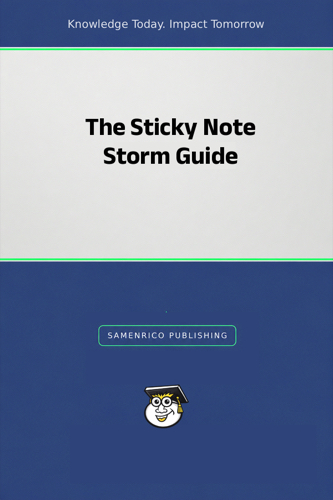
Non-FictionSelf-HelpSticky Notes
The Sticky Note Storm Guide eBook
Uses physical or digital sticky notes for idea clu
Uses physical or digital sticky notes for idea clustering.
Formats
Free sample
Chapter 1: The Spreadsheet Lie--–- Every Monday morning at 9 AM, the product team at a midsize Saa S company called Bright Path gathered to review their "Innovation Pipeline." The spreadsheet was immaculate. Color-coded columns. Weighted scoring. ROI projections calculated to two decimal places. The CEO loved it.
The investors loved it. The team hated it—not because the spreadsheet was wrong, but because it was sterile. They had stopped proposing bold ideas months ago. Why bother? The spreadsheet's algorithm always favored safe bets: "optimize login flow" over "reinvent onboarding," "fix button color" over "explore voice interface." The spreadsheet wasn't evil.
It was just linear. And linear thinking, when applied to nonlinear problems, kills creativity before it can breathe.This chapter reveals why sticky notes beat spreadsheets—not as a nostalgic preference for analog tools, but as a matter of cognitive science. You will learn how spatial memory unlocks patterns that rows and columns hide, why "controlled chaos" is a prerequisite for breakthrough ideas, and the one non-negotiable rule that separates productive storms from messy piles. By the end, you will never open Excel before a brainstorming session again.The Cognitive Science of Sticky Notes Your brain is not a computer. It does not process information in tidy rows and columns.
Instead, the hippocampus—your brain's memory center—is optimized for spatial navigation. For millions of years, humans survived by remembering where things were: the berry bush was near the big rock, the river was east of the cave, the predator's den was past the fallen tree. This is called spatial memory, and it is extraordinarily powerful.When you place a sticky note on a physical wall, your brain encodes its location automatically. You don't have to try. You will remember, days later, that the note about "user trust" was in the top-left corner, near the window, just above the note about "security warnings." This spatial map becomes a mental index.
When you need to recall that insight, your brain navigates back to that location. The wall becomes an external hard drive for your hippocampus.Digital tools mimic this effect. Infinite canvases in Miro and Mural preserve spatial relationships. You can zoom out and see the entire "landscape" of ideas. The brain treats a well-organized digital board much like a physical room.
However, digital tools have one advantage physical walls lack: undo/redo functions reduce the fear of making mistakes. On a physical wall, moving a note feels permanent. Digitally, you can experiment wildly, knowing that Ctrl+Z is your safety net. The best teams use both—physical for initial divergence, digital for iterative convergence.Spreadsheets have no spatial dimension. A row is a row.
Column B is no different from Column F. Your brain cannot navigate a spreadsheet spatially because there is no there there. You remember formulas, not locations. You remember values, not relationships. This is why spreadsheet-driven brainstorming feels like swimming in molasses: your brain is working against its own biology.The Case for Chaos: Why Premature Convergence Kills Ideas Most teams cluster too early.
They write a few notes, see a pattern, and immediately start grouping. This is premature convergence—the enemy of innovation. When you cluster too early, you force ideas into categories that may not be the right categories. You shut down ambiguity before it has revealed its value.Divergent thinking requires mess. The mess is not a bug; it is a feature.
In the messy middle, ideas collide. A note about "slow checkout" sits next to a note about "customers don't trust the payment badge." A separate note about "shipping costs hidden until last step" is three feet away. Only when you see all three together—spatially—do you realize they are the same problem. But if you had clustered "checkout issues" after only ten notes, you would have missed the connection.Controlled chaos is the solution. The rules are simple: no hierarchies, no judgment, no clustering until all notes are on the wall.
Every idea gets the same size note. Every person gets the same number of minutes to write. The chaos is controlled by time, not by categories. This is the opposite of a spreadsheet. A spreadsheet imposes order immediately—every idea must fit into a column.
A sticky note wall postpones order until after all ideas are visible. That delay is where the magic happens.Real-world evidence: A study from the University of California found that teams who brainstormed without any structure generated 37% more novel ideas than teams who used structured templates. However, those same unstructured teams struggled to synthesize their ideas. The solution is not chaos or structure—it is chaos followed by structure. Sticky notes provide the chaos phase.
Clustering (Chapters 5-7) provides the structure phase. Spreadsheets try to do both at once and succeed at neither.Comparing the Top 3 Methods Before you storm, you must choose your weapon. Three dominant methods exist, each with a different balance of silence, speed, and group size. This book primarily uses the KJ Method (best for deep problems), but you should understand all three.The KJ Method (Japan)Named after anthropologist Jiro Kawakita, the KJ Method is the gold standard for wicked problems—those with no clear right answer. The steps are: (1) write notes silently, (2) post them simultaneously, (3) sort into groups silently, (4) name each group, (5) diagram relationships between groups.
The entire process is nonverbal until the naming phase. This forces participants to engage with the ideas, not the people behind them. The KJ Method is best for teams that struggle with groupthink, hierarchy, or loud voices. It takes longer (90-120 minutes) but produces deeper insights.Affinity Diagramming (Western)Developed by Kawakita's Western counterparts, affinity diagramming is similar but more verbal. Teams write notes, then discuss where each note belongs.
The facilitator reads notes aloud, and the group negotiates placement. This is faster (45-60 minutes) and works well for teams that already have high trust and psychological safety. However, it is vulnerable to the "loud voice problem"—extroverts and senior people will influence the grouping. Use affinity diagramming for routine problems, not breakthrough challenges.Octopus Clustering A hybrid method designed for large groups (8-20 people). Everyone stands around the wall simultaneously and moves notes into groups.
No talking for the first 15 minutes. You can only move one note at a time. This creates a "many hands" effect—clusters emerge organically from collective action. Octopus clustering is chaotic and exhilarating. It is best for generating alignment quickly, but it can miss subtle distinctions.
This book's Silent Sorting Ceremony (Chapter 5) is a formalization of Octopus Clustering.Which method does this book use? The Sticky Note Storm Guide primarily teaches the KJ Method because it is the most robust for difficult problems. However, Chapter 5 includes modifications for affinity diagramming (verbal sorting) and Octopus Clustering (large groups). You will learn all three, but master the KJ Method first.The "One Idea Per Note" Rule: Non-Negotiable If you take nothing else from this chapter, remember this rule: One idea per note. It sounds simple.
It is not. Your team will fight it. Someone will write "improve mobile experience AND fix desktop navigation" on a single note. Someone else will write a numbered list. A third person will write…
This is the end of the free sample. Get the eBook to keep going. Buy now
About this book
Details
- Author
- Leavitt Tracey
- Publisher
- SamEnrico
- Language
- English
- Genre
- Non-Fiction, Self-Help, Sticky Notes
- Released
- 2026-06-08
- Pages (approx.)
- 134
- Available as
- eBook, Audiobook

Read better in the ZLOADR app
Your eBooks on your phone or tablet. Sign in with your SamEnrico account and start reading.
More by Leavitt Tracey
 Addiction Recovery Charity Fraud HandbookLeavitt Tracey$11.99
 Whole30 for Food AddictionLeavitt Tracey$11.99
 Blue Zone Water Quality GuideLeavitt Tracey$11.99
 Funeral Small Talk GuideLeavitt Tracey$11.99
 The Blood and the Blueprint: Rome's Architectural RevolutionLeavitt Tracey$11.99
 Artificial Intelligence: The Future is NowLeavitt Tracey$11.99
 Referral CAC ReductionLeavitt Tracey$12.99
 Founder Depression During Product LaunchLeavitt Tracey$12.99
 Understanding Wohlwill–andrade SyndromeLeavitt Tracey$17.99
 How to Start a Photograph Developing Business (Beginners Guide)Leavitt Tracey$11.99
You may also like
 Hong Kong Handover 1997Dunn Johnnie$11.99
 Zumba For Postnatal Recovery CourseNeal Christian$11.99
 Zumba for BeginnersLadner Nikia$11.99
 YouTube Comment Mining GuideHumes Pandora$12.99
 Worry Box MeditationCarlin Rudy$11.99
 Workplace Stress MeditationNguyen Lynn$11.99
 Workplace Stress and Sleep RepairHawley Ivory$11.99
 Workplace Perfectionism CureDelaney Jeffry$11.99
 Workplace Injustice Anger GuideWallen Isabelle$11.99
 Work Addiction and Burnout LinkGreenwood Ester$11.99
 Women in Yoga and WellnessBeattie Galina$11.99
 Women in Stand Up ComedyChun Evangeline$11.99