
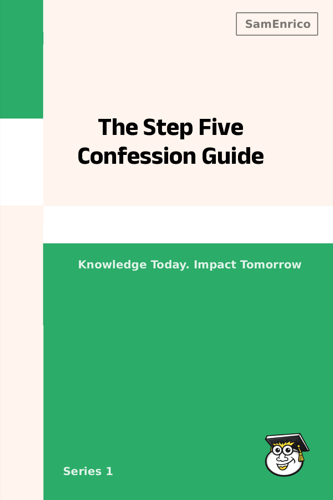
Non-FictionSelf-HelpConfession
The Step Five Confession Guide eBook
Admit exact nature of wrongs to another human bein
by Finch Keshia
Admit exact nature of wrongs to another human being with preparation and discernment.
Formats
Free sample
Chapter 1: The Wall Crumbles...--Every secret you have ever kept is still alive inside you. Not as a memory—memories fade. But as an active, metabolically expensive burden that your brain carries as if it were a physical weight. This is not metaphor. This is neurology.You have likely spent years, perhaps decades, building a fortress.
Each brick is a truth you decided no one could ever know. A failure you buried. A harm you caused but never admitted. A shame so deep you convinced yourself that if anyone saw it, they would walk away and never come back. Brick by brick, you constructed a wall of isolation.
And now you are trapped inside it, wondering why you feel so alone even when you are surrounded by people who claim to love you.The problem is not that you have done terrible things. Almost everyone has. The problem is that you have been trying to carry those things alone.This chapter is about why secrecy keeps you sick, why courage is the only way out, and why the bridge to freedom is built not by forgetting your past but by finally speaking it aloud to another human being. By the time you finish this chapter, you will understand why Step Five is not a punishment but a rescue. And you will be ready to begin the work of dismantling the wall, brick by brick, until you can see the sky again.The Weight of Unspoken Things Let us begin with a simple experiment.
Think of one thing you have never told anyone. Not the worst thing necessarily—just something you have kept hidden. Now notice what happens in your body. Does your chest tighten? Do your shoulders rise toward your ears?
Does your stomach clench? That is not anxiety about the memory itself. That is the physiological cost of active secrecy.Research from the field of psychoneuroimmunology has demonstrated that keeping secrets is not merely emotionally draining but physically exhausting. When you hide a truth, your brain remains in a state of low-grade vigilance, constantly monitoring for any threat of discovery. This is not a choice you make consciously.
It is an ancient survival mechanism, leftover from a time when expulsion from the tribe meant death. Your nervous system cannot distinguish between "if they find out about the affair, I might lose my marriage" and "if they find out I stole food, I might be banished from the cave." The response is identical: hypervigilance, elevated cortisol, disrupted sleep, and a persistent sense of danger.This is the first thing you need to understand about Step Five. You are not being asked to confess because you are bad. You are being asked to confess because the weight of unspoken things is killing you.The metaphor of the wall of isolation comes directly from the foundational literature of twelve-step recovery. In the AA Big Book, the authors describe the alcoholic as someone who has "shut himself off from the sunlight of the Spirit" by building a fortress of resentments, fears, and secrets.
But modern shame research has given us even more precise language. Brené Brown, whose work on vulnerability has reshaped our understanding of shame, writes that shame cannot survive being spoken. It thrives in silence, secrecy, and judgment. The moment you speak your shame aloud to someone who responds with empathy, shame loses its power.But here is the catch. You cannot speak your shame to just anyone.
You cannot whisper it into a void and expect to feel better. And you certainly cannot keep it locked inside while pretending that self-help books or positive thinking will make it go away. The wall must come down through an act of courage that is both terrifying and liberating: full, honest, fearless disclosure to another human being who has earned the right to hear it.The Difference Between Guilt and Shame Before we go any further, we need to make a crucial distinction. Most people use the words guilt and shame interchangeably. They are not the same thing.
And confusing them has kept countless people trapped in unnecessary suffering.Guilt is about behavior. "I did something bad."Shame is about identity. "I am bad."Guilt can be healthy. When you feel guilty about something you did, that guilt motivates repair. You apologize.
You make amends. You change your behavior. Guilt is the emotional signal that you have violated your own values, and that signal can guide you back to integrity.Shame, by contrast, is almost never productive. Shame says that the thing you did is not an action but an identity marker. You did not lie; you are a liar.
You did not hurt someone; you are a hurtful person. Shame attaches to your core self, and because you cannot amputate your core self, shame becomes a life sentence. There is no repair from shame because shame tells you that you are beyond repair.Here is what the best recovery literature agrees on: Step Five is designed to target shame, not guilt. Your guilt will be addressed in later steps when you make amends. But Step Five is where shame goes to die.
Because shame can only live in darkness. The moment you speak your worst truth to another human being and that person does not recoil, does not leave, does not confirm your worst fears about yourself—the shame narrative collapses. You cannot simultaneously hold the belief "I am unlovable" while experiencing someone listening to your worst confession and staying present.This is why Step Five is often described as the most terrifying and the most transformative of all the steps. It is the step where you gamble everything on the possibility that you are not as alone as you think. And when you win that gamble, you do not just feel better.
You become someone new.The Self-Assessment No One Wants to Take Let us be honest with each other. You picked up this book for a reason. Maybe you have been in recovery for years and have never fully completed Step Five. Maybe you are new to the steps and have been dreading this one since you first heard about it. Maybe you are not even in a twelve-step program but have been carrying secrets so long that you can barely remember what it felt like to be light.Wherever you are, start here.
Take out a piece of paper or open a note on your phone. Answer the following questions as honestly as you can. No one else will see this but you.One: How many people in your life currently know the full truth about your struggles? Not the edited version. Not the version that makes you look good.
The full, unfiltered truth about your failures, your fears, and the harms you have caused. Count them. If the number is zero, you are living behind the wall of isolation.Two: When was the last time you said aloud, to another person, the thing you are most ashamed of? If the answer is "never" or "I cannot remember," you have been carrying that secret alone for too long.Three: What do you believe would happen if someone knew the worst thing…
This is the end of the free sample. Get the eBook to keep going. Buy now
About this book
Details
- Author
- Finch Keshia
- Publisher
- SamEnrico
- Language
- English
- Genre
- Non-Fiction, Self-Help, Confession
- Released
- 2026-06-09
- Pages (approx.)
- 138
- Available as
- eBook, Audiobook

Read better in the ZLOADR app
Your eBooks on your phone or tablet. Sign in with your SamEnrico account and start reading.
More by Finch Keshia
 Senior Sleep ConfidenceFinch Keshia$11.99
 Police Officer Shift SleepFinch Keshia$11.99
 Strength Training for MetabolismFinch Keshia$11.99
 Round Robin BrainstormFinch Keshia$11.99
 Design Thinking for Vendor ManagementFinch Keshia$11.99
 Mediterranean Weight LossFinch Keshia$11.99
 Smoking Cessation for Heavy SmokersFinch Keshia$11.99
 The Renaissance of the Game: How a 15th-Century Duke Built Europe's First Sports DynastyFinch Keshia$11.99
 The Bloodied Fields of Sedan: Bismarck's Gambit and France's FallFinch Keshia$11.99
 Service Providers Guide to Cardiovascular SurgeryFinch Keshia$11.99
 How to Produce Inflatable FurnitureFinch Keshia$11.99
 Pitch Your Slash Career to EmployersFinch Keshia$12.99
You may also like
 Hong Kong Handover 1997Dunn Johnnie$11.99
 Zumba For Postnatal Recovery CourseNeal Christian$11.99
 Zumba for BeginnersLadner Nikia$11.99
 YouTube Comment Mining GuideHumes Pandora$12.99
 Worry Box MeditationCarlin Rudy$11.99
 Workplace Stress MeditationNguyen Lynn$11.99
 Workplace Stress and Sleep RepairHawley Ivory$11.99
 Workplace Perfectionism CureDelaney Jeffry$11.99
 Workplace Injustice Anger GuideWallen Isabelle$11.99
 Work Addiction and Burnout LinkGreenwood Ester$11.99
 Women in Yoga and WellnessBeattie Galina$11.99
 Women in Stand Up ComedyChun Evangeline$11.99