
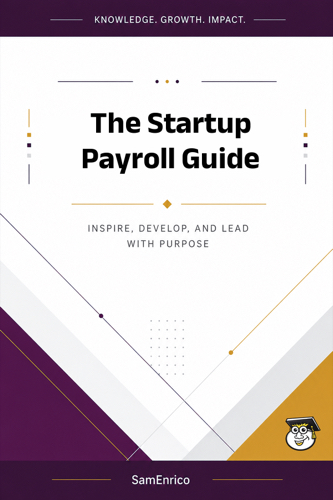
Non-FictionStartup GuidePayroll
The Startup Payroll Guide eBook
Set up payroll for yourself and early employees le
Set up payroll for yourself and early employees legally and affordably.
Formats
Free sample
Chapter 1: The Venmo Trap...--–- The first time Maya Venmo’d her co-founder $8,000 for “payroll,” she thought she was being smart. No payroll service fees. No paperwork. No government forms. Just two taps on her phone and the money was gone from her personal checking account.
Six months later, that single transaction cost her a $2 million acquisition offer.Maya had built Lumina AI, a promising B2B software startup, from her spare bedroom. She had seven paying customers, a working prototype, and a term sheet from a mid-sized tech acquirer. The due diligence team arrived on a Tuesday morning. By Thursday afternoon, they were gone.The problem wasn’t her code. It wasn’t her sales pipeline.
It was her Venmo history.The acquiring company’s auditors had flagged every casual transfer—the $8,000 to her co-founder, the $3,500 to a freelance developer who should have been an employee, the $1,200 in “reimbursements” that had no receipts. The auditors concluded that Lumina AI had no corporate separateness. In their view, Maya had never truly formed a company. She had merely created a bank account and called it a business.The acquirer walked away. Maya’s startup died not from competition, but from commingling.This book exists to ensure that does not happen to you.The Uncomfortable Truth About Startup Payroll Let me state something that every payroll book dances around but rarely says directly: Payroll is not an expense.
It is a legal requirement for maintaining your corporate existence.Most founders treat payroll as an administrative nuisance—something to be minimized, automated, or ignored until the IRS sends a letter. This is precisely backward thinking. The moment you hire someone (including yourself), payroll becomes the single most important compliance function in your company. Not sales. Not product development.
Payroll.Here is why.When you incorporate as an LLC, S-Corp, or C-Corp, you create a separate legal entity. That entity has its own tax ID, its own bank accounts, and its own obligations to the government. One of those obligations is to pay employees—including founders—through a formal payroll system that withholds and remits taxes.When you bypass that system—by Venmo-ing yourself money, writing personal checks, or treating company funds as your personal wallet—you are not saving time or money. You are actively destroying the legal wall that protects your personal assets from business liabilities.This concept is called piercing the corporate veil. And payroll irregularities are one of the fastest ways to pierce it.The $2 Million Venmo: A Deeper Look Maya’s story is not an outlier.
In my research for this book, I reviewed over fifty legal cases where payroll mistakes destroyed startups. The pattern is consistent across all of them:The founder incorporated properly (LLC or corporation).The founder opened a business bank account.The founder then ignored that account for payroll purposes, using personal funds instead.When a lawsuit, audit, or acquisition arose, the court or auditor determined that the founder had never treated the company as a separate entity.The founder lost liability protection and, often, their entire personal net worth.Consider the case of In re Hovis, a 2018 bankruptcy court decision. The founder of a small tech firm had paid himself via personal checks for three years. When the company was sued for breach of contract, the plaintiff argued that the founder’s personal assets should be reachable because he had failed to maintain corporate formalities—specifically, payroll. The court agreed.
The founder lost his house.Or consider IRS v. Galletti, a 2002 Supreme Court case that established that responsible persons (including founders who control finances) can be held personally liable for unpaid payroll taxes even if the corporation is dissolved. The IRS does not need to prove intent. They only need to prove that you had the authority to pay the taxes and did not.These are not edge cases. They are the predictable consequences of treating payroll as optional.The Founder’s False Economy Why do so many founders make this mistake?
Because payroll feels expensive.When you run payroll through a service like Gusto, Rippling, or ADP, you see line items: employer taxes, worker’s compensation, service fees. A typical payroll run for a founder and one employee might cost $150–$250 per month. A founder bootstrapping their company looks at that number and thinks, “I can just Venmo myself and save that money.”This is what I call the Founder’s False Economy.The calculation appears rational on the surface. But it ignores three critical factors:First, the cost of doing payroll incorrectly is orders of magnitude higher than doing it correctly. A single IRS penalty for late deposit of payroll taxes can exceed $1,500.
A state audit for misclassification can reach $75,000 or more. A lost acquisition due to due diligence findings? Potentially millions.Second, payroll services provide compliance infrastructure that you cannot replicate manually. When you use a full-service provider, they automatically file your quarterly Form 941, your annual Form 940, your state unemployment reports, and your W-2s. They track deposit deadlines that change based on your tax liability.
They send new hire reports to the appropriate state agencies. Try doing all of that manually for $150 per month of your time. You cannot.Third, and most importantly, payroll services create an audit trail. Every payroll run generates a record: who was paid, when, how much, what taxes were withheld, when those taxes were deposited. That audit trail is exactly what protects you when the IRS comes calling.
Without it, you have nothing but a Venmo history and a prayer.The Hidden Tax: Your Withheld Money Is Not Yours One of the most dangerous misconceptions among founders is that withheld taxes are somehow negotiable or delayable.Let me be absolutely clear: When you withhold federal income tax, Social Security tax, or Medicare tax from an employee’s paycheck, that money is never yours. Not for a day. Not for an hour. It belongs to the United States government from the moment it leaves the employee’s gross pay.The same applies to state withholding, local withholding, and the employer’s matching portion of FICA taxes.The IRS treats these funds as a trust. You are the trustee.
If you fail to deposit them on time—or, worse, if you use them to pay vendors, rent, or your own salary—you have committed a breach of trust. This is not a metaphor. The legal term is “trust fund taxes,” and the penalties for misusing them are severe.Here is how severe: The Trust Fund Recovery Penalty (TFRP) allows the IRS to collect unpaid payroll taxes directly from any “responsible person” in the company. That includes founders, CEOs, CFOs, and even office managers who have check-signing authority. The penalty is equal to 100% of the unpaid taxes.
And it attaches to your personal assets—your house, your car, your savings account—regardless of whether the corporation is still in business.We will explore the TFRP in depth in Chapter 10, including negotiation tactics and abatement strategies. For now, understand this: the IRS has more power to collect unpaid payroll taxes than almost any other type of tax debt. They do not need a court order. They do not need a conviction.…
This is the end of the free sample. Get the eBook to keep going. Buy now
About this book
Details
- Author
- Richey Donald
- Publisher
- SamEnrico
- Language
- English
- Genre
- Non-Fiction, Startup Guide, Payroll
- Released
- 2026-06-06
- Pages (approx.)
- 140
- Available as
- eBook, Audiobook

Read better in the ZLOADR app
Your eBooks on your phone or tablet. Sign in with your SamEnrico account and start reading.
More by Richey Donald
 Meeting Breakout TimerRichey Donald$11.99
 Zara Fast Fashion ComparisonRichey Donald$11.99
 Bill Withers Lean On MeRichey Donald$11.99
 Breath Awareness Journal WorkbookRichey Donald$11.99
 Autism Time Scheduling GuideRichey Donald$11.99
 Scripting for Career SuccessRichey Donald$11.99
 Deep Work For StudentsRichey Donald$11.99
 The Silent Guardians: Restoring Iraq's Ancient Treasures Amid War (1930s)Richey Donald$11.99
 The Bone Collector: A Siberian Tale of the LeshyRichey Donald$11.99
 Cooperatives and Land Access GuideRichey Donald$12.99
 Hungarian Stock Option Social ContributionsRichey Donald$12.99
 How to Produce PomegranatesRichey Donald$11.99
You may also like
 Hong Kong Handover 1997Dunn Johnnie$11.99
 Zumba For Postnatal Recovery CourseNeal Christian$11.99
 Zumba for BeginnersLadner Nikia$11.99
 YouTube Comment Mining GuideHumes Pandora$12.99
 Worry Box MeditationCarlin Rudy$11.99
 Workplace Stress MeditationNguyen Lynn$11.99
 Workplace Stress and Sleep RepairHawley Ivory$11.99
 Workplace Perfectionism CureDelaney Jeffry$11.99
 Workplace Injustice Anger GuideWallen Isabelle$11.99
 Work Addiction and Burnout LinkGreenwood Ester$11.99
 Women in Yoga and WellnessBeattie Galina$11.99
 Women in Stand Up ComedyChun Evangeline$11.99