
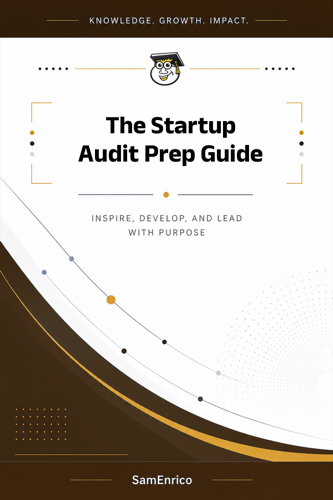
The Startup Audit Prep Guide eBook
Prepare for investor or IRS audits with organized
Prepare for investor or IRS audits with organized records and documentation.
Formats
Free sample
Chapter 1: The Chaos Tax...--–- The first time I watched a founder lose $3.2 million over a $47 coffee receipt, I thought I had misunderstood the math. I hadn’t.The meeting lasted forty-seven minutes. The founder—let’s call him Alex—had built a B2B Saa S company from his garage into a seventy-person operation with $4 million in annual recurring revenue. A tier-one venture capital firm had flown across the country to see him. They’d already reviewed his financials, interviewed his leadership team, and sent a non-binding term sheet for $3.2 million at a healthy valuation.
All that remained was final due diligence: two weeks of document verification before signing.On day three of due diligence, the VC’s legal team made a routine request. They asked for receipts and approvals for the twenty largest expenses in the previous twelve months. Among those expenses was a $47 charge at a coffee shop near Alex’s office. The receipt showed a latte and a sandwich, purchased on a Tuesday morning at 10:14 a.m. The VC’s associate emailed Alex: “Can you confirm the business purpose of this coffee shop expense and who attended?”Alex laughed when he read the email.
He was raising three million dollars. They were asking about a coffee. He fired back a quick reply: “Probably just a working meeting. Not sure who. Doesn’t matter.”It mattered.The VC’s legal team flagged the response.
They asked again. Alex, now annoyed, said he didn’t remember and that it was a waste of everyone’s time. The legal team escalated to the general partner. The general partner pulled the deal for twenty-four hours to review the entire diligence file. What they found was not one missing receipt.
What they found was a pattern.Over the previous three years, Alex’s company had seventy-eight expenses over $500 with no written business purpose. Twelve had no receipts at all. Four had handwritten receipts that were illegible. The cap table had three different versions floating around, none of which matched the board minutes. An early employee had been issued stock options, but the approval form was never signed.
A contractor had worked full-time for eighteen months but was still classified as a 1099.The general partner called Alex. He said, “We’re not investing in a company that can’t track a coffee receipt. If you can’t manage your own records, we don’t trust you to manage our money.”The term sheet was withdrawn. Alex spent the next six months trying to raise from other firms. Every new investor asked the same question: “Why did the last deal fall through?” Alex told the truth.
Word spread. He never raised again. Eighteen months later, the company ran out of cash and shut down.All because of a $47 coffee receipt. But not really. The coffee receipt was just the symptom.
The real disease was something I call the Chaos Tax.What Is the Chaos Tax?The Chaos Tax is the invisible cost that disorganized records extract from every startup, every single day. It has four components, and most founders never see any of them until it is too late.First, the Fundraising Delay Tax. Every week that your data room is incomplete or your records are messy, you push out your closing date. A clean data room closes in two weeks. A messy one takes six to eight weeks.
In startup time, those extra four weeks mean you miss a quarter of growth. You burn cash you didn’t need to burn. Sometimes, you miss your window entirely.Second, the Valuation Penalty. Investors discount for risk. One of the largest risks they assess is governance risk—the likelihood that your company has hidden liabilities or operational chaos.
When a VC sees a disorganized cap table or missing receipts, they do not assume you are busy. They assume you are hiding something. The average valuation penalty for a messy data room is between 15 and 30 percent. On a $10 million valuation, that is $1.5 to $3 million left on the table.Third, the Legal Fee Surcharge. Every hour that a lawyer spends hunting for a missing document is an hour you pay for.
In a typical due diligence process, a disorganized startup will spend an extra $30,000 to $80,000 in legal fees simply because the lawyers have to chase down information that should have been organized from the beginning.Fourth, the Silent Death Tax. This is the one no one talks about. Startups do not usually die in a single dramatic moment. They die slowly, bleeding cash on avoidable penalties, missing credits, and lost opportunities. A founder who cannot claim the R&D credit because they didn’t document experimentation leaves $100,000 to $500,000 on the table every year.
A founder who misclassifies contractors and gets audited faces back taxes of $10,000 to $50,000 per worker. A founder who pierces the corporate veil loses limited liability protection and puts their personal assets at risk.The Chaos Tax is not a fine. It is not a penalty. It is the sum of every small leak in your financial boat. And if you are like most founders reading this book, you are leaking more than you know.The Great Misconception: “Only Fraudulent Companies Get Audited”Before we go any further, we need to kill a myth.
Most founders believe that audits are rare, random, and only happen to companies that are cheating. This belief is wrong in every possible way, and it is the single most dangerous belief in startup finance.Let us look at the data.The IRS audits fewer than one percent of individual tax returns, which is where the “audits are rare” myth comes from. But corporate returns, especially those of high-growth startups, are audited at significantly higher rates. According to IRS data and analysis from tax professionals, startups that claim the Research and Development (R&D) tax credit have an audit rate between three and five percent—three to five times higher than the average small business. Startups that raise more than $1 million in a single round are flagged for review at even higher rates, particularly if they have international investors or complex cap tables.Why?
Because the IRS uses artificial intelligence. The Discriminant Inventory Function System (DIF) scores every corporate tax return on a scale from 0 to 1,000 based on statistical anomalies. A high score does not mean fraud. It means your return looks unusual compared to similar companies. And startups are inherently unusual.Consider what a typical startup looks like on paper: negative net income (losses), high research expenses, stock option grants to employees, convertible notes that may or may not have been converted, and international transactions with contractors or customers.
To the IRS’s algorithm, a healthy startup looks like a red flag factory. The algorithm cannot tell the difference between a legitimate loss and tax evasion. It only sees deviation from the norm. And startups are nothing but deviation from the norm.Venture capital due diligence works the same way. Investors do not manually review every line item in your financials.
They use automated tools that scan your data room for anomalies: missing signatures, inconsistent dates, round-dollar expenses, mismatched cap table versions. The algorithm does not trust you.…
This is the end of the free sample. Get the eBook to keep going. Buy now
About this book
Details
- Author
- Stanton Deidra
- Publisher
- SamEnrico
- Language
- English
- Genre
- Non-Fiction, Startup Guide, Audit
- Released
- 2026-06-06
- Pages (approx.)
- 156
- Available as
- eBook, Audiobook

Read better in the ZLOADR app
Your eBooks on your phone or tablet. Sign in with your SamEnrico account and start reading.
More by Stanton Deidra
 James Brown Godfather SoulStanton Deidra$11.99
 Success Ownership WorkbookStanton Deidra$11.99
 Deep Work For AccountantsStanton Deidra$11.99
 Retiree Talent Migration PatternsStanton Deidra$11.99
 Writer Time Blocking GuideStanton Deidra$11.99
 Theme Days Scheduling GuideStanton Deidra$11.99
 The Great Spruce Heist: How One Tree Changed a NationStanton Deidra$11.99
 PT Master GuideStanton Deidra$11.99
 The Golden Road of Axum: Africa's Forgotten Maritime EmpireStanton Deidra$11.99
 How to Produce Pool and SPA Chlorine GeneratorsStanton Deidra$11.99
 Exploring Photography: Composition, Light & EditingStanton Deidra$11.99
 Brown Mustard: Seed HarvestingStanton Deidra$11.99
You may also like
 Hong Kong Handover 1997Dunn Johnnie$11.99
 Zumba For Postnatal Recovery CourseNeal Christian$11.99
 Zumba for BeginnersLadner Nikia$11.99
 YouTube Comment Mining GuideHumes Pandora$12.99
 Worry Box MeditationCarlin Rudy$11.99
 Workplace Stress MeditationNguyen Lynn$11.99
 Workplace Stress and Sleep RepairHawley Ivory$11.99
 Workplace Perfectionism CureDelaney Jeffry$11.99
 Workplace Injustice Anger GuideWallen Isabelle$11.99
 Work Addiction and Burnout LinkGreenwood Ester$11.99
 Women in Yoga and WellnessBeattie Galina$11.99
 Women in Stand Up ComedyChun Evangeline$11.99