
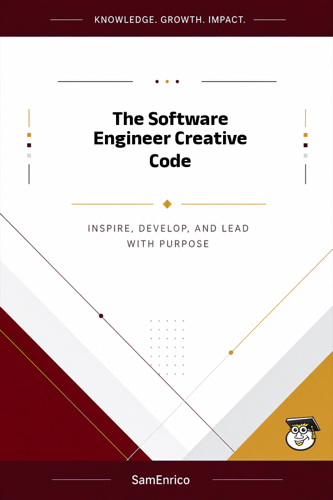
The Software Engineer Creative Code eBook
Write elegant, novel solutions using reframing, co
by Sisk Rosalva
Write elegant, novel solutions using reframing, code poetry, and functional aesthetics.
Formats
Free sample
Chapter 1: The Invisible Frame...--–- Every bug report arrives wearing a mask. It pretends to be a question about code—"why did the variable become null?"—but beneath the mask is always a deeper question: "what assumption did we make that turned out to be false?" Most software engineers spend their careers answering the masked question. They add null checks, retry loops, and conditionals. They make the code longer, more defensive, and harder to read. And the bugs keep coming, because they never unmasked the question in the first place.This chapter is about learning to see through the mask.
It is about a single skill that separates merely productive engineers from genuinely creative ones: reframing. Reframing is the act of changing the question before you change the code. It is not optimism, not positive thinking, and not a soft skill. It is a rigorous, teachable technique for escaping the cognitive traps that keep your code ordinary.Let us begin with a story about a bug that was not a bug.The Case of the Missing Null Check A junior engineer we will call Maya was assigned a bug report that read: "When the user cancels a payment, the confirmation screen shows an error message briefly before disappearing." The default frame: something is wrong with the confirmation screen's lifecycle. Maybe a state management issue.
Maybe a race condition. Maya spent two days tracing React component lifecycles, adding use Effect cleanup functions, and testing edge cases. Nothing worked. The error message still flickered.Then a senior engineer walked by and asked: "Why does the confirmation screen appear at all when the user cancelled?" Maya paused. She had accepted the frame that the confirmation screen was supposed to appear.
The bug report had not questioned that assumption. She looked at the product requirements: "On cancellation, return to the payment form with a toast notification." The confirmation screen was never supposed to load. The bug was not a lifecycle bug. It was a routing bug. The cancellation handler was calling the wrong navigation function.The fix took five minutes.
The two days of work were not wasted—Maya learned about React lifecycles—but they were unnecessary. She had answered the masked question ("why does the confirmation screen flicker?") instead of the real question ("why is the confirmation screen loading at all?").This is cognitive fixedness. It is the inability to escape the first framing of a problem. And it is the single greatest barrier to creative code.What Is Cognitive Fixedness?Cognitive fixedness is a well-documented phenomenon in psychology. In the 1940s, Karl Duncker designed the "candle problem": participants were given a candle, a box of thumbtacks, and a book of matches, and asked to attach the candle to a wall so it would not drip wax.
Most participants tried to tack the candle directly to the wall (failed) or melt wax to glue it (failed). The solution was to empty the thumbtack box, tack it to the wall, and use it as a shelf for the candle. But participants rarely saw this because they were fixed on the box's first frame: "container for thumbtacks." They could not see it as "shelf."Software engineering is full of candle problems. A bug report frames a symptom as the problem. A performance requirement frames milliseconds as the goal.
A type error frames null as the enemy. Each frame is a box. Creative code begins when you empty the box and turn it into a shelf.Consider a null pointer exception. The default frame: "something is null when it should not be." The fix: add a null check. But what if the real frame is "this data can legitimately be absent"?
Then the fix is not a null check but an Optional type that makes absence explicit throughout the call chain. The code becomes shorter, safer, and more expressive—not because you added a check, but because you changed the question from "how do I avoid null?" to "how do I model absence?"The Three Reframing Moves Over a decade of studying creative engineers, I have observed three repeatable moves for escaping cognitive fixedness. Each move is a deliberate question you ask before writing a single line of code.Move One: Reverse the Problem Instead of asking "How do I solve this?", ask "How could I make this worse?" Then invert the answers. This is not a trick. It works because your brain is good at generating worst-case scenarios—it has been trained by experience to see failure modes.
Once you have a list of ways to make things worse, you have a map of what to avoid. And often, the inverse of a worst-case scenario is a novel solution.Example: A team was struggling with a rate limiter that was too aggressive. The default frame: "How do we make the rate limiter smarter?" They spent weeks tuning parameters. Then someone asked: "How could we make the rate limiter as terrible as possible?" Answers: make it random, make it slow down good actors, make it fail open during high load, make it impossible to debug. The inverse of "random" was "deterministic." The inverse of "slow down good actors" was "prioritize based on historical success." The inverse of "fail open" was "fail closed with a fallback cache." Within a day, they had redesigned the rate limiter as a deterministic priority queue with aging.
It was simpler, faster, and more fair than anything they had tuned.Move Two: Shift the Level of Abstraction Every problem can be examined at multiple levels of abstraction. A null pointer is a line-level problem (specific variable), a function-level problem (caller didn't check), a module-level problem (invariant not enforced), a system-level problem (data source allowed null), or a requirements-level problem (absence is actually valid). Most engineers default to one level—usually the level where they first saw the symptom.To reframe, deliberately shift up or down. Ask: "What is one level above this problem?" and "What is one level below?" Then ask: "Which level, if fixed, would make all the other levels easier?"Example: A database query was timing out after five seconds. The line-level frame: "optimize the SQL." The team spent days adding indexes.
The time dropped to 4.5 seconds—still not enough. Then someone shifted up to the requirements level: "Does this query need to run at all during the user's request?" The answer was no. The data was for a weekly report that could be precomputed overnight. The fix was not a faster query but a cached report table. The problem vanished entirely because they shifted up one level.Move Three: Replace the Goal with the Opposite Goal This is a variant of reversal, but more specific.
Instead of accepting the goal as given, ask: "What would a solution look like that achieves the opposite of the stated goal?" Then see what constraints that opposite solution reveals.Example: A team was told "reduce memory usage by 30%." The default frame: compress data, use smaller types, free caches earlier. They asked: "What would a solution look like that increased memory usage by 30%?" Answers: duplicate data structures, keep caches forever, precompute everything, never garbage collect. The inverse of duplication was deduplication (shared…
This is the end of the free sample. Get the eBook to keep going. Buy now
About this book
Details
- Author
- Sisk Rosalva
- Publisher
- SamEnrico
- Language
- English
- Genre
- Non-Fiction, Self-Help, Software
- Released
- 2026-06-09
- Pages (approx.)
- 145
- Available as
- eBook, Audiobook

Read better in the ZLOADR app
Your eBooks on your phone or tablet. Sign in with your SamEnrico account and start reading.
More by Sisk Rosalva
 Sudden Spouse Death RecoverySisk Rosalva$11.99
 Cameroon Anglophone EscapeSisk Rosalva$11.99
 Breath As Anesthetic TechniqueSisk Rosalva$11.99
 Workaholism Recovery After RetirementSisk Rosalva$11.99
 Self Hypnosis For Self Esteem GuideSisk Rosalva$11.99
 Mountain Path WalkingSisk Rosalva$11.99
 Stress And Weight Gain ScienceSisk Rosalva$11.99
 Dreams About Parent DyingSisk Rosalva$11.99
 Pets.com: The $300 Million Puppet That Barked Too LoudSisk Rosalva$11.99
 Nefertiti's Forgotten Oath: The Pharaoh's ShadowSisk Rosalva$11.99
 The Silk Road of the Sea: The Venetian Merchant-AdmiralsSisk Rosalva$11.99
 How to Become a MillwrightSisk Rosalva$11.99
You may also like
 Outsourcing for Software DevelopersSands Breanne$11.99
 The OKR Software GuideRoller Lyman$11.99
 Team Creativity for DevelopersMoses Katia$11.99
 Daily Review for ProgrammersMoon Ouida$11.99
 The Remote Developer Time GuideMaldonado Jorge$11.99
 Remote Software Development CommunicationGomez Sadie$11.99
 Delegation Software ToolsDunbar Maple$11.99
 Constraints for CodersHarter Elisha$11.99
 Chunking API DocumentationRoyster Ying$11.99
 Pomodoro for CodingZimmer Blaine$11.99
 NVC In Tech Teams GuideMessina Larita$11.99
 Creative Habits for CodersValles Jeannetta$11.99