
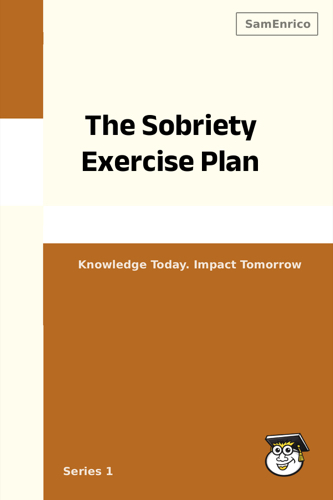
The Sobriety Exercise Plan eBook
Use regular physical activity to reduce cravings,
by Yu Chastity
Use regular physical activity to reduce cravings, improve mood, and build discipline.
Formats
Free sample
Chapter 1: The Hijacked Brain--The first time I tried to get sober, I lasted eleven days. Eleven dry, gray, miserable days where I ate enough sugar to kill a horse, snapped at everyone who loved me, and stared at the ceiling at 3 a.m. wondering if this was the rest of my life. I didn't drink. I counted that as a win.
But I didn't feel better. I felt worse. Flat. Numb. Like someone had drained the color out of the world and left me in a black-and-white movie where nothing mattered.On day twelve, I drank again.
Not because I wanted to. Because I needed to feel something. Anything.Here is what I didn't understand then: my brain wasn't broken. It was hijacked. And no amount of willpower, shame, or white-knuckling was going to fix it because I had removed the only source of pleasure my brain knew how to use—alcohol—without giving it a replacement.This book is that replacement.But before we get to the plan, the workouts, the breathwork, and the 30-day detox, we have to understand what we're fighting.
Because you cannot defeat an enemy you refuse to see. And the enemy is not your lack of willpower. The enemy is not your past mistakes. The enemy is not the bottle.The enemy is a tiny, almond-shaped region in the center of your brain called the nucleus accumbens. And it has been lying to you for years.The Myth of the "Broken Addict"Let me start with a controversial statement that might make you uncomfortable: you are not broken.I know.
You've probably heard the opposite in twelve-step meetings, from well-meaning therapists, and from the voice in your own head that wakes you up at 3 a.m. "You're an addict," that voice whispers. "You have a disease. You're different from normal people. Your brain is defective."That voice is wrong.Here is what the latest neuroscience actually tells us: your brain is working exactly as it evolved to work.
It is doing its job perfectly. The problem is not a defect in your hardware. The problem is that alcohol has tricked your hardware into chasing the wrong reward.Let me explain.Every human brain comes equipped with a reward system that has one job: keep you alive long enough to reproduce. When you eat food, your brain releases dopamine. When you have sex, your brain releases dopamine.
When you bond with your children, when you win a competition, when you learn something new, when you connect with a friend—dopamine. This is not random. Evolution figured out that creatures who felt good when they did survival-related things were more likely to survive.Dopamine is not pleasure. This is a critical distinction that most recovery books get wrong. Dopamine is not the experience of happiness.
Dopamine is the molecule of motivation. It is the chemical that says, "Do that again." It is the engraving mechanism that turns a one-time behavior into a lifelong habit.When you drink alcohol, you flood your brain with dopamine. Not a little. A lot. Up to ten times the amount released by natural rewards like food or sex.
And here is the cruel trick: your brain cannot tell the difference between a natural reward that keeps you alive and a chemical impostor that is slowly killing you. All it knows is that dopamine just spiked, so whatever you just did must be important for survival.So it learns. It adapts. It rewires itself to make sure you do that thing again.This is not a defect. This is the most successful survival system ever evolved.
It just happens to be working for the wrong team right now.The Nucleus Accumbens: Your Brain's Betrayer Let me introduce you to the main character of this chapter. It has a complicated name, but you don't need to remember the Latin. Just remember what it does.The nucleus accumbens is the Grand Central Station of your brain's reward circuitry. Every signal about pleasure, motivation, and desire passes through this tiny cluster of neurons. When you see a slice of pizza after a twelve-hour fast, your nucleus accumbens lights up.
When you think about your first cup of coffee in the morning, your nucleus accumbens activates. When you smell the whiskey on someone's breath or see the neon sign of your old bar, your nucleus accumbens screams.It is not evil. It is not broken. It is doing exactly what it evolved to do: motivate you toward things it has learned are rewarding.The problem is what it has learned.Alcoholics and heavy drinkers have nucleus accumbens that have been sculpted by thousands of dopamine hits. Each drink was a chisel stroke, carving deeper grooves into your reward circuitry.
The first time you drank, the effect was mild. Your brain said, "Hmm, that was interesting." The hundredth time, your brain said, "DO THAT AGAIN NOW." The thousandth time, your brain stopped bothering with the word "again." It just screamed "NOW" on a loop.This is called neuroadaptation. Your brain literally changes its physical structure in response to repeated dopamine floods. The neurons in your nucleus accumbens grow new connections to each other, creating superhighways of craving that can be triggered by a song, a time of day, a stressful email, or even just the thought of Friday night.And here is the part that makes early sobriety so brutal: when you stop drinking, those superhighways don't disappear. They sit there, waiting.
Silent but ready. Your nucleus accumbens still remembers every single drink. It still believes that alcohol is the most important survival activity you have ever discovered.So when you white-knuckle your way through day three, day seven, day eleven, your nucleus accumbens is not cheering you on. It is screaming at you to go back. Not because you are weak.
Because you trained it well.The Anhedonia Trap Now let me tell you about the thing that almost killed me after I stopped drinking. The thing that no one warned me about. The thing that sends more people back to the bottle than any craving ever will.Anhedonia.It sounds clinical and harmless. It is neither.Anhedonia is the inability to feel pleasure from things that used to bring you joy. Food tastes like cardboard.
Sunsets look gray. Music sounds like noise. The laugh of a child, the warmth of a lover, the satisfaction of a job well done—all of it flat. Hollow. Pointless.Anhedonia is not sadness.
Sadness is an emotion. Anhedonia is the absence of emotion. It is the slow, creeping realization that nothing matters anymore. And it is the number one hidden cause of relapse.Here is why it happens.Remember how alcohol flooded your brain with unnaturally large amounts of dopamine? Your brain responded to that flood the way any smart system responds to too much input: it turned down the volume.
Your dopamine receptors—the tiny locks that dopamine keys fit into—actually decreased in number. Your brain said, "We're getting way too much dopamine signal. Let's remove some receptors to bring this back to normal."This is called downregulation. It is the same process that happens when you walk into a…
This is the end of the free sample. Get the eBook to keep going. Buy now
About this book
Details
- Author
- Yu Chastity
- Publisher
- SamEnrico
- Language
- English
- Genre
- Non-Fiction, Self-Help, Exercise
- Released
- 2026-06-09
- Pages (approx.)
- 141
- Available as
- eBook, Audiobook

Read better in the ZLOADR app
Your eBooks on your phone or tablet. Sign in with your SamEnrico account and start reading.
More by Yu Chastity
 FCPA Extradition CasesYu Chastity$11.99
 Insomnia Therapy Without Medication GuideYu Chastity$11.99
 Delegation FAQYu Chastity$11.99
 TM For Diabetes ManagementYu Chastity$11.99
 The Gacy Death CertificateYu Chastity$11.99
 Perfectionism and Imposter CycleYu Chastity$11.99
 Chunking Podcast GuideYu Chastity$11.99
 Hitler Mein KampfYu Chastity$11.99
 Whispers in the Wire: The Secret Love Letters of the Great EscapeYu Chastity$11.99
 The Last Message: The Titanic's Wireless Room SecretsYu Chastity$11.99
 The Quantum Wave: How a Pacific Lab Unlocked the Secrets of the UniverseYu Chastity$11.99
 The Dancer's Guide to Hitch HikeYu Chastity$11.99
You may also like
 Hong Kong Handover 1997Dunn Johnnie$11.99
 Zumba For Postnatal Recovery CourseNeal Christian$11.99
 Zumba for BeginnersLadner Nikia$11.99
 YouTube Comment Mining GuideHumes Pandora$12.99
 Worry Box MeditationCarlin Rudy$11.99
 Workplace Stress MeditationNguyen Lynn$11.99
 Workplace Stress and Sleep RepairHawley Ivory$11.99
 Workplace Perfectionism CureDelaney Jeffry$11.99
 Workplace Injustice Anger GuideWallen Isabelle$11.99
 Work Addiction and Burnout LinkGreenwood Ester$11.99
 Women in Yoga and WellnessBeattie Galina$11.99
 Women in Stand Up ComedyChun Evangeline$11.99