
Non-FictionSelf-HelpScripted Communication
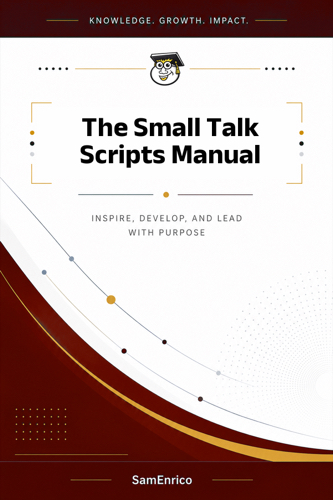
The Small Talk Scripts Manual eBook
Provides word-for-word scripts for 100 common soci
by Chow Tamera
Provides word-for-word scripts for 100 common social scenarios.
Formats
Free sample
Chapter 1: The Four Locks...--You are standing in a crowded room. Someone has just said something to you—something innocuous, like “Long week, huh?”—and your brain has turned to static. You know you should say something back. You want to say something back. But the words will not come.This is not a personality flaw.
It is not social anxiety (though that may be present). It is not evidence that you are “bad at people.”It is a mismatch problem.Every conversation is a locked door. The key that opens one lock will jam another. The person who wants practical advice will feel suffocated by emotional validation. The person who needs to vent will feel dismissed by solutions.
The person who is signaling social identity will feel interrogated by questions.For years, the self-help industry has sold you the same lie: “Just be curious.” “Just listen.” “Just be yourself.”These are not wrong. They are incomplete. They are like telling someone to “just drive” without explaining that a car has a steering wheel, pedals, and a gearshift—and that the gearshift works differently depending on whether you are driving an automatic or a manual transmission.This chapter is the gearshift. Before you use a single script from this book, you need to diagnose what kind of conversation you are actually in. Most people never learn to do this.
They fire the same conversational weapon—questions, advice, stories, silence—at every situation, and then wonder why it works sometimes and backfires others.The difference between someone who “naturally” connects with everyone and someone who freezes is not charisma. It is pattern recognition.This chapter will teach you to recognize the four fundamental types of conversations. You will learn a simple diagnostic framework that takes less than three seconds to run. And you will receive Scripts 1 through 5—word-for-word phrases that help you ask the meta-question that changes everything: “Wait, are you looking for advice or just for me to listen?”By the end of this chapter, you will never again give a solution to someone who needs a hug.The Mistake That Took Me Ten Years to See Let me tell you about the worst conversation of my life.I was twenty-four years old. My partner at the time came home from work, sat down on the couch, and started crying.
She had been passed over for a promotion that she had worked toward for eighteen months. The person who got the job had less experience, fewer qualifications, and had been with the company for only six months.She was devastated.And I, in my infinite wisdom, decided to solve the problem.I spent the next twenty minutes laying out a detailed plan. “You should talk to HR. You should document your accomplishments. You should schedule a meeting with the director.
You should update your resume. You should start looking at other companies. You should—”She stopped crying. She stood up. She walked into the bedroom and closed the door.I remember standing in the living room, confused.
I had helped her. I had given her a roadmap. Why was she angry?The answer, which I would not understand for nearly a decade, is that she was not asking for a roadmap. She was asking for presence. She did not need a solution.
She needed someone to sit in the dark with her and say, “That is absolutely unfair. I am so sorry.”I was trying to unlock an Emotional conversation with a Practical key. The lock jammed. The door stayed closed. And I stood there wondering why the key would not turn.This is the single most common mistake in human communication.
It happens between spouses, between parents and children, between managers and employees, between friends, between strangers. Someone says, “My mother is sick,” and we say, “Have you tried this doctor?” Someone says, “I am so overwhelmed,” and we say, “Here is how I manage my calendar.”We are solution-givers in a world that often just wants witnesses.The good news is that the fix is simple. It is not easy—simple and easy are not the same thing. But it is simple. You just have to learn to ask one question before you respond.
Not out loud, necessarily. Sometimes just to yourself.What kind of conversation is this?The Four Locks: A Framework for Diagnosing Any Conversation After studying the research of Charles Duhigg (Supercommunicators), the negotiation tactics of the FBI’s hostage negotiation unit, and thousands of hours of recorded conversations, a clear pattern emerges. Every conversation falls into one of four categories. Sometimes conversations move between categories. But at any given moment, a conversation has a dominant type.Think of these as four locks.
Each requires a different key.Lock #1: Practical (What Do We Do?)The Practical conversation is about action. It asks: What is the problem? What are the possible solutions? What are the trade-offs? What should we do next?You are in a Practical conversation when someone says:“What do you think I should do about...”“I need your advice on...”“Can you help me figure out...”“What would you do in my situation?”The person wants information, analysis, options, or a plan.
They may want you to help them think through a decision. They may want you to share your expertise. They may want you to play devil’s advocate.The wrong response in a Practical conversation is emotional validation without action. If someone asks, “What do you think I should do about my boss?” and you say, “That sounds really hard,” they will feel unheard. They did not come to you for empathy.
They came to you for strategy.The right key for a Practical lock is a solution-oriented response. This does not mean you have to have the answer. It means you need to engage with the problem. You can ask clarifying questions. You can brainstorm options.
You can share what you have done in similar situations. You can say, “I don’t know, but let me think about it and get back to you.”Lock #2: Emotional (How Do We Feel?)The Emotional conversation is about experience. It asks: How do you feel? How do I feel? Can you sit with me in this feeling?
Do I have permission to feel this way?You are in an Emotional conversation when someone says:“I just need to vent for a minute.”“I am so frustrated/angry/sad/exhausted.”“Can I tell you about something that happened?”(Silence, followed by tears)The person does not want a solution. They do not want advice. They do not want you to fix anything. They want to be witnessed. They want permission to feel what they are feeling without judgment.
They want someone to say, “That makes sense. I understand why you would feel that way.”The wrong response in an Emotional conversation is problem-solving. If someone says, “I am so tired,” and you say, “Have you tried going to bed earlier?” they will feel dismissed. You have turned their feeling into a problem to be solved. You have implied that their feeling is illegitimate.The right key for an Emotional lock is validation.
This does not mean you have to agree with everything they say. It means you need to acknowledge that their…
This is the end of the free sample. Get the eBook to keep going. Buy now
About this book
Details
- Author
- Chow Tamera
- Publisher
- SamEnrico
- Language
- English
- Genre
- Non-Fiction, Self-Help, Scripted Communication
- Released
- 2026-06-08
- Pages (approx.)
- 148
- Available as
- eBook, Audiobook

Read better in the ZLOADR app
Your eBooks on your phone or tablet. Sign in with your SamEnrico account and start reading.
More by Chow Tamera
 Symbol Interpretation TraumaChow Tamera$11.99
 Stress and Breathwork for CouplesChow Tamera$11.99
 The Dancer's Warmup RitualChow Tamera$11.99
 The Last Broadcast of Amelia Earhart’s Ghost RadioChow Tamera$11.99
 How to Produce Battery CleanerChow Tamera$11.99
 Information ManagerChow Tamera$11.99
 How to Start a Bedford Cord Worsted Weaving Business (Beginners Guide)Chow Tamera$11.99
 High Risk Industry BankingChow Tamera$12.99
You may also like
 Hong Kong Handover 1997Dunn Johnnie$11.99
 Zumba For Postnatal Recovery CourseNeal Christian$11.99
 Zumba for BeginnersLadner Nikia$11.99
 YouTube Comment Mining GuideHumes Pandora$12.99
 Worry Box MeditationCarlin Rudy$11.99
 Workplace Stress MeditationNguyen Lynn$11.99
 Workplace Stress and Sleep RepairHawley Ivory$11.99
 Workplace Perfectionism CureDelaney Jeffry$11.99
 Workplace Injustice Anger GuideWallen Isabelle$11.99
 Work Addiction and Burnout LinkGreenwood Ester$11.99
 Women in Yoga and WellnessBeattie Galina$11.99
 Women in Stand Up ComedyChun Evangeline$11.99