
Non-FictionSelf-HelpCharisma Training
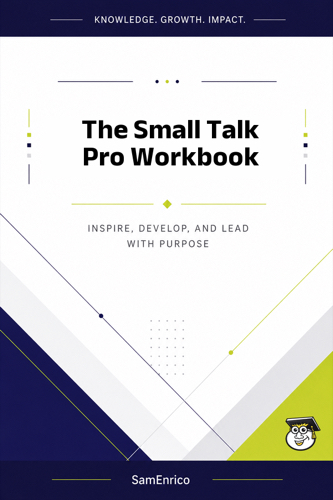
The Small Talk Pro Workbook eBook
Advanced techniques for charming strangers and lea
by Read Mari
Advanced techniques for charming strangers and leaving lasting positive impressions.
Formats
Free sample
Chapter 1: Killing Your Interrogation Reflex--–- You’re standing at a networking event, drink in hand, when a stranger approaches. “Hi,” they say. “What do you do?” You answer. They ask where you live. You answer.
They ask how long you’ve been here. You answer. Three minutes later, you both run out of words, nod awkwardly, and escape to opposite corners. You leave thinking: That person was nice, I guess? I can’t remember a single thing about them.This is the Interview Mode.
It is the single most common conversational failure on the planet, and you have been trained to do it since childhood. Every family dinner, every first day of school, every “get to know you” icebreaker has reinforced the same destructive pattern: rapid-fire, factual, closed-ended questions that treat the other person like a form to be filled out rather than a human to be discovered.The result? Conversations that feel like job interviews. Connections that never spark. And a quiet, nagging belief that you’re just “not good at small talk.”You are good enough.
Your technique is wrong.This chapter will dismantle your interrogation reflex and replace it with something radically different: a way of speaking that invites story, emotion, and mutual vulnerability. By the time you finish the exercises at the end of this chapter, you will never again ask “What do you do?” without cringing.The Anatomy of a Failed Opening Let us examine a typical conversation between two strangers at a coffee shop, a conference, or a wedding. We will call them Alex and Jordan.Alex: Hey, how are you?Jordan: Good, you?Alex: Yeah, good. Crazy weather, right?Jordan: Yeah, it’s been weird.Alex: So, what do you do?Jordan: I’m in marketing.Alex: Oh cool. Do you like it?Jordan: Yeah, it’s fine.Alex: How long have you been doing that?Jordan: About five years.Alex: Nice.
Where are you from originally?Jordan: Chicago.Alex: Oh, I love Chicago. Deep dish pizza, right?Jordan: Yeah.(Silence. Alex looks at phone. Jordan excuses herself to the bathroom.)This exchange contains eighteen words from Jordan. Seventeen of them are factual answers to factual questions.
The eighteenth is “Yeah.” No emotion. No story. No follow-up invitation. No connection.The problem is not that Alex is boring or that Jordan is unfriendly. The problem is that Alex has accidentally triggered a neurological response called interrogation defensiveness.
When the human brain perceives a rapid sequence of questions — especially factual, closed-ended questions — it shifts into threat detection mode. The amygdala activates. Cortisol rises. The other person stops listening and starts evaluating: Why are they asking this? What do they want from me?
When will this end?You have experienced this yourself. Think of the last time a salesperson, a recruiter, or an overly eager date asked you a series of rapid questions. You did not feel curious. You felt trapped.The Interview Mode is a reflex. It feels like the “safe” option because questions seem polite.
But politeness without warmth is just an interrogation with better manners.Why Your Brain Defaults to Bad Questions You were not born asking “What do you do?” You learned it. And you learned it for three very specific reasons, none of which serve you anymore.Reason 1: Social Scripting. From elementary school icebreakers to corporate training seminars, we are taught that getting to know someone means exchanging biographical data. Name. Job.
Hometown. Hobbies. These are not conversation starters; they are database fields. They require no creativity and produce no connection.Reason 2: Fear of Silence. The average person can tolerate only about four seconds of silence before feeling compelled to speak.
When a conversation stalls, most people reflexively throw out a question — any question — to fill the void. The question is rarely good. It is simply available. “How was your weekend?” “Got any plans later?” “Seen any good movies lately?” These are the conversational equivalent of junk food: easy to consume, nutritionally empty.Reason 3: False Efficiency. Many people believe that asking factual questions is “efficient.” You gather data quickly, identify common ground, and move on.
This is a catastrophic misunderstanding of human connection. Efficiency is for spreadsheets, not for strangers. When you treat a conversation like a data-gathering mission, the other person feels like a specimen.The good news is that a reflex can be unlearned. The brain’s social circuitry is remarkably plastic. With deliberate practice, you can replace the interrogation reflex with something far more powerful: the Conversational Bob & Weave.The Conversational Bob & Weave: A New Default Boxers do not stand still.
They move. They dodge. They feint. They create openings by disrupting their opponent’s rhythm. Conversation works the same way.
A static exchange of question-answer-question-answer is predictable and exhausting. The Bob & Weave introduces two simple moves that transform the entire dynamic.Move 1: When you answer a question, add a “commentary hook.”Do not just answer. Answer plus something else — an emotion, an observation, a playful exaggeration, or a question back. The hook is what the other person can grab onto to continue the conversation.Flat answer: “I’m a teacher.” (Dead end. The other person must invent a new question.)Answer with a hook: “I’m a teacher, which mostly means I’m a professional cat-herder.” (Now the other person can ask about cat-herding, laugh, or share their own chaotic work story.)Move 2: When you ask a question, first share a micro-vulnerability.Do not just ask.
Ask after revealing something small about yourself — a minor flaw, a relatable struggle, a moment of self-awareness. This signals that you are not interrogating; you are collaborating.Flat question: “What do you do?” (Feels like a form.)Question with micro-vulnerability: “I’ll go first: I’m a teacher, which means I spend half my day saying ‘please stop licking the desk.’ What’s the strangest part of your work?” (Now the question is an invitation, not an demand.)Together, these two moves create a rhythm that feels less like an interview and more like a dance. You weave in a hook. You bob with a vulnerability. The other person relaxes because you have shown them how to play.Green Light Vulnerability Only Before we go further, a critical rule.
The vulnerability you share in the Bob & Weave must be Green Light — minor, low-stakes, and self-aware. This is Level 1 on the Vulnerability Traffic Light introduced in the Core Philosophy.Green Light (Approved for Chapter 1 and Chapter 3 Flaw Bait): Minor daily fails. “I burned my toast this morning.” “I waved at someone who was waving at the person behind me.” “I asked ‘what floor?’ while already standing in an elevator.” These are relatable, funny, and signal that you do not take yourself too seriously.Yellow Light (Use after 10+ minutes, not here): Social flaws. “I’m bad at remembering names.” “I overthink every text message.” These require trust.Red Light (Use only after multiple meetings): Values-based struggles. “I’m scared of failure.” “I struggle to ask for help.” Never use Red Light in the first conversation.The Bob & Weave uses only Green Light vulnerability.
You are not confessing your deepest insecurities. You are showing that you are human enough to laugh at yourself.The “Yes…
This is the end of the free sample. Get the eBook to keep going. Buy now
About this book
Details
- Author
- Read Mari
- Publisher
- SamEnrico
- Language
- English
- Genre
- Non-Fiction, Self-Help, Charisma Training
- Released
- 2026-06-09
- Pages (approx.)
- 134
- Available as
- eBook, Audiobook

Read better in the ZLOADR app
Your eBooks on your phone or tablet. Sign in with your SamEnrico account and start reading.
More by Read Mari
 Stress and Nervous System RegulationRead Mari$11.99
 EMDR and Dream ProcessingRead Mari$11.99
 MBSR for Flying AnxietyRead Mari$11.99
 The Forgotten Maestro: How Li Juren Brought Broadway to ShanghaiRead Mari$11.99
 How to Produce Battery AccessoriesRead Mari$11.99
 Remote Account Verification TipsRead Mari$12.99
 How to Start a Boiler Insurance Business (Beginners Guide)Read Mari$11.99
 Hypobaric Chamber Operation (Altitude)Read Mari$11.99
You may also like
 Hong Kong Handover 1997Dunn Johnnie$11.99
 Zumba For Postnatal Recovery CourseNeal Christian$11.99
 Zumba for BeginnersLadner Nikia$11.99
 YouTube Comment Mining GuideHumes Pandora$12.99
 Worry Box MeditationCarlin Rudy$11.99
 Workplace Stress MeditationNguyen Lynn$11.99
 Workplace Stress and Sleep RepairHawley Ivory$11.99
 Workplace Perfectionism CureDelaney Jeffry$11.99
 Workplace Injustice Anger GuideWallen Isabelle$11.99
 Work Addiction and Burnout LinkGreenwood Ester$11.99
 Women in Yoga and WellnessBeattie Galina$11.99
 Women in Stand Up ComedyChun Evangeline$11.99