
Non-FictionSelf-HelpSocial Courage
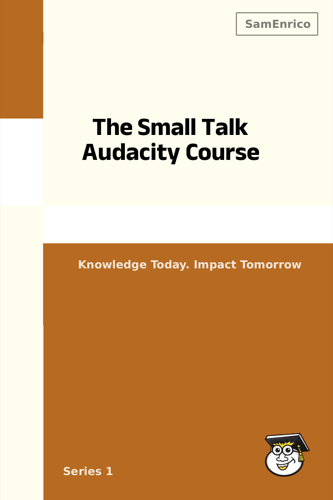
The Small Talk Audacity Course eBook
Overcomes fear of rejection with exposure therapy
by Stine Melony
Overcomes fear of rejection with exposure therapy and social risk-taking.
Formats
Free sample
Chapter 1: The Script Trap--–- You are standing at a networking event, plastic cup of warm white wine in your hand, scanning the room for the least threatening person to talk to. In your head, a script is running on a loop: Hi, I’m [name]. What do you do? Oh, that’s interesting. I work in [industry].
How long have you been doing that? You rehearsed it in the car. You rehearsed it in the bathroom mirror. You rehearsed it so many times that the words have lost all meaning, like a word you’ve said fifty times in a row until it becomes nonsense syllables.And yet, you cannot approach.Your feet are glued to the floor. Your heart is hammering.
You take a sip of wine to buy time, but the script is already crumbling. What if you forget a line? What if they ask something you didn’t prepare for? What if you say your line and they just stare at you? The script that was supposed to save you has become a trap.This is the great irony of most small talk advice.
It promises to give you the perfect words, the foolproof icebreakers, the magic phrases that will make anyone like you. But instead of freeing you, those scripts become a cage. You don’t trust yourself to speak without them. You believe that if you don’t have the right line, you have nothing at all.This chapter is going to dismantle that belief. Not gently.
Not politely. We are going to take a hammer to the idea that scripts are your friend and show you that they are actually the primary reason your social anxiety has persisted for so long. By the end of this chapter, you will understand why memorizing lines is a form of avoidance, not preparation. You will learn the difference between false safety behaviors and genuine skill-building. And you will take your first real step toward audacity: speaking without a net.The Great Script Lie Let us start with a confession.
You have been lied to by almost every small talk book, article, and Tik Tok influencer you have ever encountered. They told you that the problem was a lack of words. They told you that if you just had the right "opener," the perfect "closer," or a memorized list of "questions to ask anyone," your anxiety would evaporate. They sold you the fantasy that social confidence is a matter of having a bigger vocabulary of scripts.This is a lie.Scripts do not reduce anxiety. They inflate it.
Here is why. When you memorize a script, you raise the stakes of the interaction dramatically. A normal conversation is fluid, messy, and full of pauses and corrections. No one expects perfection. But when you are running a script, you have a standard of perfection in your head.
You need to deliver the line exactly as rehearsed. You need to hit your mark. You need to perform.And performance anxiety is far worse than social anxiety.Think about the difference between having a casual conversation with a close friend and giving a prepared speech to an audience. Which one makes you more nervous? The speech, of course.
Because the speech has a script. There is a right way and a wrong way to say it. There is judgment baked into every word. Now apply that logic to small talk. When you walk into a room with a script, you are not preparing to have a conversation.
You are preparing to give a performance. And performances can fail.The second problem with scripts is that they prevent authenticity. Human beings are exquisitely sensitive to inauthenticity. We can spot a rehearsed line from a mile away. It feels like being sold something.
When you deliver a scripted icebreaker, the other person does not think, "Wow, what a smooth conversationalist." They think, "Why are they talking like a customer service robot?" Scripts create a wall between you and the other person because they prevent the one thing that actually builds connection: genuine, unrehearsed, slightly messy human presence.The third problem is the most damaging. Scripts teach your brain the wrong lesson. Every time you rely on a memorized line to get through an interaction, your brain files away a piece of data: "I survived because I had a script. Without the script, I would have died." Over time, this convinces you that you are incapable of handling social situations on your own. You become dependent on the crutch.
And a crutch, by definition, is something you use because you believe you cannot walk without it.This is not preparation. This is fear reinforcement disguised as preparation.False Safety Behaviors: The Hidden Engine of Anxiety Let me introduce you to a concept that will appear throughout this book. It comes from cognitive behavioral therapy, and understanding it is the single most important step you will take toward curing your fear of rejection. The concept is called False Safety Behaviors.A false safety behavior is anything you do to reduce anxiety in the short term that actually increases anxiety in the long term. These behaviors feel like they are helping.
They feel like common sense. But they are the engine that keeps your social anxiety running.Here are common false safety behaviors in social situations:Rehearsing what you are going to say before you say it Checking your phone to look busy Standing against a wall or in a corner Crossing your arms or holding an object as a shield Avoiding eye contact Leaving the conversation as soon as possible Drinking alcohol to "loosen up"Only talking to people you already know Preparing scripts or lists of questions in advance Asking closed-ended questions that require short answers so you can escape quickly Notice something about this list. Almost all of them are things that conventional small talk advice encourages. "Prepare some icebreakers in advance," they say. "Keep a list of questions in your phone." "If you feel awkward, just excuse yourself to the bathroom." This is the opposite of helpful.
This is fear maintenance disguised as advice.Every time you use a false safety behavior, your brain learns a destructive lesson. The lesson is not "I am capable." The lesson is "I survived because I hid, not because I was competent." Your brain does not distinguish between surviving because you were brave and surviving because you avoided danger. It only registers the outcome: you did not die. And it attaches that outcome to whatever behavior you used to achieve it.So if you check your phone to avoid talking to someone, and then you do not die, your brain learns: "Checking my phone prevents death." If you rehearse a script and the conversation does not implode, your brain learns: "Rehearsing scripts prevents disaster." Over months and years, these false safety behaviors become deeply entrenched habits. You believe you cannot socialize without them.
But the truth is the opposite: you cannot socialize with them because they are preventing you from learning that you are already enough.The Performance Paradox There is a cruel paradox at the heart of social anxiety. The more you prepare, the worse…
This is the end of the free sample. Get the eBook to keep going. Buy now
About this book
Details
- Author
- Stine Melony
- Publisher
- SamEnrico
- Language
- English
- Genre
- Non-Fiction, Self-Help, Social Courage
- Released
- 2026-06-08
- Pages (approx.)
- 140
- Available as
- eBook, Audiobook

Read better in the ZLOADR app
Your eBooks on your phone or tablet. Sign in with your SamEnrico account and start reading.
More by Stine Melony
 Workplace Trauma DreamsStine Melony$11.99
 Stress and Retirement TogetherStine Melony$11.99
 The Audition Survival KitStine Melony$11.99
 The Last Heist of the Rosetta StoneStine Melony$11.99
 How to Start a Physiologist Business (Beginners Guide)Stine Melony$11.99
 Bank Account for Offshore CompaniesStine Melony$12.99
 How to Produce a Bean HarvesterStine Melony$11.99
 LanguagesStine Melony$11.99
You may also like
 Hong Kong Handover 1997Dunn Johnnie$11.99
 Zumba For Postnatal Recovery CourseNeal Christian$11.99
 Zumba for BeginnersLadner Nikia$11.99
 YouTube Comment Mining GuideHumes Pandora$12.99
 Worry Box MeditationCarlin Rudy$11.99
 Workplace Stress MeditationNguyen Lynn$11.99
 Workplace Stress and Sleep RepairHawley Ivory$11.99
 Workplace Perfectionism CureDelaney Jeffry$11.99
 Workplace Injustice Anger GuideWallen Isabelle$11.99
 Work Addiction and Burnout LinkGreenwood Ester$11.99
 Women in Yoga and WellnessBeattie Galina$11.99
 Women in Stand Up ComedyChun Evangeline$11.99