
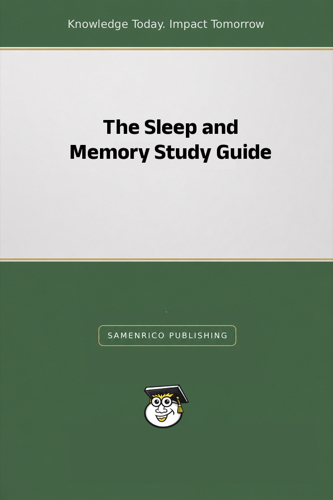
Non-FictionSelf-HelpSleep Science
The Sleep and Memory Study Guide eBook
Optimizes sleep for memory consolidation.
by Golden Kasey
Optimizes sleep for memory consolidation.
Formats
Free sample
Chapter 1: The Silent Architect...--–- You are about to learn something that will fundamentally change how you think about the space between closing your eyes and opening them again. It is not a void. It is not a pause. It is not a nightly death from which you are miraculously resurrected each morning. Sleep, as you will soon discover, is the most active, purposeful, and computationally intensive state your brain ever enters.
And if you have been treating it as merely the absence of wakefulness, you have been robbing yourself of your own memories.Every night, while you lie motionless beneath your blankets, your brain orchestrates a symphony of neural activity so complex that no supercomputer on Earth can fully replicate it. This symphony has a single, overriding purpose: to transform the chaotic stream of experiences from your waking hours into a stable, durable, and accessible archive that will define who you are tomorrow, next week, and decades from now. Without this process, you would wake each morning as a stranger to yourself, unable to recall yesterday's conversations, last week's lessons, or the faces of those you love.The tragedy of modern life is that we have forgotten what sleep actually does. We have reduced it to an inconvenience, a waste of productive hours, a biological nuisance that we tolerate because our bodies eventually refuse to cooperate. We brag about surviving on four hours.
We wear sleep deprivation as a badge of honor. And in doing so, we have become a species that learns poorly, remembers badly, and ages faster than we should. The science is unequivocal: sleep is not the enemy of productivity. It is the only thing that makes productivity possible.This chapter will dismantle every misconception you hold about rest. You will learn about a hidden cleaning system in your brain that only activates during deep sleep, flushing out toxic waste products linked to Alzheimer's disease.
You will confront the evolutionary paradox that has puzzled scientists for decades: why would natural selection create a state that renders animals vulnerable to predators, unless the benefits were absolutely extraordinary? You will understand the fierce debate between two of the world's leading sleep researchers, and why their seemingly conflicting views actually point to the same urgent conclusion. And by the end of this chapter, you will calculate your personal "sleep anchor point"—the minimum non-negotiable core sleep duration below which your memory system collapses entirely, regardless of how many naps you take or how much caffeine you consume.This is not a chapter about "sleep hygiene." It is not a collection of gentle suggestions about warm baths and chamomile tea. This is a surgical examination of the most powerful memory tool you already possess but have never been taught to use. The silent architect is working every night.
The question is whether you will finally start listening.The Great Unlearning: Why Everything You Think About Sleep Is Wrong Let us begin with a simple experiment. Close your eyes for ten seconds. Now open them. What happened during that brief interval? If you are like most people, you would say "nothing." Your visual system stopped receiving input.
Your muscles relaxed. Your mind might have wandered. But from a neuroscientific perspective, something extraordinary occurred: your brain did not power down. It reorganized.Sleep is not the opposite of wakefulness. It is an alternative state of consciousness with its own unique biology, chemistry, and purpose.
The old metaphor—that sleep is like turning off a computer to let it cool down—is catastrophically wrong. A computer does nothing when powered off. It performs no computations. It consolidates no information. Your brain, by contrast, becomes more active in some regions during sleep than it is during wakefulness.
The difference is not one of activity versus inactivity. It is one of network configuration.During wakefulness, your brain operates in an "online" mode. Sensory information streams in through your eyes, ears, skin, and nose. Your prefrontal cortex makes decisions. Your motor cortex directs movements.
Your hippocampus—a small, seahorse-shaped structure deep in your temporal lobe—acts as a temporary scratch pad, holding onto recent experiences for seconds or minutes before they fade or get transferred elsewhere. This online mode is metabolically expensive. It burns through energy at a rate that would be unsustainable if maintained indefinitely.During sleep, your brain switches to an "offline" mode. Sensory inputs are largely gated off. The prefrontal cortex steps back.
But other regions—particularly the hippocampus, the thalamus, and the cortex—begin a precisely choreographed dance of replay, transfer, and integration. This is not maintenance. This is construction. Your brain is not resting. It is building.The evidence for this claim is overwhelming.
In the 1920s, the German psychiatrist Hans Berger invented the electroencephalogram (EEG), which allowed scientists to measure electrical activity in the human brain through electrodes placed on the scalp. What Berger discovered was shocking: the sleeping brain does not produce a flat, silent line. It produces massive, slow waves that sweep across the cortex like tides. Later researchers discovered sleep spindles—brief bursts of 12-16 Hz activity that act as gateways for memory transfer. And in the 1950s, Eugene Aserinsky and Nathaniel Kleitman discovered REM sleep, a stage in which the brain appears almost as active as it is during wakefulness, yet the body is completely paralyzed.Your brain is not a machine that powers off at night.
It is a machine that changes gears, shifts into a different mode, and performs its most critical work precisely when you are least aware of it.The Glymphatic System: Your Brain's Hidden Janitor One of the most important discoveries in sleep science in the last decade has nothing directly to do with memory. It has to do with garbage. Specifically, it has to do with the toxic metabolic waste that accumulates in your brain every waking moment—and how sleep is the only time your brain can take out the trash.In 2012, Dr. Maiken Nedergaard and her colleagues at the University of Rochester Medical Center announced the discovery of the glymphatic system. The name is a nod to the lymphatic system in the rest of your body, which clears waste from tissues, and to the glial cells in your brain that make this system possible.
The glymphatic system is a network of channels that pumps cerebrospinal fluid through your brain, flushing out metabolic byproducts that would otherwise accumulate to toxic levels.Here is what makes this discovery revolutionary: the glymphatic system is primarily active during sleep. Specifically, it activates during deep non-REM sleep, when your brain cells shrink slightly, creating more space for fluid to flow between them. During wakefulness, the glymphatic system operates at a fraction of its capacity. During deep sleep, it goes into overdrive, clearing out waste products including beta-amyloid and tau proteins—the same proteins that form the sticky plaques and tangles characteristic of Alzheimer's disease.Think about what this means. Every hour you spend awake, your brain produces metabolic waste.
Every hour you spend asleep, your brain clears that waste away. If you consistently shortchange your sleep, the waste accumulates. It does not simply "wait" for the next night. It builds up, day…
This is the end of the free sample. Get the eBook to keep going. Buy now
About this book
Details
- Author
- Golden Kasey
- Publisher
- SamEnrico
- Language
- English
- Genre
- Non-Fiction, Self-Help, Sleep Science
- Released
- 2026-06-05
- Pages (approx.)
- 154
- Available as
- eBook, Audiobook

Read better in the ZLOADR app
Your eBooks on your phone or tablet. Sign in with your SamEnrico account and start reading.
More by Golden Kasey
 Sardinian Lifestyle Longevity FactorsGolden Kasey$11.99
 Nonprofit Shell Company Fraud GuideGolden Kasey$11.99
 Food Log for Binge AwarenessGolden Kasey$11.99
 Chore Division Under StressGolden Kasey$11.99
 The Ironclad Revolution: Dahlgren’s Guns and the Birth of Naval WarfareGolden Kasey$11.99
 Understanding Weaver–Johnson SyndromeGolden Kasey$17.99
 How to Start a Bleached Paper Pulp Made By Mechanical Processes Business (Beginners Guide)Golden Kasey$11.99
 India via Madrid SystemGolden Kasey$12.99
 Angel Investor vs CrowdfundingGolden Kasey$12.99
 Software Account ManagerGolden Kasey$11.99
You may also like
 Hong Kong Handover 1997Dunn Johnnie$11.99
 Zumba For Postnatal Recovery CourseNeal Christian$11.99
 Zumba for BeginnersLadner Nikia$11.99
 YouTube Comment Mining GuideHumes Pandora$12.99
 Worry Box MeditationCarlin Rudy$11.99
 Workplace Stress MeditationNguyen Lynn$11.99
 Workplace Stress and Sleep RepairHawley Ivory$11.99
 Workplace Perfectionism CureDelaney Jeffry$11.99
 Workplace Injustice Anger GuideWallen Isabelle$11.99
 Work Addiction and Burnout LinkGreenwood Ester$11.99
 Women in Yoga and WellnessBeattie Galina$11.99
 Women in Stand Up ComedyChun Evangeline$11.99