
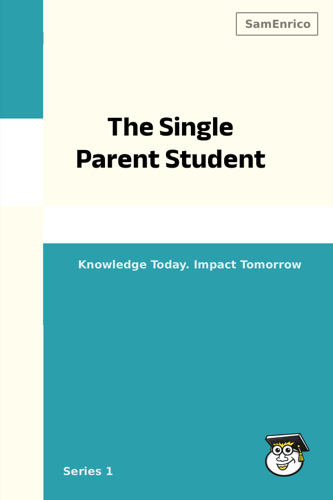
Non-FictionSelf-HelpParent Student
The Single Parent Student eBook
Balances childcare, work, and degree completion.
Balances childcare, work, and degree completion.
Formats
Free sample
Chapter 1: The Trapdoor System--The first time you missed a deadline, you told yourself it wouldn't happen again. The second time, you apologized to the professor and promised to do better. By the third time, you started to believe something was wrong with you.You are not alone in this belief. Nearly every single parent student I have interviewed over five years of research has confessed, usually in a whisper, that they feel like they are failing. Not failing a class—failing at life.
They describe a constant, low-grade humiliation: the daycare calling to say a child has a fever just as you sit down for an exam; the boss scheduling you for a closing shift on the night of a group project meeting; the financial aid letter arriving with less money than you expected, and no explanation of why. Each event feels like proof of your inadequacy. Each event feels personal.It is not personal. It is structural. And until you understand the mechanism behind your exhaustion, you will continue to blame yourself for a problem you did not create.This chapter introduces a concept that will reframe everything you have experienced as a single parent student.
It is called the "trapdoor system." Once you see it, you cannot unsee it. And once you see it, you will stop apologizing for needing flexibility and start demanding it.The Myth of the Level Playing Field Higher education in the United States was designed for a specific kind of student. That student is between eighteen and twenty-two years old, has no dependents, does not work full-time, and has access to parental support—financial, emotional, and logistical. Every policy, every deadline, every assumption about "reasonable effort" flows from this template.Consider the standard syllabus. It assumes you can attend every class at a fixed time, study for two to three hours per credit hour per week, participate in group projects outside of class, and meet with professors during office hours.
It assumes that when you go home, you go home to a quiet space where no one needs your attention. It assumes that if an emergency arises, you have a support network to absorb the disruption.Now consider the actual life of a single parent student. You are not eighteen. You have at least one child who depends entirely on you for food, shelter, medical care, and emotional regulation. You likely work at least twenty hours per week, often more.
Your "home" is not a dormitory with a meal plan; it is an apartment or house where you are the sole person responsible for groceries, bills, repairs, school forms, doctor appointments, and bedtime. When an emergency arises—and emergencies arise constantly with young children—you do not have a spouse or partner to absorb the disruption. You are the disruption absorber.The gap between these two realities is not a gap in your character. It is a gap in design. The university was not built for you.
That does not mean you cannot succeed within it. It means you must stop playing by rules written for someone else.Introducing the Trapdoor System Sociologist Lewis Coser, writing in the 1970s, coined the term "greedy institutions" to describe social structures that demand exclusive, unlimited loyalty from their members. The classic examples were the Catholic priesthood (which demanded celibacy and total devotion) and the traditional military (which demanded relocation and availability at all hours). Coser observed that greedy institutions are not necessarily malevolent; they simply have no natural limit to their demands. They will take as much as you will give.The university is a greedy institution.
It wants your evenings for study, your weekends for group projects, your holidays for finals preparation. It wants you to check your email constantly, respond to discussion boards promptly, and attend optional review sessions. It has no mechanism to say, "That is enough; you have given sufficient time to your education." The demand is always elastic.The family is also a greedy institution. Your child does not care that you have a midterm tomorrow. Your child wants dinner, a bath, a bedtime story, and comfort in the middle of the night.
There is no limit to the demands of parenting; you cannot negotiate with a fever or a nightmare or a school project due the same morning as your own exam. The family will take as much as you will give.For a partnered student, these two greedy institutions are held in check by a third entity: the spouse or co-parent. When the university demands too much, the partner absorbs family duties. When the family demands too much, the partner absorbs academic duties. The partner is a shock absorber, a buffer, a backup.You do not have a partner.
You are the shock absorber for both institutions simultaneously. And when two greedy institutions pull on a single person with no backup, that person does not fail because they are weak. That person fails because the system is impossible.This is the trapdoor system. It is not a single barrier you can climb over. It is a floor that gives way beneath you the moment you stop moving.
As long as everything goes perfectly—no illnesses, no car trouble, no late paychecks, no snow days—you can stay on top of the floor. But the moment anything goes wrong, the trapdoor opens, and you fall. Then you blame yourself for falling, even though the floor was designed to collapse.The Invisible Load: Work That Does Not Count One of the reasons single parent students blame themselves is that much of their work is invisible. Sociologist Arlie Hochschild, in her landmark study "The Second Shift," documented how working mothers performed a second shift of housework and childcare after their paid jobs ended. Single parents perform a third shift: the work of managing systems.Consider what a partnered traditional student does not have to think about.
They do not track school calendar holidays to arrange childcare. They do not monitor Medicaid renewal deadlines while also monitoring financial aid deadlines. They do not keep a mental inventory of which medications need refilling and which appointments need scheduling. They do not coordinate custody exchanges or communicate with an ex-spouse about school forms. They do not lie awake at night calculating whether the car will pass inspection or whether the rent increase can be absorbed.All of this work is real.
It takes time, energy, and cognitive bandwidth. But none of it counts toward your academic progress. No professor gives you credit for securing a backup babysitter. No registrar awards points for rescheduling a doctor's appointment around a lab session. No financial aid officer asks how many hours you spent appealing a denied benefit.This invisible load is the primary reason single parent students report feeling "behind" even when their grades are acceptable.
You are not behind. You are carrying a second job that no one sees, no one pays you for, and no one considers when evaluating your performance.A study by the Institute for Women's Policy Research found that single mother students spend an average of thirty-one hours per week on childcare and household tasks, in addition to their paid work and coursework. That…
This is the end of the free sample. Get the eBook to keep going. Buy now
About this book
Details
- Author
- Lemons Leandra
- Publisher
- SamEnrico
- Language
- English
- Genre
- Non-Fiction, Self-Help, Parent Student
- Released
- 2026-06-09
- Pages (approx.)
- 140
- Available as
- eBook, Audiobook

Read better in the ZLOADR app
Your eBooks on your phone or tablet. Sign in with your SamEnrico account and start reading.
More by Lemons Leandra
 Loci for Cooking RecipesLemons Leandra$11.99
 Medication for NightmaresLemons Leandra$11.99
 EQ For Teachers And EducatorsLemons Leandra$11.99
 Drug Dependency Success StoriesLemons Leandra$11.99
 Mindfulness Meditation for Addiction RecoveryLemons Leandra$11.99
 Memory Palace PodcastsLemons Leandra$11.99
 Sendwave Remittance ExitLemons Leandra$12.99
 Self Worth And WorkaholismLemons Leandra$11.99
 Metta For IndecisionLemons Leandra$11.99
 The Silk and the Spy: A Love Affair That Changed HistoryLemons Leandra$11.99
 The Last Whisper of the Nightingale: The Enigmatic Tale of the Vanishing SongbirdsLemons Leandra$11.99
 The Janes: Abortion on TrialLemons Leandra$11.99
You may also like
 Hong Kong Handover 1997Dunn Johnnie$11.99
 Zumba For Postnatal Recovery CourseNeal Christian$11.99
 Zumba for BeginnersLadner Nikia$11.99
 YouTube Comment Mining GuideHumes Pandora$12.99
 Worry Box MeditationCarlin Rudy$11.99
 Workplace Stress MeditationNguyen Lynn$11.99
 Workplace Stress and Sleep RepairHawley Ivory$11.99
 Workplace Perfectionism CureDelaney Jeffry$11.99
 Workplace Injustice Anger GuideWallen Isabelle$11.99
 Work Addiction and Burnout LinkGreenwood Ester$11.99
 Women in Yoga and WellnessBeattie Galina$11.99
 Women in Stand Up ComedyChun Evangeline$11.99