
Non-FictionSelf-HelpCognitive Distortions
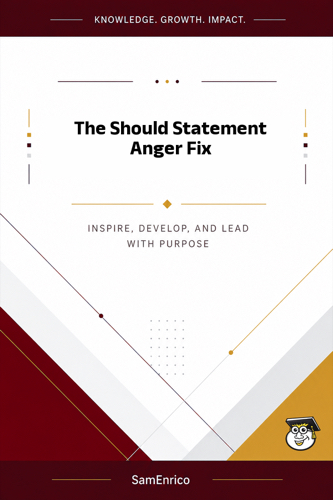
The Should Statement Anger Fix eBook
Challenges rigid expectations that trigger frustra
by Mojica Maria
Challenges rigid expectations that trigger frustration.
Formats
Free sample
Chapter 1: The Silent Explosion--You are not a bad person for getting angry. Let’s get that out of the way immediately. You are not broken, you do not have a “rage problem” that requires moral condemnation, and you are certainly not alone. Every single person reading this sentence has, at some point in the past seventy-two hours, felt a spike of irrational fury over something that, in retrospect, seems absurdly small. The coffee that spilled.
The driver who merged without signaling. The partner who left a wet towel on the floor. The website that took three seconds too long to load. The child who asked “why” one too many times.These moments do not make you a monster. They make you human.But here is what you need to understand before we go any further: that explosion of anger—the one that came out of nowhere, the one that made you say something you regretted, the one that left you feeling exhausted and ashamed afterward—did not come from nowhere.
It came from everywhere. It came from a hidden rulebook you have been carrying around for years, maybe decades, without ever knowing you were holding it. And every single entry in that rulebook begins with the same five-letter word: SHOULD.The Case of the Missing Anger Let me tell you about a man named David. David is a forty-two-year-old software engineer, married, with two children under the age of ten. He came to see me not because he thought he had an anger problem—he specifically said, “I’m not an angry person”—but because his wife had given him an ultimatum after he screamed at their seven-year-old daughter for leaving her shoes in the hallway.“I don’t understand what happened,” David told me, his hands spread wide in genuine confusion.
“One second I was walking into the house after a normal day at work. The next second, I was shouting. My daughter started crying. My wife looked at me like I was a stranger. And I felt… I felt completely justified in the moment.
But an hour later, I felt like garbage. I apologized. I hugged my daughter. But I could see in my wife’s eyes that she didn’t believe me anymore. She’s heard the apology before.”I asked David to walk me through the thirty seconds before the explosion.
What did he see? What did he feel? What was he thinking?“I saw the shoes,” he said. “Just sitting there. In the middle of the hallway.
And I thought—I thought, ‘She knows better. We’ve told her a hundred times. She SHOULD know better by now.’”There it was. The Should.I asked David to say that sentence again, but this time to listen to the word “should” as if it were a foreign language. “She should know better.” I asked him: what does that word actually mean in this context?
Does it mean “it is statistically probable that a seven-year-old will remember to put her shoes away every single time”? No. Does it mean “the laws of physics require that these shoes not be in the hallway”? No. Does it mean “I have a preference that my daughter learns organizational skills over time, and I am willing to teach her patiently”?
Also no.What “should” means in David’s sentence—and in yours, when you use it—is this: “Reality has violated my command, and I am entitled to punish the offender.”David had written a rule in his head: Seven-year-old children should remember to put their shoes away. He had never discussed this rule with his daughter. He had never asked her if she agreed to it. He had simply assumed it was true because it felt true. And when reality—in the form of a tired child who forgot—broke his rule, his brain treated it not as a minor inconvenience but as an act of treason.That is the Silent Explosion.
That is what this entire book is about.Introducing the Should Monster Let me give this hidden rulebook a name, because naming something is the first step to taming it. I call it the Should Monster.The Should Monster is the internal voice that dictates how the world, other people, and you yourself must behave. It speaks in absolutes. It does not tolerate exceptions. It does not care about context, fatigue, bad days, or the fact that other people have their own internal rulebooks that may not match yours.
The Should Monster demands compliance, and when compliance is not delivered, it demands punishment—usually in the form of rage.Here is what the Should Monster sounds like in everyday life:“The person in front of me at the grocery store should move faster.”“My boss should have noticed how hard I worked on that project.”“The traffic should not be this bad at 6 PM on a Tuesday.”“My partner should know what I want without me having to ask.”“I should not have made that mistake. I am better than that.”“The world should be fair. Bad things should not happen to good people.”Do any of those sound familiar? Of course they do. They are the background noise of modern life, the constant hum of unmet expectations that fuels low-grade irritation and occasional explosive rage.
Most people never question these statements. They feel true. They feel like descriptions of the way things ought to be. But here is the uncomfortable truth that this book will force you to confront: the Should Monster is not describing reality. The Should Monster is demanding a fantasy.The grocery store customer is not moving faster.
Your boss did not notice your project. The traffic is exactly this bad. Your partner does not know what you want. You made the mistake. The world is not fair.
These are the facts. The Should Monster looks at these facts and screams, “THIS SHOULD NOT BE!” But screaming at reality is like screaming at the ocean to stop being wet. It accomplishes nothing except exhausting you.The Neurochemistry of a Should Before we go any further into the psychology of Shoulds, we need to understand what happens inside your brain and body when you encounter a violated Should. This is not abstract theory. This is biology.When your brain detects a discrepancy between what you expect and what you actually experience, it activates a network called the anterior cingulate cortex—the brain’s error-detection system.
This is the same system that lights up when you hit the wrong note on a piano or when you realize you’ve taken the wrong exit on the highway. Normally, this error signal is mild and easily resolved. You notice the wrong note, you correct it, you move on.But when the discrepancy involves a Should—when your brain interprets the error as a violation of a rule that should not be broken—the anterior cingulate cortex sends an emergency signal to the amygdala, your brain’s threat-detection center. The amygdala does not distinguish between a physical threat (a tiger charging at you) and a psychological threat (a violated Should). It treats both as survival emergencies.
It floods your body with cortisol and adrenaline. Your heart rate spikes. Your breathing becomes shallow. Blood rushes to your…
This is the end of the free sample. Get the eBook to keep going. Buy now
About this book
Details
- Author
- Mojica Maria
- Publisher
- SamEnrico
- Language
- English
- Genre
- Non-Fiction, Self-Help, Cognitive Distortions
- Released
- 2026-06-05
- Pages (approx.)
- 138
- Available as
- eBook, Audiobook

Read better in the ZLOADR app
Your eBooks on your phone or tablet. Sign in with your SamEnrico account and start reading.
More by Mojica Maria
 Russian Front German SoldierMojica Maria$11.99
 NVC Journal WorkbookMojica Maria$11.99
 Canva Brand Identity for LandscapersMojica Maria$11.99
 Golden Shadows: The Untold Story of Cathy Freeman’s Olympic Triumph and Indigenous LegacyMojica Maria$11.99
 AI for Lead Time ForecastingMojica Maria$12.99
 Learn to Play the Double Contrabass FluteMojica Maria$11.99
 How to Start a Climbing Clothing for Men and Boys (weatherproof) Business (Beginners Guide)Mojica Maria$11.99
 Gluttonous Turing Machine OperatorMojica Maria$11.99
You may also like
 Hong Kong Handover 1997Dunn Johnnie$11.99
 Zumba For Postnatal Recovery CourseNeal Christian$11.99
 Zumba for BeginnersLadner Nikia$11.99
 YouTube Comment Mining GuideHumes Pandora$12.99
 Worry Box MeditationCarlin Rudy$11.99
 Workplace Stress MeditationNguyen Lynn$11.99
 Workplace Stress and Sleep RepairHawley Ivory$11.99
 Workplace Perfectionism CureDelaney Jeffry$11.99
 Workplace Injustice Anger GuideWallen Isabelle$11.99
 Work Addiction and Burnout LinkGreenwood Ester$11.99
 Women in Yoga and WellnessBeattie Galina$11.99
 Women in Stand Up ComedyChun Evangeline$11.99