
Non-FictionSelf-HelpShame Navigation
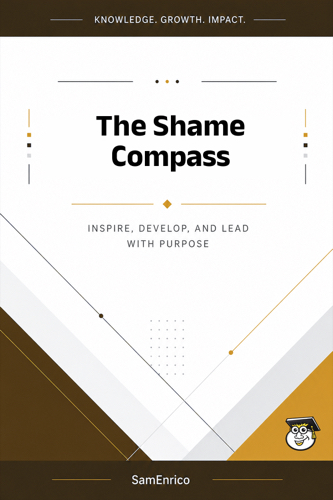
The Shame Compass
Points toward shame triggers' origins to navigate
by Tyner Myrtis
Points toward shame triggers' origins to navigate away from avoidance.
Formats
About this book
Free sample
Chapter 1: The Wound Before Language...--–- The memory arrived without warning. You are four years old, standing in a kitchen. Someone’s face changes—a tightening around the mouth, eyes that stop seeing you and start judging you. You don’t know what you did wrong. You only know that something inside you crumples like paper.
Forty years later, that crumpling still happens. Same sensation. Same collapse. Same wordless certainty that you are the problem.This is not a memory of an event. It is a memory of a wound.
And that wound was encoded before you had the words to explain it, defend against it, or even name it. That is why shame feels so much like truth. It was written directly on the body, not on the whiteboard of conscious thought.The Pre-Verbal Crime Scene Most people believe shame begins with a thought. “I did something stupid, therefore I am stupid.” But that sequence is backwards. The physical sensation comes first—the heat, the collapse, the urge to disappear.
The thought arrives later, as an explanation for a feeling that was already there.Neuroscience confirms what trauma therapists have long observed: the brain’s limbic system (emotional processing) matures years before the prefrontal cortex (language, reasoning, narrative). A child at age three can feel rejected with devastating intensity but cannot say, “I feel rejected because my mother turned away when I needed her.” Instead, the body simply learns: When I reach, the world withdraws. Therefore, reaching is dangerous. Therefore, I am dangerous.This is the pre-verbal crime scene. And shame is the forensic evidence.Consider how infants communicate distress.
They cry. They arch their backs. They turn away. These are not manipulative behaviors; they are survival signals. If a caregiver consistently fails to respond—or worse, responds with irritation, disgust, or coldness—the infant’s nervous system does not conclude, “My caregiver is struggling.” It concludes, “I am the reason for this bad feeling.” Because for a child, the alternative—that the person responsible for their survival is unreliable or dangerous—is unthinkable.
Better to be bad than to be helpless.This is not a philosophical failure. It is a biological miracle of adaptation.…
This is the end of the free sample. Get the eBook to keep going. Buy now
Contents
- Chapter 1
- Chapter 2
- Chapter 3
- Chapter 4
- Chapter 5
- Chapter 6
- Chapter 7
- Chapter 8
- Chapter 9
- Chapter 10
- Chapter 11
- Chapter 12
Details
- Author
- Tyner Myrtis
- Publisher
- SamEnrico
- Language
- English
- Genre
- Non-Fiction, Self-Help, Shame Navigation
- Released
- 2026-06-07
- Pages (approx.)
- 151
- Available as
- eBook, Audiobook

Read better in the ZLOADR app
Your eBooks on your phone or tablet. Sign in with your SamEnrico account and start reading.
More by Tyner Myrtis
 Single Parent Money WorryTyner Myrtis$11.99
 Detroit Teamster Mob Connection UncoveredTyner Myrtis$11.99
 Nocturnal Panic Attack GuideTyner Myrtis$11.99
 SAD Journal LogTyner Myrtis$11.99
 War Resisters League CentennialTyner Myrtis$11.99
 Job Loss for HospitalityTyner Myrtis$11.99
 Actor Memoir Master GuideTyner Myrtis$11.99
 The Silk and the Scandal: Australia’s First Fashion ForgerTyner Myrtis$11.99
 Kamikaze Winds: The Mongols' Failed Invasion of Japan (1274 & 1281)Tyner Myrtis$11.99
 How to Produce Pharmacy StocksTyner Myrtis$11.99
 How to Become a ProsthetistTyner Myrtis$11.99
 Sabbatical and Leave Planning GuideTyner Myrtis$12.99
You may also like
 Hong Kong Handover 1997Dunn Johnnie$11.99
 Zumba For Postnatal Recovery CourseNeal Christian$11.99
 Zumba for BeginnersLadner Nikia$11.99
 YouTube Comment Mining GuideHumes Pandora$12.99
 Worry Box MeditationCarlin Rudy$11.99
 Workplace Stress MeditationNguyen Lynn$11.99
 Workplace Stress and Sleep RepairHawley Ivory$11.99
 Workplace Perfectionism CureDelaney Jeffry$11.99
 Workplace Injustice Anger GuideWallen Isabelle$11.99
 Work Addiction and Burnout LinkGreenwood Ester$11.99
 Women in Yoga and WellnessBeattie Galina$11.99
 Women in Stand Up ComedyChun Evangeline$11.99