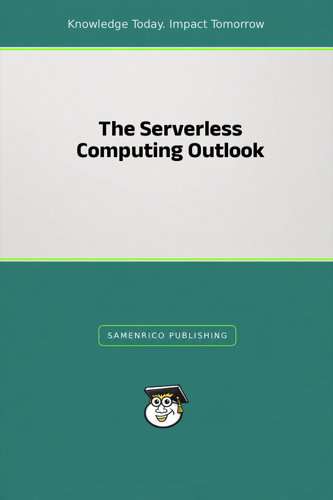
The Serverless Computing Outlook eBook
Projects serverless adoption to surpass traditiona
by Peel Coralie
Projects serverless adoption to surpass traditional IaaS by 2029.
Formats
Free sample
Chapter 1: The 87% Lie...--For a decade, we have been lied to. Not maliciously, not conspiratorially, but lied to nonetheless. The lie comes printed on every cloud bill, whispered in every sales pitch, and baked into every infrastructure spreadsheet. It is the lie of the idle server—the quiet assumption that paying for a virtual machine to sit there, waiting, is simply the cost of doing business in the modern world.It is not. It is a tax.
And it is the largest hidden tax in the history of enterprise technology.Let me show you the receipt.The Receipt You Never Read In 2023, a Fortune 500 retail company—let us call them "Midwest Retail"—hired a cloud economics firm to audit their AWS bill. They were spending $47 million annually on compute. The audit revealed something remarkable. Of those 47 million dollars, just over $6 million paid for actual compute work. The remaining $41 million paid for virtual machines that were doing nothing useful.Forty-one million dollars.
For idle servers.When the CTO saw the report, he did not believe it. He asked for a second audit. That audit came back with the same numbers. Then he asked a question that should terrify every cloud executive: "How long has this been happening?" The answer: at least seven years. They had been burning roughly $40 million per year on idle infrastructure for nearly a decade.
That is nearly $300 million in waste. Enough to build a new headquarters. Enough to hire a thousand engineers. Enough to acquire three competitors.Instead, it paid for servers that spent 87% of their lives doing absolutely nothing.The 87% Lie Defined This is the 87% Lie. It is the gap between what you pay for in cloud computing and what you actually use.
Industry-wide studies consistently show that typical Iaa S (Infrastructure-as-a-Service) virtual machines run at 5% to 15% CPU utilization on average. Let us be generous and take the high end: 13% utilization means 87% idleness.But the lie is not just about CPU cycles. It is about everything attached to those idle servers: the memory, the network allocation, the storage I/O capacity, the licensing fees, the management overhead, and the carbon emissions. Every single one of these costs is billed as if the server were running at 100% utilization. None of them are discounted for the 87% of time the server does nothing.Think about any other industry operating this way.
Imagine renting a delivery truck but paying for it to sit in your parking lot 87% of the time, engine running, fuel burning, while making zero deliveries. You would fire the fleet manager immediately. And yet, in cloud computing, this is not just accepted—it is the standard model.How We Got Here: A Brief History of Waste To understand why the 87% Lie persists, we must travel back to the early 2000s. Before cloud computing, companies bought physical servers. A physical server, once purchased, was a sunk cost.
Running it 24/7 cost almost nothing extra in operational terms—a bit of electricity and cooling. So there was no economic penalty for idleness. The server was already paid for.Then cloud computing arrived. Amazon Web Services launched its first EC2 instance in 2006. The genius of cloud was that you no longer had to buy servers—you rented them by the hour.
This was revolutionary. For the first time, compute became an operating expense rather than a capital expense. Startups could scale without buying hardware. Enterprises could experiment without committing.But something interesting happened on the way to the revolution. The pricing model—pay by the hour—carried forward the assumption of the physical server era.
The assumption was that servers would be "always on" because, well, that is what servers do. The hour became the smallest unit of billing. And the industry normalized around this assumption.Then, in 2014, AWS Lambda launched. Lambda was different. You did not pay by the hour.
You paid by the millisecond of actual execution time. If your code ran for 100 milliseconds, you paid for 100 milliseconds. If it did not run at all, you paid nothing. This was not just a new pricing model. It was a radical re-imagining of what compute could be.The industry called this "serverless." The name is terrible because there are still servers—you just do not manage them.
But the economic model is everything. Pay-for-execution is to pay-by-the-hour what the smartphone was to the landline. It is not an incremental improvement. It is a category shift.The Economics of Idle, Visualized Let me make the math painfully concrete.Consider a simple API endpoint that receives 1,000 requests per day. Each request takes 200 milliseconds to process.
On Iaa S, you need a virtual machine running 24/7 to handle those requests. Even the smallest VM costs roughly $15 per month. That is $180 per year.Now calculate the actual compute work. One thousand requests per day, times 200 milliseconds, is 200 seconds of work per day. Over a year, that is roughly 20 hours of actual compute.
You are paying for 8,760 hours (24/7/365) but using only 20 hours. That is 0.2% utilization. You are paying 500 times more than the work is worth.On serverless, you pay for exactly those 200 milliseconds per request. At typical pricing ($0.0000167 per GB-second), that same workload costs roughly $1.20 per year. Not $180.
One dollar and twenty cents.This is not a marginal difference. This is a 150x multiplier on waste. And this is a relatively generous example—moderate traffic, simple API. For spikier workloads (think batch processing, cron jobs, event-driven pipelines), the multiplier grows into the thousands.But wait, you might say. What about the database?
What about the other services that need to run continuously? This is an important point, and we will address it thoroughly in Chapter 3. For now, let us focus on the compute layer itself. The database is a separate conversation. The compute layer—the part that runs your application logic—is where the 87% Lie does its most expensive work.The 68% Signal Here is where the lie begins to crack.
In a 2024 survey of 1,500 cloud decision-makers, 68% of organizations cited faster deployment and reduced maintenance as their primary cloud driver. Not cost. Not scalability. Speed and less operational burden.This is the canary in the coal mine. For years, cloud vendors sold Iaa S on price.
"Pay only for what you use," they said. But the fine print always read: "pay only for what you allocate by the hour, whether you use it or not." Now, organizations are waking up to the hidden tax. They are realizing that the real cost of Iaa S is not the line item on the invoice. It is the developer time spent managing servers that should not exist. It is the operations team waking up at 3 AM to patch a kernel.
It is the twelve-week lead time to provision a new environment because the cloud team is backlogged.The 68% are not saying they want to pay less. They are saying they want to work less on infrastructure and more on features that matter to customers. They are saying that undifferentiated heavy lifting—the work of keeping servers alive, patched, scaled, and secured—adds zero competitive advantage. And they are increasingly willing to pay a premium to eliminate it.The irony is that serverless eliminates the tax and reduces the bill simultaneously. You get faster…
This is the end of the free sample. Get the eBook to keep going. Buy now
About this book
Details
- Author
- Peel Coralie
- Publisher
- SamEnrico
- Language
- English
- Genre
- Non-Fiction, Forecast & Outlook, Serverless
- Released
- 2026-06-07
- Pages (approx.)
- 140
- Available as
- eBook, Audiobook

Read better in the ZLOADR app
Your eBooks on your phone or tablet. Sign in with your SamEnrico account and start reading.
More by Peel Coralie
 Trademark Protection AbroadPeel Coralie$11.99
 Improv for Remote TeamsPeel Coralie$11.99
 Lilly Singh YouTube to TVPeel Coralie$11.99
 Financial Stress for Hotel StaffPeel Coralie$11.99
 Tamerlane: The Iron Conqueror and His Blood-Stained LegacyPeel Coralie$11.99
 Travel Preferences GuidePeel Coralie$12.99
 PayPal Non Resident LLC GuidePeel Coralie$12.99
 How to Become a Pneumatic-tool OperatorPeel Coralie$11.99
 Understanding Ramer–ladda SyndromePeel Coralie$17.99
 Health & Safety ConsultantPeel Coralie$11.99