
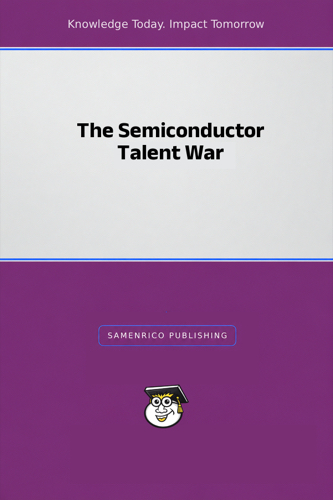
Non-FictionForecast & OutlookSemiconductors
The Semiconductor Talent War eBook
Analyze global competition for chip designers and
by Woody Meagan
Analyze global competition for chip designers and fabrication engineers.
Formats
Free sample
Chapter 1: The Zero-Sum Equation--The phone call came at 11:47 PM on a Tuesday. Dr. Mei Lin, a 28-year-old process integration engineer at TSMC’s Fab 14 in Tainan, Taiwan, was reviewing yield data when her manager appeared at her cubicle. “Mei,” he said, his voice low, “you need to take this.” The caller was a recruiter from Intel’s new Arizona fab. The offer: a 40% base salary increase, a $150,000 signing bonus, full relocation for her and her parents, and a green card sponsorship within 18 months.
“You wouldn’t be the first,” the recruiter said. “We’ve already hired forty of your colleagues.”This book is about the war behind that phone call.The semiconductor industry is accustomed to thinking in billions—billions of transistors, billions of dollars in fab construction, billions of chips shipped annually. But in the 2020s, a new unit of scarcity has emerged: the person. Specifically, the highly trained, battle-hardened engineer who understands how to design a chip that consumes nanowatts per instruction, or how to etch a layer of metal with atomic precision across a 300-millimeter wafer. These people do not scale.
They cannot be manufactured. And they are leaving the industry faster than they can be replaced.The semiconductor talent war is not a metaphor. It is a zero-sum competition between nations, companies, and even individual fabs for a pool of human beings that is not growing nearly fast enough to meet demand. This chapter establishes the scale of the crisis, introduces the framework that will guide this book, and explains why every reader—whether an engineer, an executive, a policymaker, or simply a citizen of a world that runs on chips—should care deeply about who wins and who loses.The New Oil, Refined For most of the twentieth century, oil was the world’s most contested resource. Nations went to war over it.
Cartels controlled its price. Entire economies rose and fell based on access to crude. In the twenty-first century, chips have become the new oil—not because they are burned, but because every modern economy runs on them. A smartphone contains roughly 150 chips. A modern electric vehicle contains over 3,000.
A data center training a large language model might contain 25,000 GPUs, each one a marvel of lithographic precision.But unlike oil, which is geographically fixed beneath deserts and seabeds, the people who design and manufacture chips are mobile. They cross borders. They answer Linked In messages from recruiters. They choose between competing offers based on salary, mission, and the chance to work on something that matters. And unlike oil, which can be extracted faster by drilling more wells, a semiconductor engineer takes ten to fifteen years to train.
A Ph D in plasma physics cannot be accelerated. A senior verification engineer with ten years of experience cannot be minted in a bootcamp.This is the central paradox of the modern semiconductor industry. Between 2020 and 2025, governments and companies announced over $200 billion in new fab construction—in Arizona, Ohio, Germany, Japan, and across China. Yet many of these projects are delayed, not because of money or equipment, but because the people to staff them do not exist. TSMC’s Arizona plant, originally slated to open in 2024, pushed its timeline to 2025 and then to 2026.
The reason was not a shortage of lithography machines. It was a shortage of engineers who knew how to use them.The Eightfold Problem In 2022, the Semiconductor Industry Association (SIA) published a projection that would become the single most cited statistic in the talent war: by 2030, the United States alone would face a deficit of 70,000 to 90,000 semiconductor professionals. This gap assumed that universities would continue graduating students at current rates, that immigration would hold steady, and that retirements would follow predictable patterns. Every single assumption turned out to be optimistic.Let us call this the Eightfold Problem, because it has eight compounding dimensions:The retirement cliff: More than 40% of semiconductor engineers in the United States and Japan are over fifty years old. When they retire, they take decades of tribal knowledge with them.
This is not a slow leak; it is a dam breaking.The education gap: In 2005, over 100 American universities offered accredited semiconductor manufacturing programs. By 2020, fewer than forty remained. Students flocked to computer science and software engineering, where starting salaries were higher and the work was remote. The hardware pipeline dried up.The Ph D collapse: Leading-edge process development requires a doctoral degree. But the number of domestic Ph Ds in electrical engineering and materials science has been flat or declining for a decade.
The gap is filled by international students, many of whom cannot stay due to visa restrictions.The software premium: A fresh graduate with a bachelor’s degree in computer science can earn $120,000 at a software company, working from home, with unlimited PTO. A fresh graduate with a master’s degree in chemical engineering might earn $85,000 working in a fab, wearing a bunny suit, breathing filtered air, and enduring twelve-hour shifts. The market has spoken.The geographic mismatch: New fabs are being built in places like Ohio, upstate New York, and Saxony, Germany. The talent pools are in Taiwan, Bangalore, and Silicon Valley. Asking an engineer to relocate from Hsinchu to Columbus, Ohio is not impossible, but it requires incentives that most companies are unwilling to provide.The security wall: Classified defense work requires citizenship.
This locks out a huge portion of the global talent pool, including many of the most skilled engineers from allied nations. The CHIPS Act includes funding for security clearance processing, but the bottleneck is not paperwork—it is the number of citizens with the right degrees.The poaching vortex: When a new fab opens, it does not create new engineers. It hires them from existing fabs. This is pure zero-sum competition. TSMC’s Arizona plant poached from Intel’s Oregon facility.
Intel’s Ohio plant poached from TSMC’s Taiwan facility. The total talent pool does not grow; it merely reallocates at higher salaries.The missing middle: The industry has focused on recruiting Ph Ds for cutting-edge R&D and on training technicians for basic operations. It has neglected the mid-career engineers who form the backbone of process integration, yield enhancement, and equipment engineering. This missing generation will leave a leadership vacuum in the 2030s.The Eightfold Problem is not a list of separate issues. It is a system of mutually reinforcing constraints.
The retirement cliff creates urgency. The education gap ensures that new graduates cannot replace retirees. The software premium pulls young people away. The security wall locks out foreigners. And the poaching vortex ensures that even when someone is hired, someone else loses.A Tiered Scarcity Framework Not all semiconductor roles are equally scarce.
To understand the talent war, we must distinguish between four tiers of engineering talent. These tiers will appear throughout this book, and they provide a framework for the strategies and case studies that follow.Tier 1: Ultra-rare, fewer than 100 globally. These are the engineers who design quantum control systems, who understand cryogenic electronics, who can calibrate an EUV lithography machine to achieve 2-nanometer patterning. They are not recruited; they are courted. They receive offers directly from CEOs.
Their salaries are negotiated individually, and the numbers are rarely public. A Tier 1 engineer can command a total compensation…
This is the end of the free sample. Get the eBook to keep going. Buy now
About this book
Details
- Author
- Woody Meagan
- Publisher
- SamEnrico
- Language
- English
- Genre
- Non-Fiction, Forecast & Outlook, Semiconductors
- Released
- 2026-06-07
- Pages (approx.)
- 136
- Available as
- eBook, Audiobook

Read better in the ZLOADR app
Your eBooks on your phone or tablet. Sign in with your SamEnrico account and start reading.
More by Woody Meagan
 Artichoke Leaf Gut GuideWoody Meagan$11.99
 Daily Review for Massage TherapistsWoody Meagan$11.99
 Making Peace With Food WorkbookWoody Meagan$11.99
 Catherine the Great Masonic Lodge RelationsWoody Meagan$11.99
 Pixel Pioneers: The Untold Story of the First Female Game DeveloperWoody Meagan$11.99
 Ripple Effect: How a Single Instagram Post Toppled a Billion-Dollar Fashion EmpireWoody Meagan$11.99
 Office CleanerWoody Meagan$11.99
 Registered Agent Service ExplainedWoody Meagan$12.99
 Bad Debt Provision CalculatorWoody Meagan$12.99
 Understanding Benzodiazepine Withdrawal SyndromeWoody Meagan$17.99
 How to Start a Power Supply Unit for Electronic Applications Business (Beginners Guide)Woody Meagan$11.99
You may also like
 Hong Kong Handover 1997Dunn Johnnie$11.99
 Zumba For Postnatal Recovery CourseNeal Christian$11.99
 Zumba for BeginnersLadner Nikia$11.99
 YouTube Comment Mining GuideHumes Pandora$12.99
 Worry Box MeditationCarlin Rudy$11.99
 Workplace Stress MeditationNguyen Lynn$11.99
 Workplace Stress and Sleep RepairHawley Ivory$11.99
 Workplace Perfectionism CureDelaney Jeffry$11.99
 Workplace Injustice Anger GuideWallen Isabelle$11.99
 Work Addiction and Burnout LinkGreenwood Ester$11.99
 Women in Yoga and WellnessBeattie Galina$11.99
 Women in Stand Up ComedyChun Evangeline$11.99