
Non-FictionSelf-HelpSelf-Assessment
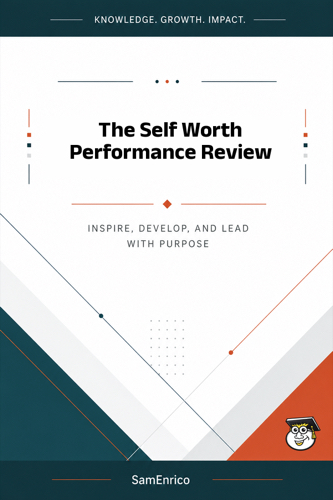
The Self Worth Performance Review eBook
Evaluate your own contributions objectively and do
Evaluate your own contributions objectively and document achievements year-round.
Formats
Free sample
Chapter 1: The Receipts Revolution...--–- The scene is familiar to the point of cliché, yet it plays out in millions of conference rooms every single quarter. A fluorescent light buzzes overhead. A manager scrolls through a spreadsheet they opened for the first time thirty seconds ago. They squint at a column of numbers, pause, and say those five words that make your blood pressure spike: "Hmm, I don't remember that project."Your entire year—the late nights, the creative breakthroughs, the client crises you talked down from the ledge, the team meetings where you held everything together while everyone else panicked—is being judged by someone's memory. Not their notes.
Not a running document of your contributions. Their memory. The same memory that forgot what they ate for breakfast three days ago. The same memory that routinely loses keys, phone numbers, and the name of their child's teacher. And yet, somehow, this memory is supposed to accurately capture and evaluate twelve months of your professional life.This is not an edge case.
This is not bad management. This is the structural reality of the traditional performance review. And it is fundamentally, irreparably broken.The Structural Breakdown of the Annual Review Let us name the problem clearly so we can dismantle it piece by piece. The traditional performance review relies on three deeply flawed assumptions.First, there is the assumption of managerial omniscience. Your manager, no matter how well-intentioned, manages multiple people.
Perhaps five. Perhaps twelve. Perhaps more. Each of those people works on multiple projects. Each project involves multiple tasks, decisions, and moments of invisible effort.
Your manager attends meetings you do not attend, fields crises you never hear about, and carries their own workload, their own stress, their own family obligations. The idea that they could accurately recall, much less evaluate, your specific contributions over a twelve-month period is not merely optimistic—it is delusional.Second, there is the assumption of recency dominance. Human memory is not a flat line of equal weight. It is a recency-weighted curve. What happened last month, and especially what happened last week, looms disproportionately large in our minds.
This means that if you had a spectacular first quarter and a mediocre fourth quarter, your manager will remember the mediocre fourth quarter. Conversely, if you stumbled badly in February but finished strong in December, those early stumbles will fade almost entirely. Your annual review becomes, in practice, a review of the last sixty to ninety days, dressed in the costume of a full-year evaluation.Third, there is the assumption of passive reception. The traditional model trains you—actively trains you, year after year—to be a passive recipient of evaluation. You do your work.
You wait. Someone else reviews your work. Someone else tells you how you did. Someone else determines your raise, your promotion, your trajectory. Over time, this conditioning creates a form of learned helplessness.
You begin to believe that your value is something to be discovered by others, not something you already possess and can demonstrate. You wait for the phone to ring instead of dialing the number yourself.This is not how high performers operate in any other domain. A surgeon does not wait for a yearly review to know whether their patient survived. A pilot does not wait for an annual evaluation to know whether they landed the plane safely. An athlete does not wait for a season-end meeting to know whether they scored the winning goal.
In those domains, feedback is immediate, data is abundant, and self-assessment is continuous. Yet in the knowledge economy—where most of us spend our working lives—we have outsourced evaluation to a once-a-year ritual designed in the 1950s for industrial workers stamping the same piece of metal every day.The Receipts Metaphor: A New Operating System Consider a different scenario. The IRS informs you that you are being audited. Your heart rate might increase, but not because you lack evidence. You have evidence.
You have bank statements, canceled checks, W-2 forms, receipts for deductible expenses, logs of charitable contributions. You do not say to the auditor, "I think I paid my taxes." You say, "Here are the receipts." You produce documentation. You show your work. You prove your case.Your career deserves the same rigor. Not because you are being audited, but because your contributions are too important to leave to someone else's memory.
The "Receipts Revolution" is a shift in mindset from passive recipient to active narrator. It is the decision to stop asking "Do they see me?" and start asking "What have I already done?" It is the recognition that waiting for external validation is not humility—it is a trap disguised as virtue.This does not mean you become a braggart or a narcissist. It does not mean you march into your manager's office and announce your own greatness. It means you become a documentarian of your own work. You collect evidence.
You track outcomes. You write down what happened, week by week, while it is still fresh. You build a case file for your own contributions, not because you are paranoid, but because you are professional.The Ditzler Connection: Taking Control of Your Own Narrative Jinny Ditzler's classic Your Best Year Yet offers a foundational insight that underpins this entire chapter and, indeed, this entire book. Ditzler observed that people who take control of their own narrative—who write down their goals, track their progress, and evaluate themselves against their own standards—consistently outperform those who wait to be evaluated by others. This is not a matter of arrogance or ego.
It is a matter of agency. When you are the author of your own evaluation, you are not waiting for permission to succeed. You are documenting the success that has already occurred.Ditzler's method involves asking yourself a series of powerful questions: What did I accomplish? What did I learn? What stopped me?
What will I do differently? These are not questions you ask once a year in a sweaty conference room. These are questions you ask regularly, systematically, with the same discipline a CEO applies to a quarterly earnings report.The Receipts Revolution adapts Ditzler's method to the specific challenge of performance reviews. You are not merely setting goals, though you will do that. You are building an evidence base.
You are creating a paper trail of your own value. You are becoming the primary author of your professional narrative.The Private Evidence Locker: Your Receipts Folder Here is where theory meets practice. You will create a Receipts Folder. This can be digital (a folder in your email, a notebook in Evernote, a spreadsheet in Google Drive) or physical (a manila folder in a filing cabinet). The medium does not matter.
The practice does.Your Receipts Folder is private. No one else sees it. It is not for your manager. It is not for HR. It is not for your mentor or your spouse or your therapist.
It is for you. It is your evidence locker, your raw data repository, your private archive of proof that you showed up, that you contributed, that you mattered.Each week, you will deposit one piece of evidence into this…
This is the end of the free sample. Get the eBook to keep going. Buy now
About this book
Details
- Author
- Garris Lakeisha
- Publisher
- SamEnrico
- Language
- English
- Genre
- Non-Fiction, Self-Help, Self-Assessment
- Released
- 2026-06-07
- Pages (approx.)
- 127
- Available as
- eBook, Audiobook

Read better in the ZLOADR app
Your eBooks on your phone or tablet. Sign in with your SamEnrico account and start reading.
More by Garris Lakeisha
 Mergers And Acquisitions GuideGarris Lakeisha$11.99
 Gambling Addiction and CryptocurrencyGarris Lakeisha$11.99
 Telehealth DetoxGarris Lakeisha$11.99
 Life Review Journal MethodGarris Lakeisha$11.99
 Interruption JournalGarris Lakeisha$11.99
 Grief and Shame After DivorceGarris Lakeisha$11.99
 Child Loss and SiblingsGarris Lakeisha$11.99
 The Poisoned Lovers: The Deadly Duet of Christine and Marcel PetiotGarris Lakeisha$11.99
 Tangaroa’s Wrath: The Great Wave That Swallowed the SunGarris Lakeisha$11.99
 How to Produce Health FoodGarris Lakeisha$11.99
 How to Produce Motor Vehicle LightingGarris Lakeisha$11.99
 How to Become a Rotor AssemblerGarris Lakeisha$11.99
You may also like
 Hong Kong Handover 1997Dunn Johnnie$11.99
 Zumba For Postnatal Recovery CourseNeal Christian$11.99
 Zumba for BeginnersLadner Nikia$11.99
 YouTube Comment Mining GuideHumes Pandora$12.99
 Worry Box MeditationCarlin Rudy$11.99
 Workplace Stress MeditationNguyen Lynn$11.99
 Workplace Stress and Sleep RepairHawley Ivory$11.99
 Workplace Perfectionism CureDelaney Jeffry$11.99
 Workplace Injustice Anger GuideWallen Isabelle$11.99
 Work Addiction and Burnout LinkGreenwood Ester$11.99
 Women in Yoga and WellnessBeattie Galina$11.99
 Women in Stand Up ComedyChun Evangeline$11.99