
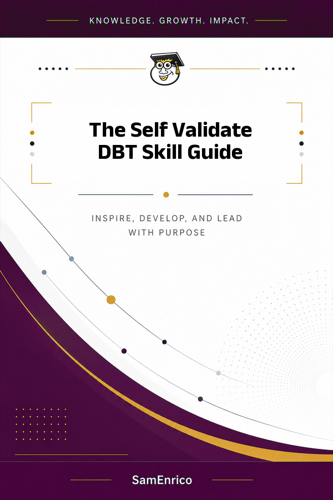
Non-FictionSelf-HelpSelf Validation
The Self Validate DBT Skill Guide eBook
Teaches acknowledging emotions without judgment.
Teaches acknowledging emotions without judgment.
Formats
Free sample
Chapter 1: The Silent Betrayal--–- You wake up. Before you open your eyes, there it is—a familiar heaviness in your chest. Not quite sadness, not quite dread. Just a gray weight pressing down. You check the clock.
It’s early. You have no reason to feel this way. Your life is fine. Good, even. So why do you feel like something is wrong?Within seconds, the second voice arrives.
It doesn’t speak in full sentences. It speaks in certainties. What’s wrong with you. You have no reason to be sad. Get over it.
Stop being so dramatic. You haven’t even gotten out of bed, and already you have done battle with yourself. You have felt a feeling, judged yourself for feeling it, and lost.This is the silent betrayal. And if you opened this book, you almost certainly know it intimately.The opening scene above is not a worst-case scenario. It is a Tuesday morning for millions of people who have learned, somewhere along the way, that their emotions are not to be trusted.
They have been told—directly, indirectly, silently, loudly—that they are too sensitive, too much, too reactive, too emotional, too dramatic, too difficult. And over time, they have stopped needing anyone else to say it. They say it to themselves.This chapter is about naming that betrayal. Because you cannot heal what you will not name. And the betrayal did not begin with you.
It began with the world around you. But it continues, every single day, in the quiet voice inside your own head. That voice is not your friend. It never was. And today, you are going to learn why.The Gap Between Knowing and Feeling Here is a strange contradiction that runs through almost every reader of this book.
Intellectually, you already know that emotions aren’t right or wrong. You have heard that feelings are just data. You have read somewhere that it is healthy to acknowledge what you feel. You might even have said these words to a friend: Of course you’re upset. Anyone would be.But when it is you?
The rules change.The moment you feel something uncomfortable—anger at a partner, jealousy toward a colleague, fear before a presentation, sadness on a perfectly fine Tuesday—your inner voice does not say, “Interesting. I notice anger.” It says, “You shouldn’t be angry. They didn’t mean it. You’re being unfair.” Or worse, it doesn’t say anything. It just floods you with shame so fast that you never even identify the original feeling.
You just know you feel bad, and then you feel bad about feeling bad.This gap between what you know intellectually and what you do automatically is the silent betrayal in action. It is not a lack of knowledge. It is a learned reflex. And like any reflex, it can be unlearned. But first, you have to understand where it came from.
Because until you see the betrayal for what it is, you will keep blaming yourself for the wound that others inflicted.What Is the Silent Betrayal?The silent betrayal is the internalized belief that your emotional reality is wrong, excessive, or unacceptable. It is the voice that says “You’re overreacting” before anyone else can. It is the reflex that makes you apologize for crying. It is the reason you hide your anger and perform your happiness. It is the quiet, constant whisper that says you cannot trust yourself.This wound is not something you were born with.
Newborns do not judge themselves for crying. Toddlers do not apologize for being scared. The silent betrayal is learned. It is taught. And it is taught primarily through repeated experiences of having your emotional reality dismissed, minimized, punished, or ignored.The word “betrayal” matters here.
Betrayal implies a trust that was broken. And you did trust your feelings once. Every child does. You trusted that when you cried, it meant you needed something. You trusted that when you felt scared, something was frightening.
You trusted that when you felt angry, something was unfair. That trust was not wrong. It was natural. It was healthy. And then someone—or many someones—taught you that your trust was misplaced.
They taught you that your feelings were not reliable guides. That you could not trust your own internal compass.That is the betrayal. And it happened so quietly, so gradually, and so early that you probably do not remember the moment it began. You only remember the aftermath. A lifetime of second-guessing yourself.
A lifetime of outsourcing your reality to others. A lifetime of feeling like something is wrong with you, without ever quite knowing what.Where the Betrayal Begins For most people, the silent betrayal begins in childhood. Not because parents are monsters—most are not—but because even well-meaning caregivers cannot always meet a child’s emotional needs. A child falls and cries. The parent says, “You’re fine.
It didn’t hurt that bad.” The child learns: What I feel is not real. A child is afraid of the dark. The parent says, “There’s nothing to be afraid of. Don’t be a baby.” The child learns: My fear is wrong. A child is angry about a rule.
The parent says, “How dare you be angry at me? Go to your room.” The child learns: Anger makes me bad.These are not abusive moments. They are ordinary moments in ordinary families. But repeated thousands of times, they teach a devastating lesson: Your internal world is not reliable. Trust what we tell you, not what you feel.Some readers had it much worse.
Overt emotional abuse—being mocked for crying, punished for anger, ignored in sadness. Neglect—no one noticing what you felt at all. Chaotic environments where emotions were unpredictable weapons. In these cases, the silent betrayal is deeper, more jagged, and more defended. The principles in this book still apply.
But go gently. The first chapters may stir things up. If you find yourself overwhelmed, put the book down. Breathe. Come back when you are ready.Other readers had perfectly kind parents but still developed the silent betrayal.
How? Because invalidation does not only come from caregivers. It comes from peers who laugh at your tears. Teachers who tell you to “calm down.” Bosses who call you “too emotional.” Partners who say “you’re being dramatic.” Cultures that tell men not to feel sadness or fear, and women not to feel anger. Religions that label certain emotions as sinful.
Media that mocks vulnerability. The betrayal is not your fault. It is the water you swam in. It was there before you were born. And it is there still.How the Betrayal Becomes Automatic Here is the insidious part.
The silent betrayal does not require anyone to be in the room anymore. It has become internalized. The external critic—the parent, the peer, the boss, the culture—has moved inside your own head. You now do to yourself what was once done to you.This is why you can have a perfectly supportive partner who says, “Tell me how you feel,” and still find yourself unable to speak. The critic is…
This is the end of the free sample. Get the eBook to keep going. Buy now
About this book
Details
- Author
- Bourque Ariana
- Publisher
- SamEnrico
- Language
- English
- Genre
- Non-Fiction, Self-Help, Self Validation
- Released
- 2026-06-05
- Pages (approx.)
- 144
- Available as
- eBook, Audiobook

Read better in the ZLOADR app
Your eBooks on your phone or tablet. Sign in with your SamEnrico account and start reading.
More by Bourque Ariana
 Alphanumeric Peg SystemBourque Ariana$11.99
 Peru Consumer ReportBourque Ariana$11.99
 Phobia FAQ GuideBourque Ariana$11.99
 Pandemic Trauma TriggersBourque Ariana$11.99
 The Gold Coast Conspiracy: How Victorian Scammers Plundered Hearts and FortunesBourque Ariana$11.99
 How to Start a Permanent Magnets (metallic) Business (Beginners Guide)Bourque Ariana$11.99
 Dara Khosrowshahi GuideBourque Ariana$12.99Dara Khosrowshahi GuideBourque Ariana$12.99Dara Khosrowshahi GuideBourque Ariana$12.99Dara Khosrowshahi GuideBourque Ariana$12.99Dara Khosrowshahi GuideBourque Ariana$12.99Dara Khosrowshahi GuideBourque Ariana$12.99
You may also like
 Hong Kong Handover 1997Dunn Johnnie$11.99
 Zumba For Postnatal Recovery CourseNeal Christian$11.99
 Zumba for BeginnersLadner Nikia$11.99
 YouTube Comment Mining GuideHumes Pandora$12.99
 Worry Box MeditationCarlin Rudy$11.99
 Workplace Stress MeditationNguyen Lynn$11.99
 Workplace Stress and Sleep RepairHawley Ivory$11.99
 Workplace Perfectionism CureDelaney Jeffry$11.99
 Workplace Injustice Anger GuideWallen Isabelle$11.99
 Work Addiction and Burnout LinkGreenwood Ester$11.99
 Women in Yoga and WellnessBeattie Galina$11.99
 Women in Stand Up ComedyChun Evangeline$11.99