
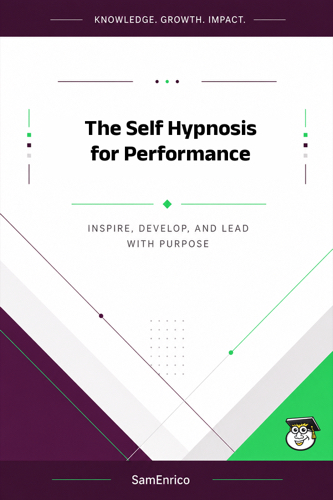
Non-FictionSelf-HelpPerformance
The Self Hypnosis for Performance eBook
Induce trance before sports, exams, or presentatio
by Thomson Kala
Induce trance before sports, exams, or presentations.
Formats
Free sample
Chapter 1: The Trance You Already Know--–- You are already a master hypnotist. You just don’t know it yet.Every day, without a single moment of training, you slip into trance. You have done it thousands of times. The question has never been whether you can enter a hypnotic state. The question has always been whether you can aim it.Consider these moments from your own life:The runner who crosses the finish line and cannot remember the last three miles.
Not because she blacked out, but because her mind narrowed so completely to the rhythm of breath and stride that everything else—the crowd, the pain, the awareness of time—vanished. She was in trance.The student who looks up from a textbook and discovers that two hours have passed like twenty minutes. He did not fall asleep. He did not daydream about something else. He was so absorbed in the material that the external world ceased to exist.
He was in trance.The musician who plays a complex solo perfectly and later cannot recall a single note. Fingers moved. Sound emerged. The conscious, calculating mind stepped aside and something else took over. That something is trance.The speaker who walks off stage and realizes she never once thought about where to put her hands or whether her voice was trembling.
She was fully present but not self-conscious. She was in performance trance.These are not exotic states reserved for monks, mystics, or stage hypnotists. They are ordinary, universal, and already yours. The only problem is that they happen randomly, unpredictably, without your permission or direction. One day you are in the zone.
The next day, on the same task, with the same preparation, you choke. Why? Because you have not learned to turn an accident into a skill.This book exists to fix that.The Great Misunderstanding: What Hypnosis Is Not Before we can use trance, we must unlearn what we think we know about it. The cultural images of hypnosis are nearly all wrong.Hypnosis is not sleep. Brain wave studies have shown this conclusively.
During sleep, the brain produces delta waves—slow, high-amplitude patterns associated with unconsciousness. During hypnosis, the brain produces alpha and theta waves—the same patterns associated with focused wakefulness, meditation, and flow states. A person in hypnosis can open their eyes, speak, move, and remember everything that happened. Sleep requires none of these.Hypnosis is not loss of control. The myth of the stage volunteer clucking like a chicken against their will persists because it is entertaining, not because it is true.
Every person in hypnosis remains fully in control of their values, ethics, and boundaries. No hypnotist can make you do anything you would not do in your normal state. The stage volunteer is not helpless; they are permissive. They have given themselves permission to play, to set aside social inhibition, to follow suggestions because they are fun. The moment a suggestion violates their genuine will, they emerge spontaneously or reject the suggestion.Hypnosis is not a special power possessed by a gifted few.
Stage hypnotists are not magicians. They are skilled at selecting participants—the 10-15% of people who are highly suggestible and enjoy performance. But the remaining 85% can still enter trance. They simply enter it differently: more slowly, more analytically, with eyes open rather than closed. Suggestibility is a spectrum, not a door that is either locked or open.
And every point on that spectrum can be trained.So what is hypnosis, actually?The most useful definition for our purposes comes from Dr. John Kappas, founder of the Hypnosis Motivation Institute: Hypnosis is the bypass of the critical factor of the conscious mind and the establishment of acceptable selective thinking.Let me translate that into plain English.Your conscious mind has a gatekeeper. Its job is to evaluate everything you experience: Is this true? Is this safe? Does this match what I already believe?
This gatekeeper is essential for daily life. It stops you from believing every advertisement, acting on every impulse, or accepting every suggestion that floats through your awareness. But the gatekeeper is also the enemy of peak performance. When you need to act without hesitation, without self-doubt, without the endless loop of “am I doing this right?” the gatekeeper must step aside.Hypnosis is the tool that invites the gatekeeper to take a brief, strategic break.Redefining Trance: Absorption, Not Oblivion The word “trance” carries baggage. For many people, it conjures images of swaying pendulums, glassy eyes, and amnesia.
Set those images aside. The clinical definition we will use throughout this book is far simpler and far more useful:Trance is a state of concentrated attention in which the peripheral awareness fades and the mind becomes highly responsive to a single focus.Notice what this definition does not require. It does not require closed eyes. It does not require relaxation. It does not require a hypnotist.
It does not require lying down or counting backwards or any of the ritual trappings that have accumulated around hypnosis like barnacles on a ship.All trance requires is concentration so intense that the rest of the world falls away.This is why the runner forgets the crowd. This is why the student loses track of time. This is why the musician plays without conscious effort. Their attention is so completely absorbed by the task that the brain stops allocating resources to anything else. The neural circuits that process self-doubt, time perception, environmental monitoring, and pain all quiet down.
What remains is pure, unfiltered engagement with the activity.The psychologist Mihaly Csikszentmihalyi called this “flow.” Athletes call it “the zone.” Neuroscientists call it “transient hypofrontality”—a temporary reduction in activity in the prefrontal cortex, the part of the brain responsible for self-awareness, planning, and inhibition. I call it trance, because that is what it has been called for centuries, and because recognizing it as hypnosis gives us access to a century of research on how to induce it reliably.The reframe is simple and powerful: You do not need to learn a new skill. You need to learn how to access a skill you already have, on demand, in high-stakes situations.The Neurochemistry of Choking and Flowing Why does the same person sometimes perform brilliantly and sometimes fall apart? The answer lies in two competing neurological systems.The sympathetic nervous system is your body’s accelerator. It releases adrenaline and cortisol.
It increases heart rate, diverts blood to large muscles, sharpens hearing, and dilates pupils. This is the “fight or flight” response, and it evolved to help you outrun predators or fight off attackers. It is useful. But it is also blunt.The parasympathetic nervous system is your body’s brake. It releases acetylcholine.
It slows heart rate, constricts pupils, and directs blood flow to digestion and repair. This is the “rest and digest” response. It is also useful. But it is also slow to engage.Peak performance requires a third state: the high-frequency vagal tone state. This is not accelerator and not brake.
It is the finely tuned balance where the body is alert but not panicked, focused but not rigid, responsive but not reactive. Heart rate is…
This is the end of the free sample. Get the eBook to keep going. Buy now
About this book
Details
- Author
- Thomson Kala
- Publisher
- SamEnrico
- Language
- English
- Genre
- Non-Fiction, Self-Help, Performance
- Released
- 2026-06-09
- Pages (approx.)
- 140
- Available as
- eBook, Audiobook

Read better in the ZLOADR app
Your eBooks on your phone or tablet. Sign in with your SamEnrico account and start reading.
More by Thomson Kala
 Widower Grief GuideThomson Kala$11.99
 Prince Purple ReignThomson Kala$11.99
 Immigrant Cleaner To TycoonThomson Kala$11.99
 Fiverr Order Cancellation ReductionThomson Kala$11.99
 Breaking the Pornography Habit GuideThomson Kala$11.99
 Public Speaking JournalThomson Kala$11.99
 Copper IUD GuideThomson Kala$11.99
 The Iron Witch of Pskov: A Slavic Sorceress and the Cursed SpireThomson Kala$11.99
 The Maestro of the Outback: Peter Sculthorpe and the Sound of AustraliaThomson Kala$11.99
 MLA Citation Made Simple GuideThomson Kala$12.99
 London Pop-Up Retail Permit GuideThomson Kala$12.99
 A Collector's Handbook to the Skoda 1000mbxThomson Kala$11.99
You may also like
 Hong Kong Handover 1997Dunn Johnnie$11.99
 Zumba For Postnatal Recovery CourseNeal Christian$11.99
 Zumba for BeginnersLadner Nikia$11.99
 YouTube Comment Mining GuideHumes Pandora$12.99
 Worry Box MeditationCarlin Rudy$11.99
 Workplace Stress MeditationNguyen Lynn$11.99
 Workplace Stress and Sleep RepairHawley Ivory$11.99
 Workplace Perfectionism CureDelaney Jeffry$11.99
 Workplace Injustice Anger GuideWallen Isabelle$11.99
 Work Addiction and Burnout LinkGreenwood Ester$11.99
 Women in Yoga and WellnessBeattie Galina$11.99
 Women in Stand Up ComedyChun Evangeline$11.99