
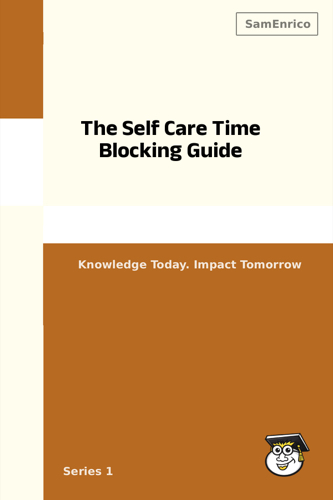
The Self Care Time Blocking Guide eBook
Protects exercise, sleep, and relaxation time.
Protects exercise, sleep, and relaxation time.
Formats
Free sample
Chapter 1: The Hustle Lie--–- You are reading this book because you are exhausted in a way that sleep does not fix. You have tried the to-do list apps, the early morning routines, the motivational podcasts, and the stern self-promises made on Sunday night. Yet here you are, on a Tuesday afternoon that feels like the fourth Tuesday of an endless week, wondering why protecting time for a simple workout or a full night of sleep feels like negotiating with a hostage taker.The problem is not your willpower. The problem is not your calendar app or your inability to wake up at 5 AM like the productivity guru on Instagram. The problem is a lie so deeply embedded in modern culture that most people do not even recognize it as a belief.
They mistake it for common sense. The lie is this: if you just work a little harder, a little longer, a little smarter, you will eventually catch up. And once you catch up, you will finally have time for exercise, sleep, and relaxation.This chapter dismantles that lie. It will show you, with mathematical certainty, that catching up is impossible. It will introduce you to the concept of Time Guilt—the chronic feeling that any moment not spent on visible work is a moment stolen from your obligations.
And it will offer a radical alternative: the practice of strategic incompleteness. By the end of this chapter, you will have permission to leave tasks undone. More importantly, you will understand why that permission is not just acceptable but necessary for your survival.The Mathematics of Perpetual Overwhelm Let us begin with a simple question that most time management books avoid: why do you never reach the end of your to-do list? The conventional answer is that you are not organized enough, not disciplined enough, or not using the right system. The real answer is mathematical.Your to-do list does not behave like a finite checklist.
It behaves like a living organism that reproduces faster than you can kill it. Every task you complete generates new tasks. Answering an email creates three more emails. Completing a project report triggers a review meeting, which generates action items, which generate sub-tasks. This is not a failure of your system.
This is the fundamental nature of knowledge work in a connected economy.Let me introduce the Completion Fallacy. This is the false but deeply comforting belief that finishing your to-do list is a possible state. It is not. Even on your most productive day—the day you crossed off seventeen items and felt like a superhero—you looked at the list and saw that it still contained items. Worse, new items had appeared while you were working.
The list is a hydra. Cut off one head, and two grow back.Parkinson's Law states that work expands to fill the time available for its completion. But there is a darker corollary that most people miss: tasks expand to fill the time available, and then they generate new tasks that expand to fill the time that does not yet exist. This is why a three-day project assigned two weeks ago still took three days. This is why the person who works sixty hours a week still has a backlog.
The load adjusts to consume the limits.Here is the mathematical truth that will set you free: your load (demands, tasks, notifications, roles) consistently exceeds your limits (hours in the day, energy reserves, cognitive bandwidth). This is not a temporary condition that will resolve when you get that promotion, when the kids are older, when the project ends. This is the permanent condition of being a responsible adult in a world that never stops producing obligations.The only way to make load and limits equal is to reduce the load. Not to increase efficiency. Not to wake up earlier.
Not to find a better calendar app. To deliberately, consciously, and strategically leave things undone.Time Guilt: The Invisible Thief If the Completion Fallacy is the belief, Time Guilt is the emotion that enforces it. Time Guilt is the chronic feeling that any moment not spent on visible, productive, measurable work is a moment stolen from your obligations. It is the voice that whispers while you are on a run: you should be answering emails. It is the knot in your stomach when you close your laptop at 6 PM.
It is the reason you check work messages while on vacation, the reason you feel lazy when you take a nap, the reason you have not had an uninterrupted hour of leisure in years.Time Guilt operates through a simple psychological mechanism: the substitution of visibility for value. Tasks that are visible—emails in an inbox, messages in a Slack channel, items on a shared to-do list—feel urgent because others can see them. Tasks that are invisible—your need for sleep, your requirement for exercise, your desperate longing for five minutes of silence—feel optional because no one is demanding them.Consider the following scenario. You have a workout scheduled for 6 PM. At 5:45 PM, an email arrives from your manager with a question about a project.
The question is not urgent. It does not need an answer until tomorrow morning. But the email is visible. It sits in your inbox, unread, glowing with the implied demand for a response. Your Time Guilt activates.
You tell yourself you will answer quickly, just a two-minute reply, and then go to the gym. Two minutes become ten. The reply generates a follow-up question. By 6:30 PM, you have lost your workout window. You tell yourself you will work out tomorrow.
Tomorrow, the same thing happens. Six months later, you have gained twelve pounds, your sleep is fragmented, and you cannot remember the last time you felt rested.Here is the cruel irony: Time Guilt punishes you for the very activities that would eliminate it. Exercise reduces anxiety. Sleep restores cognitive function. Relaxation resets your stress response.
But because these activities have no visible output—no email sent, no task checked, no notification cleared—Time Guilt categorizes them as "optional" or even "selfish." You feel guilty for taking care of yourself, so you stop taking care of yourself, which makes you less effective at work, which generates more Time Guilt. The spiral continues until you break.The Strategic Incompleteness Protocol If catching up is impossible and Time Guilt is the trap that keeps you running, then the solution must be radical. It must violate every productivity rule you have ever been taught. The solution is strategic incompleteness: the deliberate, explicit, and guilt-free choice to leave tasks undone.Strategic incompleteness is not procrastination. Procrastination is the unconscious avoidance of a task you know you should do.
Strategic incompleteness is the conscious selection of tasks that will not get done today, this week, or possibly ever. You do not forget about them. You do not hope they will disappear. You look at them, assess their value relative to your non-negotiable self-care blocks, and declare them sacrificial.Here is the protocol.First, write your actual to-do list. Not the curated, realistic list you wish you had.
The full, overwhelming, anxiety-producing list that lives in your head and your various apps and your sticky notes and your…
This is the end of the free sample. Get the eBook to keep going. Buy now
About this book
Details
- Author
- Higgs Caroyln
- Publisher
- SamEnrico
- Language
- English
- Genre
- Non-Fiction, Self-Help, Self Care
- Released
- 2026-06-07
- Pages (approx.)
- 128
- Available as
- eBook, Audiobook

Read better in the ZLOADR app
Your eBooks on your phone or tablet. Sign in with your SamEnrico account and start reading.
More by Higgs Caroyln
 Micromanagement Anger Control CourseHiggs Caroyln$11.99
 Nobel Laureates in Structural BiologyHiggs Caroyln$11.99
 Charlie Rose Dark Set LifeHiggs Caroyln$11.99
 Credit Card Debt Escape PlanHiggs Caroyln$11.99
 The Great Sydney Forgery: The Counterfeit King and His Downfall (1920s)Higgs Caroyln$11.99
 Geospatial Data AnalystHiggs Caroyln$11.99
 Twilio PLG GuideHiggs Caroyln$12.99
 EAC Payment Systems GuideHiggs Caroyln$12.99
 Understanding Quadriceps Sparing MyopathyHiggs Caroyln$17.99
 How to Start a Pepper Substitute Business (Beginners Guide)Higgs Caroyln$11.99
You may also like
 Hong Kong Handover 1997Dunn Johnnie$11.99
 Zumba For Postnatal Recovery CourseNeal Christian$11.99
 Zumba for BeginnersLadner Nikia$11.99
 YouTube Comment Mining GuideHumes Pandora$12.99
 Worry Box MeditationCarlin Rudy$11.99
 Workplace Stress MeditationNguyen Lynn$11.99
 Workplace Stress and Sleep RepairHawley Ivory$11.99
 Workplace Perfectionism CureDelaney Jeffry$11.99
 Workplace Injustice Anger GuideWallen Isabelle$11.99
 Work Addiction and Burnout LinkGreenwood Ester$11.99
 Women in Yoga and WellnessBeattie Galina$11.99
 Women in Stand Up ComedyChun Evangeline$11.99