
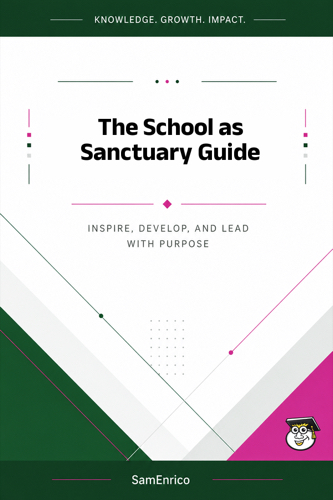
Non-FictionBiographyEducational Resilience
The School as Sanctuary Guide
Using education and teachers as lifelines from hom
Using education and teachers as lifelines from home chaos.
Formats
About this book
Free sample
Chapter 1: The Invisible Backpack--The student who throws a desk across the room is not having a good day. That much is obvious. But what is not obvious—what no teacher can see without training—is that fifteen minutes before walking into your classroom, that same student watched their parent get arrested, or went without dinner, or listened to screaming through a paper-thin wall until 2:00 AM. The desk does not fly because the student is "bad." The desk flies because the student's nervous system has been calibrated for survival, not for seventh-grade math.This is the central deception of traditional classroom management: the assumption that all students arrive with the same neurological baseline, the same capacity for self-regulation, and the same ability to distinguish between a minor correction and a life-threatening attack. They do not.
For students growing up in chaotic homes—homes marked by instability, unpredictability, neglect, or violence—the world does not feel safe. School does not automatically feel like a refuge. In fact, for many, school feels like just another unpredictable environment where adults have power and that power can shift without warning.This book exists because that reality is not a life sentence. Schools can become sanctuaries. Teachers can become lifelines.
But first, we have to understand what we are actually dealing with. And that requires us to look at something most educators have been trained to ignore: the invisible backpack that every child from a chaotic home carries through the school doors every single morning.The ACEs Revolution In the mid-1990s, Dr. Vincent Felitti and Dr. Robert Anda conducted a study that would fundamentally change our understanding of childhood. The Adverse Childhood Experiences (ACEs) study surveyed over 17,000 adults about their childhood experiences and correlated those experiences with adult health outcomes.
The findings were staggering.The study identified ten categories of childhood adversity: physical abuse, emotional abuse, sexual abuse, physical neglect, emotional neglect, domestic violence, parental separation or divorce, household mental illness, household substance abuse, and household incarceration. Researchers found that these experiences were not rare. Nearly two-thirds of participants reported at least one ACE. More than…
This is the end of the free sample. Get the eBook to keep going. Buy now
Contents
- Chapter 1
- Chapter 2
- Chapter 3
- Chapter 4
- Chapter 5
- Chapter 6
- Chapter 7
- Chapter 8
- Chapter 9
- Chapter 10
- Chapter 11
- Chapter 12
Details
- Author
- Pettit Kendall
- Publisher
- SamEnrico
- Language
- English
- Genre
- Non-Fiction, Biography, Educational Resilience
- Released
- 2026-06-09
- Pages (approx.)
- 142
- Available as
- eBook, Audiobook

Read better in the ZLOADR app
Your eBooks on your phone or tablet. Sign in with your SamEnrico account and start reading.
More by Pettit Kendall
 Saying No Without Guilt WorkbookPettit Kendall$11.99
 Postpartum Depression and Premature BirthPettit Kendall$11.99
 The Paper Planner Time BlockPettit Kendall$11.99
 Civil Constitution Clergy GuidePettit Kendall$11.99
 Slovenia Remote Work GuidePettit Kendall$11.99
 Benzo Recovery Tinnitus Relief HandbookPettit Kendall$11.99
 Self Esteem For Military VeteransPettit Kendall$11.99
 Body Image Confidence for TeensPettit Kendall$11.99
 Binary Midnight: The Last Broadcast of Station ZeroPettit Kendall$11.99
 Ozymandias' Shadow: The Architect of EternityPettit Kendall$11.99
 How to Start a Rental Center BusinessPettit Kendall$11.99
 Mailchimp Template Reuse StrategyPettit Kendall$12.99
You may also like
 Hong Kong Handover 1997Dunn Johnnie$11.99
 Zumba For Postnatal Recovery CourseNeal Christian$11.99
 Zumba for BeginnersLadner Nikia$11.99
 YouTube Comment Mining GuideHumes Pandora$12.99
 Worry Box MeditationCarlin Rudy$11.99
 Workplace Stress MeditationNguyen Lynn$11.99
 Workplace Stress and Sleep RepairHawley Ivory$11.99
 Workplace Perfectionism CureDelaney Jeffry$11.99
 Workplace Injustice Anger GuideWallen Isabelle$11.99
 Work Addiction and Burnout LinkGreenwood Ester$11.99
 Women in Yoga and WellnessBeattie Galina$11.99
 Women in Stand Up ComedyChun Evangeline$11.99