
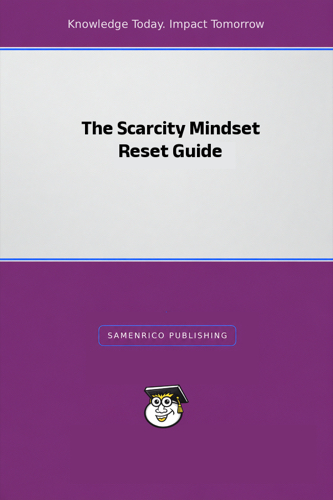
The Scarcity Mindset Reset Guide eBook
Shift from constant financial fear to practical pr
Shift from constant financial fear to practical problem-solving.
Formats
Free sample
Chapter 1: The Finite Pie–- Maria checked her bank account five times before breakfast. Not because she needed to. Because she couldn't stop. Her balance was fine—$3,247 after rent, which was objectively not a crisis. But her chest felt tight, the way it always did before a panic attack.
She had just declined coffee with a colleague because "things are tight right now," which was technically true but also technically not the reason. The real reason was a feeling she couldn't name: a bone-deep certainty that any spending, even optional spending, was one step closer to the edge. She wasn't poor. She was scared. And as she stared at her perfectly adequate bank balance, she couldn't shake the voice that whispered: It's never enough.The Lie You Didn't Know You Believed Here is a question that sounds simple but is actually a trap: Are resources naturally limited?Your first instinct is probably to say yes.
Of course resources are limited. There's only so much money, so much food, so much time, so much housing, so many good jobs. This is basic economics. Scarcity is the first thing you learn in Econ 101. And you're not wrong—resources are objectively finite on a planetary scale.
But that's not the question I'm asking.The question is whether your resources are naturally limited in a way that justifies your constant, low-grade financial terror.Because here's what the research shows: most people who feel scarcity are not experiencing actual lack. They are experiencing perceived lack. And that distinction changes everything.Let me tell you about a study that cracked this open. Researchers asked two groups of people to play a simple game. Each group was given a set of resources—in one version, plenty; in another, just enough to get by.
Then they introduced a twist: a competitor who might take some of those resources away. The group with plenty barely reacted. They strategized calmly. But the group with just enough? Their brains went haywire.
They hoarded. They made impulsive defensive moves. They attacked preemptively. And here's the kicker—the competitor never actually took anything. The threat was entirely hypothetical.The "just enough" group wasn't responding to reality.
They were responding to the story their brains told about reality. That story is what I call the Finite Pie fallacy.The Finite Pie: Your Brain's Default Setting Imagine a pie. It's the only pie you'll ever get. Every time someone else takes a slice, your slice gets smaller. That's the Finite Pie worldview.
It's simple, intuitive, and almost certainly wrong for most of your financial life.Here's why your brain loves this story: evolution. For 99% of human history, resources actually were a finite pie. If you lived in a hunter-gatherer tribe and another tribe took your hunting grounds, your children starved. If a famine hit and you didn't hoard food, you died. The human brain was shaped in an environment of brutal, literal scarcity.
Your ancient ancestors didn't worry about 401(k)s or credit scores. They worried about whether they'd eat tomorrow.That brain is the one you're using to check your bank account.Modern life is different in ways your ancient brain cannot comprehend. Wealth is not fixed. New industries emerge. People invent things that create entirely new categories of value.
The economy grows. But your brain doesn't believe this. Your brain believes what kept your ancestors alive: hold tight, don't share, assume the worst, treat every loss as catastrophic.This is why you can have $3,247 in the bank and still feel like you're drowning. This is why you can get a raise and feel exactly the same level of anxiety six months later. This is why millionaires have panic attacks about money.
The Finite Pie isn't a description of reality. It's a survival instinct that outlived its usefulness.Actual Scarcity vs. Perceived Scarcity We need to be brutally honest here because this distinction can tip into toxic positivity if we're not careful. Actual scarcity is real. It is not a mindset problem.
If you don't have enough food to feed your children, that is not a failure of your thinking. If you are choosing between paying rent and buying medication, that is not a "perception issue." Actual scarcity exists, and it is a horror that millions of people live with every day.This book is not for those moments.This book is for the vast middle ground—people who have enough but feel like they don't. People whose bank accounts say one thing and whose nervous systems say another. People who say "I can't afford that" when they technically could, but the fear of spending is so overwhelming that it feels like a true statement.The research on this is startling. In study after study, when researchers ask people to report their income and then ask them how they feel about their financial situation, the correlation is weak at best.
There are people making $40,000 who feel financially secure. There are people making $400,000 who feel broke. Income matters, but mindset matters just as much.Here's how to tell which category you're in:Actual Scarcity (not what this book is for):You regularly skip meals because there isn't enough food You have been evicted or are facing imminent eviction You cannot afford necessary medical care or medication You have no access to emergency funds of any kind (family, credit, savings)Your basic needs (shelter, food, safety) are genuinely not being met Perceived Scarcity (what this book is for):You have enough for basics but live in constant fear of losing that stability Your income covers your expenses but you feel guilty or anxious about any discretionary spending You avoid looking at your bank account because you assume it's worse than it is You have some savings but feel like it's "not enough"You compare yourself to others and feel like you're falling behind If you're in the second category, the problem is not your bank account. The problem is the story your brain is telling you about your bank account. And that story can be rewritten.The Scarcity Loop: How Fear Creates More Fear Here's where it gets interesting—and also where it gets painful.
Perceived scarcity doesn't just feel bad. It actively creates more scarcity. This is the Scarcity Loop, and it is one of the most destructive patterns in human psychology.The Scarcity Loop has four stages:Stage 1: The Trigger. Something happens that activates your scarcity wiring. A bill arrives.
A friend mentions a promotion. You see a social media post about someone your age buying a house. The stock market drops 2%. Your car makes a weird noise. The trigger can be real or imagined, large or small.
What matters is that your brain interprets it as a threat.Stage 2: Tunnel Vision. Once the threat is registered, your brain narrows its focus. This is the amygdala hijack we discussed in the Introduction. Your peripheral vision—cognitive, not literal—shuts down. You stop seeing opportunities, options, and resources.
You see only the threat and whatever immediate relief is available. This is why people in scarcity loops make decisions that look irrational from the outside: taking high-interest payday loans, skipping preventive maintenance, avoiding necessary investments.Stage 3…
This is the end of the free sample. Get the eBook to keep going. Buy now
About this book
Details
- Author
- Jeffrey Gayla
- Publisher
- SamEnrico
- Language
- English
- Genre
- Non-Fiction, Self-Help, Mindset
- Released
- 2026-06-07
- Pages (approx.)
- 122
- Available as
- eBook, Audiobook

Read better in the ZLOADR app
Your eBooks on your phone or tablet. Sign in with your SamEnrico account and start reading.
More by Jeffrey Gayla
 Validating In Eating DisordersJeffrey Gayla$11.99
 Mayor of a Casino CityJeffrey Gayla$11.99
 Single Parent Self Care WorkbookJeffrey Gayla$11.99
 Dribbble Shot Envy GuideJeffrey Gayla$11.99
 Obsidian Memory VaultJeffrey Gayla$11.99
 Bilevel PAP Therapy GuideJeffrey Gayla$11.99
 Sleep Deprivation Memory LossJeffrey Gayla$11.99
 Pomodoro For Note TakingJeffrey Gayla$11.99
 The Visionaries of Stone: The Architectural Genius of the Swahili CoastJeffrey Gayla$11.99
 The Medici Dynasty: Blood, Art, and the Birth of the Modern Family EmpireJeffrey Gayla$11.99
 The Last Voyage of the DemeterJeffrey Gayla$11.99
 Growing Ficus PumilaJeffrey Gayla$11.99
You may also like
 Hong Kong Handover 1997Dunn Johnnie$11.99
 Zumba For Postnatal Recovery CourseNeal Christian$11.99
 Zumba for BeginnersLadner Nikia$11.99
 YouTube Comment Mining GuideHumes Pandora$12.99
 Worry Box MeditationCarlin Rudy$11.99
 Workplace Stress MeditationNguyen Lynn$11.99
 Workplace Stress and Sleep RepairHawley Ivory$11.99
 Workplace Perfectionism CureDelaney Jeffry$11.99
 Workplace Injustice Anger GuideWallen Isabelle$11.99
 Work Addiction and Burnout LinkGreenwood Ester$11.99
 Women in Yoga and WellnessBeattie Galina$11.99
 Women in Stand Up ComedyChun Evangeline$11.99